Hindu students at medical college in Dehradun punished for wearing tilak, their kalavas cut off, while Muslim students allowed to wear hijab
 Dehradun, Uttarakhand, India
  27 June, 2026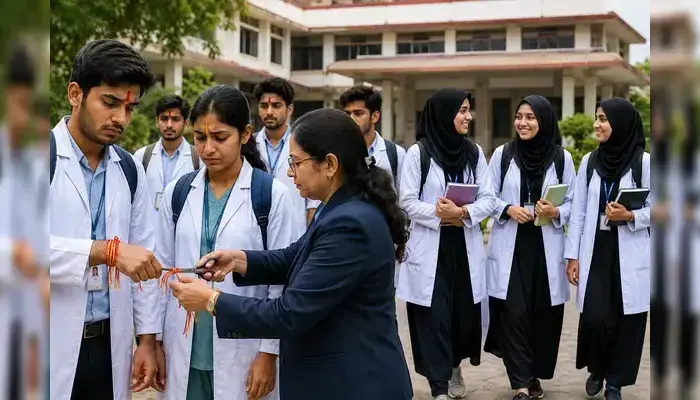
Case Summary
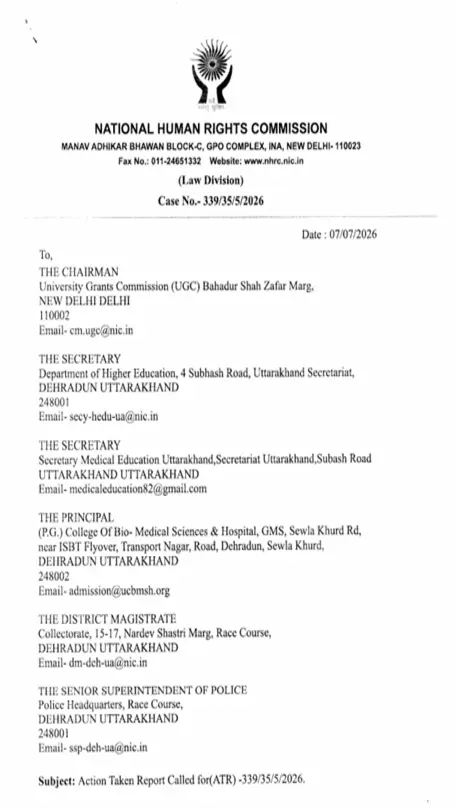
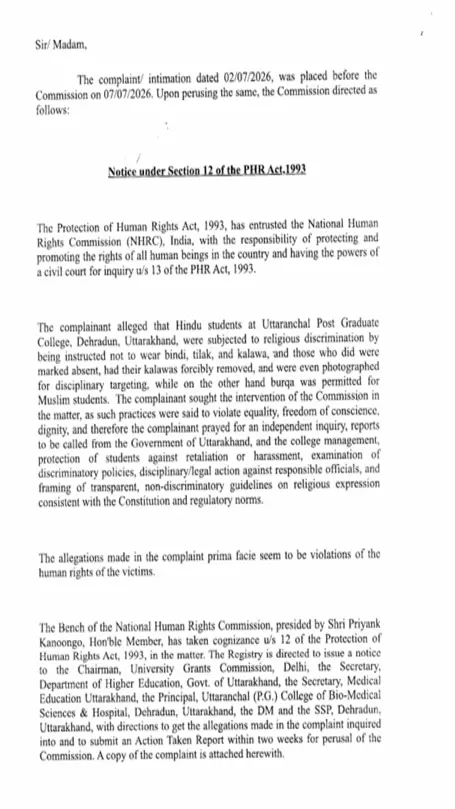
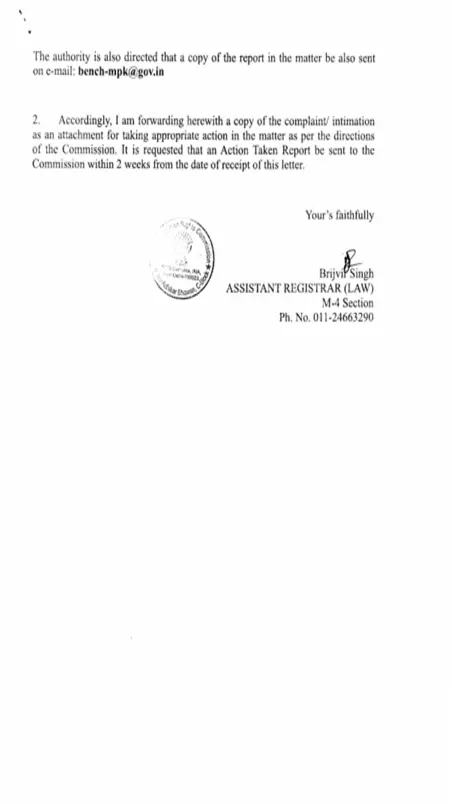
In Dehradun, Uttarakhand, Hindu medical students at Uttaranchal Post Graduate College were targeted for wearing a tilak and kalava. Their kalavas were cut off, and they were marked absent from attendance for wearing a tilak. This restriction was imposed by the college principal, Alphonsa Mathew, a Christian woman. According to media reports, the incident came to light after a video went viral on the internet in which Bajrang Dal workers visited the college, and Hindu medical students shared their ordeal with them. The students said that the Christian principal and other college staff members pressured Hindu students not to wear a tilak or kalava on the college premises. Students who wore them were marked absent, and the kalavas of several Hindu students were cut off. One Hindu student said, "Yesterday, when we wore tilaks, the teachers marked us absent. We are medical students and follow the Indian Nursing Council rules, and nowhere do they state that tilaks and kalavas are not allowed." Some students also revealed that the kalavas of Hindu students were cut by the college authorities. Another student said that teachers targeted students who wore a tilak by taking their photographs and sharing them in WhatsApp groups, where the principal and other staff instructed them to mark those students absent for wearing a tilak. The students said that the principal instructed them not to wear bindis, tilaks or kalavas. They further revealed that despite completing their full duties, they were still marked absent solely for wearing a tilak. In the viral video, a Hindu activist from Bajrang Dal confronted a teacher, asking why tilaks were prohibited. The teacher admitted that the Christian principal had strictly prohibited them, stating that tilaks violated the dress code and uniform rules. When questioned about why hijabs and burqas were permitted, the teacher remained silent and did not respond. The Hindu students revealed that the principal and teachers initially told them not to wear large tilaks. However, even after they began wearing small tilaks, they continued to be targeted and were marked absent for wearing them. Several Hindu male students also described how they were harassed for wearing a tilak and kalava. One Hindu student said that he came from a traditional Brahmin family, where prayers were performed three times a day. As part of his religious practice, he wore a small tilak on his forehead, ears, chest and shikha, because of which he faced harassment. The student revealed that he was called to the principal's office and warned not to wear a tilak or he would be marked absent. He further stated that this harassment occurred not only during clinical sessions but also during regular classroom lectures. The students also stated that they complied with the Indian Nursing Council rules by not wearing kalavas or ornaments during clinical sessions and by following the prescribed dress code. Despite this, they continued to face harassment and discrimination during regular classes for wearing a tilak. The Bajrang Dal activist called the police to the college to inform them about the situation. The activist also contacted the college management and the dean to inform them about the harassment faced by the students. He further stated that many Muslim students wore hijabs without any objection from the college authorities, and that they only wanted Hindu students to stop being targeted for wearing tilaks. Following this, Bajrang Dal began a sit-in protest outside the college and demanded the removal of the Christian principal. Following the public outrage, the college management suspended the principal, and Bajrang Dal warned that any similar incidents in the future would result in further protests and public demonstrations. Subsequently, a complaint was filed on 2nd July 2026, regarding the incident. The complainant sought the intervention of the National Human Rights Commission in the matter, as such practices violated equality, freedom of conscience, dignity, and therefore the complainant prayed for an independent inquiry, reports to be called from the Government of Uttarakhand, and the college management, protection of students against retaliation or harassment, examination of discriminatory policies, disciplinary/legal action against responsible officials, and framing of transparent, non-discriminatory guidelines on religious expression consistent with the Constitution and regulatory norms. Responding to the complaint, the NHRC issued a notice to the Chairman, University Grants Commission, Delhi, the Secretary, Department of Higher Education, Government of Uttarakhand, the Secretary, Medical Education, Uttarakhand, the Principal, Uttaranchal (P.G.) College of Bio-Medical Sciences & Hospital, Dehradun, Uttarakhand, the District Magistrate and the SSP, Dehradun, Uttarakhand, directing them to get conduct an inquiry conducted into the incident and submit an Action Taken Report.
Case Images
Why it is Hate Crime ?
The first primary category selected is: Restriction/ban on Hindu religious practices. The subcategory selected is: Restriction on expression of Hindu identity. An example of the state-affected prejudicial and targeted orders against the Hindu community would be a government denying the right of a Hindu or a group of Hindus to hold a religious procession owing to the animosity of non-Hindu groups. Denial of the religious right of the Hindus to assuage the non-Hindu group which harbours animosity to a point where it could lead to violence against Hindus is not only a failure of law and order but is a prejudicial order against Hindus, denying them their fundamental rights to express their religious identity. An example of a hate crime against Hindus by a non-Hindu would be a non-Hindu institution forcing its Hindu employees to abandon religious symbols that a Hindu would wear as an expression of faith owing to inherent prejudice against the faith professed by the victim or a non-Hindu group of people restricting a Hindu group from constructing a place of worship simply because the demography of the area in which the temple is being built is dominated by non-Hindus. Such actions are driven by religious animosity and/or prejudice against Hindus and their faith and would therefore be categorized as a hate crime. The second primary category selected is: Attack on Hindu religious representations. The subcategory selected is: Desecration of Hindu religious symbols. Icons and symbols or a religious representation of a spiritual ideal are widely revered in Hinduism. Iconography is of vital significance in the Hindu milieu. It helps connect people’s spiritual beliefs with the real world. Iconography within the Hindu faith takes several shapes and forms. Murtis are of most significance to Hindus, to which daily rituals, prayers and offerings are done. Besides the murtis, there are several other symbols which have deep significance in the Hindu faith – the Om and Swastika for example. Since these Hindu religious symbols hold paramount importance in Hinduism, any desecration of symbols, icons, murtis, religious representations and manifestations, is driven by animosity towards the faith itself which manifests itself through these murtis, icons and symbols. Therefore, any desecration of these Hindu religious symbols and representations is considered religiously motivated hate crimes under this category. The third primary category selected is: Attack not resulting in death. The subcategory selected is: Attacked for Hindu identity. In several cases, Hindus are attacked merely for their Hindu identity without any perceived provocation. A classic example of this category of religiously motivated hate crime is a murder in 2016. 7 ISIS terrorists were convicted for shooting a school principal in Kanpur because they got ‘triggered’ seeing the Kalava on his wrist and tilak that he had put. In this, the Hindu victim had offered no provocation except for his Hindu religious identity. The motivation for the murder was purely religious, driven by religious supremacy. Such cases where Hindus are targeted merely for their religious identity would be documented as a hate crime under this category. This case constitutes a clear example of a religiously motivated hate incident because Hindu students were specifically targeted for openly displaying their religious identity. The college principal, Alphonsa Mathew, a Christian woman, prohibited Hindu students from wearing a tilak and kalava on the college premises, while Muslim students continued to be permitted to wear the hijab. This selective restriction demonstrates that the institution did not enforce a uniform policy on religious expression but instead imposed differential standards based on the religion of the students. By prohibiting visible expressions of Hindu faith while allowing those of another religious community, the college authorities subjected Hindu students to discriminatory treatment solely because of their religion. The cutting of students' kalavas and marking them absent for wearing tilaks further reinforced this discriminatory conduct, making the incident a clear case of religiously motivated targeting directed at suppressing the public expression of Hindu identity. The Hindu students were singled out solely because of their religious identity and expression. They were not targeted for any misconduct, indiscipline, disruption of academic activities, or any other violation that could justify disciplinary action. Their only "offence" was wearing a tilak and kalava, both of which are important symbols of the Hindu faith and devotion. Had the college maintained a genuinely neutral policy regarding religious symbols, such a policy would have been applied uniformly to students of all faiths. Instead, the authorities selectively restricted Hindu religious symbols while allowing religious symbols and expressions of another faith, demonstrating that the objective was not institutional neutrality but the suppression of Hindu religious expression. The disciplinary measures imposed on Hindu students, therefore, arose solely from the peaceful manifestation of their religious identity rather than from any legitimate institutional concern. The tilak and kalava hold profound religious and cultural significance in Hinduism. They are not merely decorative items but sacred symbols associated with devotion, spirituality, blessings and religious identity. Across numerous Hindu traditions, the tilak is applied during prayers, worship, festivals, pilgrimages and other religious observances, while the kalava is tied during religious rituals as a sacred thread symbolising divine protection, commitment and spiritual sanctity. For practising Hindus, wearing these symbols is a deeply personal act of faith and an outward affirmation of their religious beliefs. Consequently, any attempt to prohibit, remove or forcibly cut these sacred symbols directly interferes with religious practice and carries deep emotional and spiritual significance for the believer. Their targeting is therefore particularly offensive to the religious sentiments of Hindu students and their families. The restrictions imposed on Hindu students further demonstrate hostility towards Hindu religious identity and expression. Rather than accommodating or respecting the students' right to peacefully practise their faith, the college authorities sought to suppress visible manifestations of Hindu identity within the institution. By making Hindu students choose between observing their religious practices and avoiding disciplinary consequences, the institution conveyed that openly practising Hinduism was unacceptable within the college environment. Such actions undermine the dignity, equality and religious freedom of Hindu students while creating an atmosphere in which the public expression of Hindu faith is discouraged and penalised. The act of cutting the kalavas and penalising students for wearing tilaks was particularly significant because it transformed an administrative restriction into direct interference with sacred expressions of Hindu faith. These actions were not limited to enforcing an institutional rule; they involved deliberate acts against religious symbols that hold deep spiritual significance for Hindu students. The kalava is a sacred thread tied during Hindu religious rituals as a symbol of divine blessings, protection and religious commitment. Cutting it off without the wearer's consent amounts to the desecration of a sacred religious symbol and demonstrates a profound disregard for its religious significance. Likewise, penalising Hindu students for wearing tilaks amounted to targeting them for the visible expression of their Hindu identity. By imposing attendance-related penalties solely because students wore a tilak, the college authorities effectively punished them for publicly identifying as Hindus. These actions, therefore, went beyond regulating appearance and instead directly targeted sacred manifestations of Hindu faith, reinforcing the discriminatory nature of the institution's conduct. It is also important to recognise the broader impact that repeated restrictions, humiliation and suppression of Hindu religious practices can have on young students. When students are punished, penalised or publicly disadvantaged for expressing their faith, they may begin to associate their Hindu identity with stigma, exclusion and adverse consequences. Over time, this creates pressure to abandon visible expressions of their religion simply to avoid disciplinary action or social humiliation. Such an environment does not promote genuine religious freedom; instead, it discourages Hindu students from openly identifying with their faith and alienates them from their religious and cultural heritage. The gravity of this incident is amplified because the victims were students subject to the authority of an educational institution. Students are particularly vulnerable to institutional pressure and the influence of teachers and administrators, whose directions they are generally expected to obey. When an institution selectively suppresses Hindu religious symbols while permitting comparable expressions of another faith, students are pressured to distance themselves from their religious identity not as a matter of free choice but out of fear of punishment, academic disadvantage or exclusion. Such conditions undermine genuine freedom of conscience by creating sustained pressure to suppress one's own religious identity. The selective targeting of Hindu religious practices within an educational institution, therefore, infringes upon the religious freedom, dignity and equal treatment of Hindu students while fostering an environment in which the open expression of Hindu identity is actively discouraged. In this case, it is also important to mention that in 2022, a massive controversy erupted in Karnataka, which took a national form, after Muslim women insisted that they should be allowed to wear burqas and hijabs in their schools and classrooms. At that time, the argument given by several politicians, social commentators, Hindu activists and even the judiciary was that schools have the right to enforce uniform rules, since wearing uniforms brings harmony and equality in the classroom, and therefore, schools not allowing girls to wear hijab in the classroom is not religious discrimination, but merely an enforcement of widely accepted uniform norms. The argument was also that overt religious symbols like the Hijab can be restricted under the school's policy of uniformity. Some pseudo-seculars and anti-Hindu leftists argue that a similar line of reasoning should be applied in this case and that college authorities have the authority to regulate student appearance in order to maintain uniformity and discipline. However, it is important to note that the tilak and kalava are benign Hindu religious symbols that neither disrupt classroom activities nor interfere with the educational environment. For Hindu students, wearing a tilak and kalava is a peaceful expression of faith and religious identity. More importantly, the issue in this case extends far beyond any purported institutional policy. According to the students, their sacred kalavas were cut off, they were marked absent from attendance for wearing tilaks, and they were prohibited from wearing these Hindu religious symbols by the college principal, while Muslim students continued to be permitted to wear the hijab. Such conduct cannot be equated with the neutral enforcement of institutional regulations. Rather, it demonstrates hostility towards Hindu religious practice and the students who adhered to it. The selective targeting of Hindu students for wearing sacred Hindu symbols, coupled with punitive actions and the unequal treatment of religious communities, raises serious concerns about the motivations behind such enforcement. The actions of the college authorities amount to religious discrimination and are consistent with the framework of a religiously motivated hate incident, where Hindu students were penalised solely for adhering to and expressing their Hindu religious identity. Overall, the cumulative facts of this case demonstrate a pattern of hostility directed at Hindu students because of their faith, religious identity, and religious expression. The forcible removal of tilaks, repeated humiliation, derogatory remarks, threats of exclusion, mockery of Hindu devotional practices, and sustained targeting of Hindu students collectively point towards conduct that was directed not at misconduct but at Hindu identity itself. Since this case meets multiple parameters of a religiously motivated hate incident, it is being added to the hate crime database of the Hinduphobia Tracker. Disclaimer: In the present case, the incident came to public attention through social media posts and local media coverage on 28 June 2026. However, information provided by the affected students indicates that the harassment, forcible removal of tilaks, and targeting of Hindu students had been occurring prior to that date as part of an ongoing pattern. Since the exact date on which this pattern of harassment first began remains unclear from the available information, 28 June 2026 is being recorded as the indicative incident date for documentation purposes only. This date should not be interpreted as the confirmed date on which the harassment commenced, but rather as the earliest date presently available from the evidence in the public domain. In this case, although multiple Hindu students were targeted by the discriminatory policy, only two male students and two female students were specifically identified in the viral video, where they appeared on camera and described their experiences. Accordingly, for documentation purposes, the victim count has been conservatively recorded as four Hindu students (two male children and two female children). This is a conservative estimate based solely on the victims who could be individually identified from the available evidence and should not be interpreted as reflecting the total number of students affected. In this case, although the discriminatory actions involved the Christian principal as well as multiple other members of the college staff, only the principal has been specifically identified by name in the available evidence, while the total number of staff members involved has not been clearly established. Accordingly, for documentation purposes, the perpetrator count has been conservatively recorded as one, referring to the Christian principal, Alphonsa Mathew. This figure should not be interpreted as representing the total number of individuals involved in the incident.
Victim Details
Total Victim
4
Deceased
0
Gender
- Male 2
- Female 2
- Third Gender 0
- Unknown 0
Caste
- SC/ST 0
- OBC 0
- General 0
- Unknown 4
Age Group
- Minor 0
- Adult 4
- Senior Citizen 0
- Unknown 0


Case Status
Complaint filed


Perpetrators Details
Perpetrators
Christian Extremists
Perpetrators Range
One Person
Perpetrators Gender
female
 Sources




