Hindu ashram donation box broken open and offerings stolen by Muslim perpetrator in Bangladesh amidst ongoing persecution of Hindu minorities
 Pabna District, Bangladesh
  24 June, 2026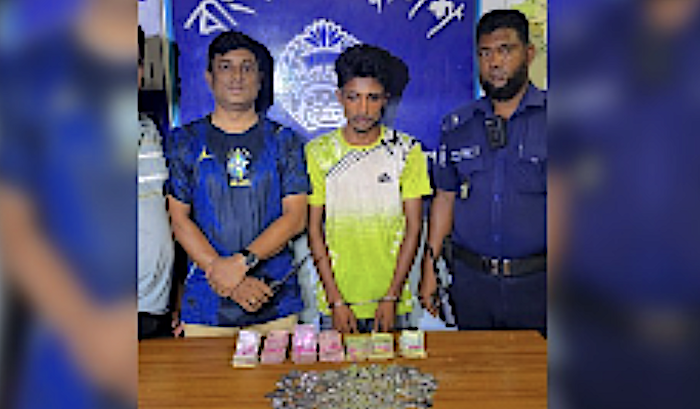
Case Summary
In Pabna district of Bangladesh, a Muslim perpetrator broke into the traditional Sri Sri Thakur Anukul Chandra Satsang Ashram and stole money from the sacred donation box kept inside the religious premises. The theft targeted a prominent Hindu religious institution and involved money donated by devotees as offerings to the ashram. The incident generated concern among local Hindus and devotees associated with the pilgrimage site, who expressed anxiety regarding the security of the ashram and the protection of Hindu religious institutions in Bangladesh. According to the ashram and police sources, the incident occurred in the early hours of 25th June 2026 at the Sri Sri Thakur Anukul Chandra Satsang Ashram in Pabna district. A group of miscreants entered the sacred premises and broke open the donation box kept inside the ashram. They then stole the money offered by devotees and fled the scene. Immediately after learning of the theft, the acting treasurer of the ashram, Dhishankar Sarkar, filed a theft case with Pabna Sadar Police Station. The incident prompted concern among members of the local Sanatan community, who expressed fears regarding the vulnerability and security of the religious institution. Following the filing of the case, a police team led by Sub-Inspector Rajib Hasan of Hemayetpur Police Outpost launched an investigation into the incident. Investigators examined CCTV footage from inside the ashram and gathered local intelligence to identify those involved in the theft. Based on the evidence collected during the investigation, police identified Mridul Hossain, son of Abdul Mannan of Hemayetpur Buderhat village in Pabna Sadar upazila, as being directly involved in the incident. Police subsequently carried out raids in various parts of Pabna city on the night of 26th June 2026. During the operation, Mridul Hossain, aged 24, was arrested from the central bus terminal area of Pabna city in the early hours of the morning. During a search following his arrest, police recovered a portion of the stolen money from his possession. Officials of the Hemayetpur Police Outpost stated that Mridul Hossain was being interrogated to determine whether additional individuals had participated in the theft and whether any organised group had been involved in the break-in at the ashram. Local members of the Sanatan Samaj and the authorities of the Sri Sri Thakur Anukul Chandra Satsang Ashram expressed satisfaction that the theft had been quickly investigated and that one of the individuals involved had been apprehended. The incident occurred amid a prolonged period of insecurity and repeated attacks on Hindu religious institutions in Bangladesh. Hindu temples, ashrams, shrines, and other places of worship have repeatedly been subjected to vandalism, theft, desecration, arson, and intimidation, creating an atmosphere of fear and insecurity among members of the Hindu minority community. This escalation of violence against Hindus in Bangladesh has unfolded in three distinct phases: first, following the ouster of Sheikh Hasina's government in August 2024; second, after the death of Sharif Osman Bin Hadi in December 2025; and third, in the immediate aftermath of the 13th National Parliamentary Election 2026. Following the ouster of Sheikh Hasina, multiple reports documented attacks on Hindu homes, temples, and religious institutions, alongside intimidation campaigns, arson, and mob assaults targeting minority neighbourhoods. The Hinduphobia Tracker has recorded 336 such incidents against the Hindu minority, underscoring the scale and persistence of anti-Hindu violence during this period. A further escalation occurred following the death of Sharif Osman Bin Hadi, a Muslim political activist and student leader known for his anti-Hindu and anti-India rhetoric. Hadi had been involved in political unrest after the fall of the Hasina government and was killed in Dhaka on 18th December 2025 during clashes. In the aftermath of his death, Hindu communities were blamed and subsequently targeted in retaliatory violence. Hindu homes were selectively set ablaze in multiple localities, forcing families to flee and leaving many displaced. The attacks appeared patterned rather than sporadic, with Muslim mobs focusing on Hindu neighbourhoods, properties, and religious symbols. Among the victims was Dipu Chandra Das, who was lynched to death and his body was set ablaze by a Muslim mob over false blasphemy allegations. The Hinduphobia Tracker documented 51 incidents of anti-Hindu violence in the period following Hadi's death alone. Such incidents underscored the vulnerability of the Hindu minority amid rising communal hostility and the weaponisation of religious accusations. Reports further indicated that posters and written materials calling for the extermination of Hindus were displayed in public spaces, signalling an alarming normalisation of genocidal rhetoric. When combined with acts of arson, vandalism, assault, and targeted intimidation, these developments suggested a coordinated environment of hostility aimed at terrorising the Hindu community and reinforcing majoritarian dominance. The third phase of violence was unleashed after the 13th National Parliamentary Election 2026. Within days of the announcement of results, Hindu families in districts such as Noakhali, Rangpur, Nilphamari, Sylhet, Thakurgaon, and Dinajpur reported coordinated attacks involving arson, looting, assault, and vandalism of temples and homes. In several instances, Hindu homes were selectively targeted, looted, and families were threatened with displacement.
Why it is Hate Crime ?
This case has been added to the tracker under the primary category - Attack on Hindu religious representations. Within this, the subcategory selected is - Desecration of Hindu religious symbol Icons and symbols or a religious representation of a spiritual ideal are widely revered in Hinduism. Iconography is of vital significance in the Hindu milieu. It helps connect people’s spiritual beliefs with the real world. Iconography within the Hindu faith takes several shapes and forms. Murtis are of most significance to Hindus, to which daily rituals, prayers and offerings are done. Besides the murtis, there are several other symbols which have deep significance in the Hindu faith – the Om and Swastika for example. Since these Hindu religious symbols hold paramount importance in Hinduism, any desecration of symbols, icons, murtis, religious representations and manifestations, is driven by animosity towards the faith itself which manifests itself through these murtis, icons and symbols. Therefore, any desecration of these Hindu religious symbols and representations is considered religiously motivated hate crimes under this category. In this case, the traditional Sri Sri Thakur Anukul Chandra Satsang Ashram in Pabna, Bangladesh, was targeted when perpetrators entered the sacred premises, broke open the donation box, and stole money that had been offered by devotees. The desecration was directed at a Hindu religious institution during a period when Hindu temples, ashrams, and sacred spaces across Bangladesh continued to face repeated incidents of theft, vandalism, desecration, and intimidation. While the available details do not explicitly indicate a religious motive, the broader context cannot be ignored. When there is an ongoing ethnic cleansing based on religious identity, every crime in and of itself is assumed to be motivated by the same religious animosity, even if there is a lack of a specific religious marker in the immediate crime. During an ongoing ethnic cleansing, the dehumanisation of people based on their religious identity and the normalisation of religious hostility drive the crimes committed against them, even when there is a lack of stated religious motive. For the purpose of documenting the 2024 ethnic cleansing of Hindus in Bangladesh, the Hinduphobia Tracker is assuming religious motivation ab initio. If a case is proven beyond a reasonable doubt to be driven by motivations other than religious hostility, it will be removed from the hate crime database post facto.


Case Status
Arrested


Perpetrators Details
Perpetrators
Muslim Extremists
Perpetrators Range
One Person
Perpetrators Gender
male
 Sources




