Hindu woman deceived into temple marriage with Muslim man posing as Hindu, targeted two other Hindu women
 Jabalpur, Madhya Pradesh, India
  28 June, 2026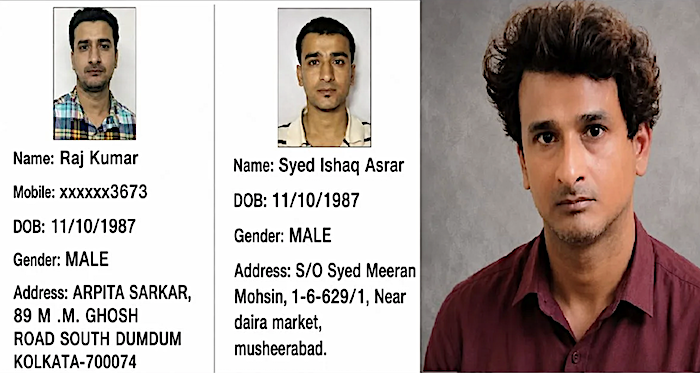
Case Summary
In Jabalpur, Madhya Pradesh, a Muslim man concealed his religious identity and posed as a Hindu to deceive and marry a Hindu woman from Kolkata. The deception came to light after the woman approached the authorities accusing the man of identity fraud and harassment. During the subsequent investigation, it emerged that the accused had employed the same modus operandi to target and deceive multiple Hindu women by assuming a Hindu identity. The accused was identified as Syed Ishaq Asrar, who had been residing in Jabalpur and working as a dentist at a private clinic in the Madan Mahal area under the Hindu name "Rajkumar." According to reports, he secured employment at the Dental Square Clinic by presenting himself as a Hindu. The clinic was operated by Dr Saket Agrawal, who had employed him as a dentist based on the identity he had furnished. According to the victim's complaint, Syed Ishaq Asrar first came into contact with a Hindu woman from Hyderabad, whom he also deceived while concealing his real identity. He later established contact with a Hindu woman from Kolkata. During their interactions, he introduced himself as a Hindu man named Rajkumar and concealed both his Muslim identity and his personal background. He further told the woman that he had separated from his first wife in Hyderabad and would soon obtain a divorce. Believing him to be a Hindu, the woman gradually developed a relationship with him. The couple subsequently moved to Jabalpur, where Syed Ishaq Asrar married the Hindu woman at the Gayatri Mandir while continuing to represent himself as a Hindu. The victim later discovered that he had concealed his real identity throughout the relationship and had not provided any legally valid proof of their marriage. She further said that he had used forged and manipulated identity documents and had repeatedly altered his identity records to maintain his fabricated Hindu identity. According to the complaint, after marrying the victim under the false Hindu identity, Syed Ishaq Asrar abandoned her and became involved with another woman. During the course of the investigation, the victim informed the authorities that he had similarly deceived other Hindu women by adopting the same false Hindu identity. Reports stated that at least two additional women came forward, revealing that the accused had entrapped three Hindu women in total by concealing his religious identity and posing as a Hindu. Following these revelations, the victim lodged a complaint saying that Syed Ishaq Asrar had concealed his religious identity, fraudulently presented himself as a Hindu, married her in a Hindu temple, and subsequently subjected her to harassment. Her complaint also prompted scrutiny of the identity documents and records used by the accused to obtain employment, with questions being raised regarding the authenticity of the documents he had submitted. As news of the incident spread, members of the Vishwa Hindu Parishad, Bajrang Dal, and other Hindu organisations reached the Dental Square Clinic and staged protests against the accused. Protesters later gathered outside the Madan Mahal police station, leading to heightened tensions in the area and increased police deployment. Police detained Syed Ishaq Asrar and launched a comprehensive investigation into the allegations. During the inquiry, officials recovered two identity cards bearing different names and initiated verification of his identity documents, educational certificates, marriage records, and employment records. Police also sought documentation from the clinic management to determine whether due verification had been conducted before his appointment. The complaint filed by the Hindu woman in Kolkata was initially registered as a Zero First Information Report and was subsequently transferred to Jabalpur for further investigation. Police stated that inquiries into the accused's identity, the authenticity of his documents, his employment records, and the allegations that he had similarly deceived multiple Hindu women remained ongoing. Further legal action, they said, would be taken based on the evidence gathered during the investigation.
Why it is Hate Crime ?
This case has been added to the tracker under the primary category of Crimes against women in relationships and other sexual crimes. Within this, the sub-category selected is - Man pretends to be Hindu. Under this, the tertiary categories selected are - Name Changed, Marries as per Hindu rituals and Pattern of targeting Hindu women. When a non-Hindu man pretends to be a Hindu to deceive a Hindu woman into a relationship, the act is seen as triggered by malafide intentions. In some cases, the woman eventually accepts the man’s original religious identity and converts after the man’s identity is revealed. These cases could be argued as cases of religious brainwashing and a result of the pressure a woman feels after getting into a relationship with a man. The woman, it can be argued, also changed her religious identity because of the stigma she believes she might face if she chooses to walk out of a deceptive relationship. However, for the purpose of documenting hate crimes, the cases in this subcategory are limited to those where there is explicit violence aimed at religious conversion against the wishes of the victim (force-feeding beef, blackmailing with intimate videos, rape on refusal to convert, etc), or if the woman herself complains of the man’s religious deception. In such cases, it is established that the deception of the non-Hindu man had a specific aim of religious conversion or targeting of the victim due to her Hindu religious identity, therefore, making it a religiously motivated hate crime. The deliberate adoption of a Hindu identity by Syed Ishaq Asrar demonstrates that religion was central to the manner in which the victim was targeted. He did not approach the Hindu woman openly under his real identity. Instead, he presented himself as a Hindu man and constructed an entirely different religious persona in order to gain her confidence and establish a relationship. Such conduct shows a calculated understanding that shared religious identity carries immense significance in matters of trust, companionship, and marriage within Hindu society. By concealing his true identity and projecting himself as a fellow Hindu, he deprived the victim of the opportunity to make an informed decision about entering the relationship. The deception was therefore not incidental but specifically tailored to exploit the trust associated with Hindu identity. Had religion been irrelevant to his intentions, there would have been no need to assume a Hindu identity in the first place. The very fact that he chose to employ this same method to establish relationships with three Hindu women, indicating that the concealment of his religious identity and assumption of a Hindu persona was not an isolated act directed at a single individual but part of a repeated pattern of conduct and that he consciously weaponised religious familiarity to gain access to their lives. Additionally, the perpetrator's real name was Syed Ishaq Asrar but he adopted the Hindu name "Rajkumar" further strengthens the religious dimension of the offence. Names carry deep religious, cultural, and familial significance and are often the first indicators of a person's identity and community background. By discarding his Muslim name and assuming a distinctly Hindu one, he intentionally erased markers of his true identity and replaced them with symbols that would make him appear familiar and trustworthy to a Hindu woman. This was not a simple alias chosen for convenience; it was a deliberate attempt to present himself as belonging to the same faith and cultural background as the victim. The change in name served as an instrument of deception specifically designed to lower the victim's guard and induce trust that may not otherwise have existed. In doing so, Hindu identity itself was reduced to a disguise that could be adopted and discarded whenever it became useful for manipulation, demonstrating a profound disregard for the sanctity of religious identity and the victim's right to make decisions based upon truthful information. The religiously aggravating nature of the offence is further reinforced by the fact that the perpetrator married the Hindu woman from Kolkata according to Hindu rites and ceremonies at the Gayatri Mandir while continuing to maintain his false Hindu identity. Hindu marriage ceremonies are not mere social formalities but sacred religious sacraments that carry profound spiritual significance. Temples such as the Gayatri Mandir are revered spaces of worship, and Hindu marriage rituals symbolise a solemn and lifelong spiritual union. By participating in these rituals while concealing his true identity, the perpetrator used sacred Hindu traditions as instruments to legitimise his deception and strengthen the false impression that he was a Hindu. The marriage ceremony was therefore not simply a personal event but an extension of the religious deception that had already been employed to gain the victim's trust. Conducting the marriage in a Hindu temple further solidified the fabricated identity he had carefully constructed and demonstrated the extent to which the deception had been planned. The use of sacred Hindu rituals and spaces to perpetuate this falsehood shows a calculated exploitation of Hindu religious beliefs and traditions for personal gain and reinforces the conclusion that the victim's Hindu identity was central to the targeting she experienced. Taken together, the assumption of a false Hindu identity, the adoption of a Hindu name, and the performance of a marriage according to Hindu rites at a Hindu temple establish a sustained pattern of religious deception directed specifically at Hindu women. Reports stating that the perpetrator used the same method to deceive and establish relationships with three Hindu women further reinforce that this was not an isolated incident but a repeated course of conduct. Therefore, the offence carries clear religiously aggravating elements, as the perpetrator consciously manipulated Hindu identity and Hindu practices in order to gain access and exploit Hindu women. Disclaimer: The exact dates on which the Muslim perpetrator first came into contact with the three Hindu women, developed relationships with them, and the sequence of these events unfolded were not specified in the available sources. The precise dates of the alleged deception and relationships are therefore unknown. However, the incident became publicly known through reports published on 28th June 2026. Accordingly, the Hinduphobia Tracker has recorded this date as the incident date for documentation purposes only.
Victim Details
Total Victim
3
Deceased
0
Gender
- Male 0
- Female 3
- Third Gender 0
- Unknown 0
Caste
- SC/ST 0
- OBC 0
- General 0
- Unknown 3
Age Group
- Minor 0
- Adult 3
- Senior Citizen 0
- Unknown 0


Case Status
Complaint filed


Perpetrators Details
Perpetrators
Muslim Extremists
Perpetrators Range
One Person
Perpetrators Gender
male
 Sources




