Hindu woman strangled to death for chanting 'Hare Krishna Hare Ram' by Muslim man amidst ongoing persecution of Hindu minority in Bangladesh
 Mymensingh, Mymensingh District, Bangladesh
  26 June, 2026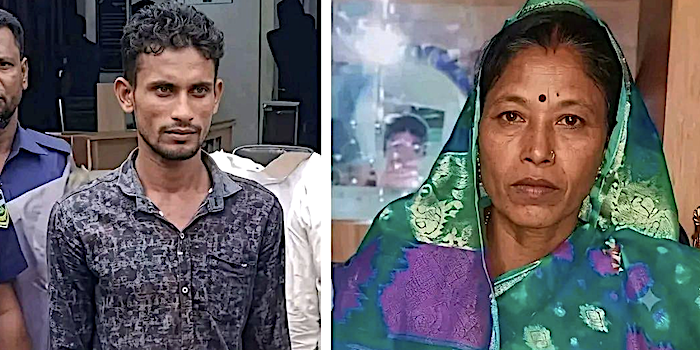
Case Summary
In Mymensingh district of Bangladesh, a 55-year-old Hindu woman, Renu Bala, was brutally murdered after she was attacked while chanting the Hindu mantra "Hare Krishna, Hare Ram". The victim, a follower of the traditional Hindu faith and a resident of the Payari area of Phulpur upazila, was strangled to death and her body was subsequently concealed under a culvert. The murder of the Hindu woman triggered widespread outrage among local residents, members of the Hindu community, and human rights activists. Within 48 hours of the recovery of the body, police arrested the sole identified perpetrator, Md. Mazharul Islam, who subsequently confessed to the killing before a court. According to police sources, Renu Bala had gone missing several days before her body was discovered. Her family members and relatives conducted an extensive search but were unable to locate her. On Tuesday 23rd June 2026, police recovered her body from beneath a culvert near Tiyarkandi Bazar in Kakani Union of Tarakanda upazila. The body had been concealed under a heap of sorghum in an apparent attempt to hide the crime. The subsequent police investigation led investigators to Md. Mazharul Islam. Acting on information gathered through technological means and intelligence inputs, law enforcement authorities conducted a raid and arrested him. Following his arrest, the accused was produced before the court on 25th June 2026 Thursday, where he confessed to killing Renu Bala. Information that emerged during the initial stages of the investigation and from the confession indicated that the victim had been chanting the mantra "Hare Krishna, Hare Ram" according to her religious beliefs when she was attacked. The assailant subsequently strangled the Hindu woman to death and attempted to conceal the body after the killing. The murder generated widespread condemnation among members of civil society and human rights activists, who demanded that the perpetrator be subjected to the maximum punishment permissible under law. Tarakanda Police Station Officer-in-Charge Abdur Rashid confirmed that the accused had been arrested in a swift operation based on information received by the police and that he had confessed to the crime before the court. The incident occurred against the backdrop of continuing violence and insecurity faced by Hindus in Bangladesh, where members of the Hindu minority have repeatedly been subjected to attacks, killings, intimidation, vandalism of temples, land-grabbing, and targeted violence. The murder of a Hindu woman while she was engaged in a religious act heightened concerns among members of the minority community regarding the safety of their religious practices and freedom of worship. This escalation of violence against Hindus in Bangladesh has unfolded in three distinct phases: first, following the ouster of Sheikh Hasina's government in August 2024; second, after the death of Sharif Osman Bin Hadi in December 2025; and third, in the immediate aftermath of the 13th National Parliamentary Election 2026. Following the ouster of Sheikh Hasina, multiple reports documented attacks on Hindu homes, temples, and religious institutions, alongside intimidation campaigns, arson, and mob assaults targeting minority neighbourhoods. The Hinduphobia Tracker has recorded 336 such incidents against the Hindu minority, underscoring the scale and persistence of anti-Hindu violence during this period. A further escalation occurred following the death of Sharif Osman Bin Hadi, a Muslim political activist and student leader known for his anti-Hindu and anti-India rhetoric. Hadi had been involved in political unrest after the fall of the Hasina government and was killed in Dhaka on 18th December 2025 during clashes. In the aftermath of his death, Hindu communities were blamed and subsequently targeted in retaliatory violence. Hindu homes were selectively set ablaze in multiple localities, forcing families to flee and leaving many displaced. The attacks appeared patterned rather than sporadic, with Muslim mobs focusing on Hindu neighbourhoods, properties, and religious symbols. Among the victims was Dipu Chandra Das, who was lynched to death and his body was set ablaze by a Muslim mob over false blasphemy allegations. The Hinduphobia Tracker documented 51 incidents of anti-Hindu violence in the period following Hadi's death alone. Such incidents underscore the vulnerability of the Hindu minority amid rising communal hostility and the weaponisation of religious accusations. Reports further indicated that posters and written materials calling for the extermination of Hindus were displayed in public spaces, signalling an alarming normalisation of genocidal rhetoric. When combined with acts of arson, vandalism, assault, and targeted intimidation, these developments suggest a coordinated environment of hostility aimed at terrorising the Hindu community and reinforcing majoritarian dominance. The third phase of violence was unleashed after the 13th National Parliamentary Election 2026. Within days of the announcement of results, Hindu families in districts such as Noakhali, Rangpur, Nilphamari, Sylhet, Thakurgaon, and Dinajpur reported coordinated attacks involving arson, looting, assault, and vandalism of temples and homes. In several instances, Hindu homes were selectively targeted, looted, and families were threatened with displacement.
Why it is Hate Crime ?
This case has been added to the tracker under the primary category - Attack resulting in death. Within this, the subcategory selected is - Attacked for Hindu identity. In several cases, Hindus are attacked merely for their Hindu identity without any perceived provocation. A classic example of this category of religiously motivated hate crime is a murder in 2016. 7 ISIS terrorists were convicted for shooting a school principal in Kanpur because they got ‘triggered’ seeing the Kalava on his wrist and tilak that he had put. In this, the Hindu victim had offered no provocation except for his Hindu religious identity. The motivation for the murder was purely religious, driven by religious supremacy. Such cases where Hindus are targeted merely for their religious identity would be documented as a hate crime. Under this category, cases where the attack led to the death of the Hindu victim/s would be documented. In this case, Renu Bala, a traditional Hindu woman from Phulpur in Mymensingh district, Bangladesh, was brutally murdered by Md. Mazharul Islam, while she was chanting the sacred Hindu mantra "Hare Krishna, Hare Ram". She was strangled to death, and her body was subsequently concealed under a culvert in an attempt to hide the crime. The murder of a Hindu woman while she was engaged in a revered act of Hindu devotion represents not merely a homicide but an attack directed at the victim's religious expression and her freedom to practise her faith. The available facts in this incident directly connect the murder to the victim's religious activity. The victim was chanting one of the most sacred mantras in Hinduism at the time of the attack. The "Hare Krishna, Hare Ram" mantra occupies a central place in Hindu devotional practice and is recited by millions of devotees as an expression of worship, spiritual devotion, and surrender to the divine. The fact that the victim was attacked and killed while performing this religious act establishes a direct nexus between her Hindu faith and the violence inflicted upon her. The murder demonstrates an intolerance towards the visible expression of Hindu religious identity. Renu Bala was not engaged in any criminal activity, dispute, or confrontation. She was participating in a peaceful religious practice in accordance with her traditional beliefs when she was attacked. The inability of the perpetrator to tolerate the chanting of a sacred Hindu mantra and the subsequent decision to kill the victim transformed an act of personal devotion into a trigger for lethal violence. Such conduct reflects hostility towards the victim precisely because she was visibly expressing her Hindu faith. The case is particularly significant because it occurred in Bangladesh, where Hindus constitute a vulnerable religious minority and where attacks on Hindus, their temples, religious symbols, and expressions of faith have repeatedly been documented. In such an environment, the killing of a Hindu woman during the performance of a sacred religious ritual cannot be viewed in isolation from the broader pattern of anti-Hindu hostility and insecurity. The murder reinforces fears among the Hindu minority that even ordinary acts of worship and religious expression may expose them to danger. The targeting of the victim also demonstrates how seemingly small acts of Hindu religious expression can become triggers for extreme violence in environments marked by religious intolerance. Chanting the names of Krishna and Ram is among the most basic and peaceful expressions of Hindu devotion. The fact that a Hindu woman lost her life while engaging in such an act suggests that the violence extended beyond a mere personal dislike or momentary anger. The murder reflected an inability to tolerate the public expression of Hindu identity and carried an element of animosity towards the victim's faith and religious practices. The brutal nature of the crime further intensified its impact on the wider Hindu community. After killing the victim, the perpetrator attempted to conceal the body beneath a culvert. The circumstances of the murder created fear and insecurity among local Hindus and reinforced concerns regarding their safety and ability to practise their religion freely. The killing of a Hindu woman engaged in prayer sends a message of vulnerability to the broader Hindu community because it demonstrates that even peaceful religious observance may become the basis for violence. This incident must also be viewed within Bangladesh's broader anti-Hindu environment, where Hindu minorities frequently face insecurity, intimidation, violence, attacks on temples, and hostility towards their religious practices and identity. The murder of Renu Bala deepened concerns regarding the safety of Hindu women and reinforced fears that visible expressions of Hindu devotion may attract hostility in an already volatile environment for religious minorities. The murder of Renu Bala, therefore, constituted an attack not only on an individual Hindu woman but also on the principle of religious freedom and the right of Hindus to openly practise and express their faith. The victim was killed while performing one of the most sacred and peaceful acts of Hindu devotion, directly linking the violence to her religious identity and practice. Given Bangladesh's sustained anti-Hindu persecution environment, this case meets all thresholds for inclusion in the Hinduphobia Tracker's hate crime database. Disclaimer: The Hinduphobia Tracker records incident dates based on when a crime occurs, not when it is reported in the media. However, in this case, the available media reports do not specify the exact date of the murder. Accordingly, the date on which the incident was published in the media, 27th June 2026, has been adopted as the indicative incident date for documentation purposes only.
Victim Details
Total Victim
1
Deceased
1
Gender
- Male 0
- Female 1
- Third Gender 0
- Unknown 0
Caste
- SC/ST 0
- OBC 0
- General 0
- Unknown 1
Age Group
- Minor 0
- Adult 1
- Senior Citizen 0
- Unknown 0


Case Status
Arrested


Perpetrators Details
Perpetrators
Muslim Extremists
Perpetrators Range
One Person
Perpetrators Gender
male
 Sources




