Hindu man brutally hacked to death with a sword by his Muslim wife's maternal uncle following interfaith marriage
 Darbhanga, Bihar, India
  25 June, 2026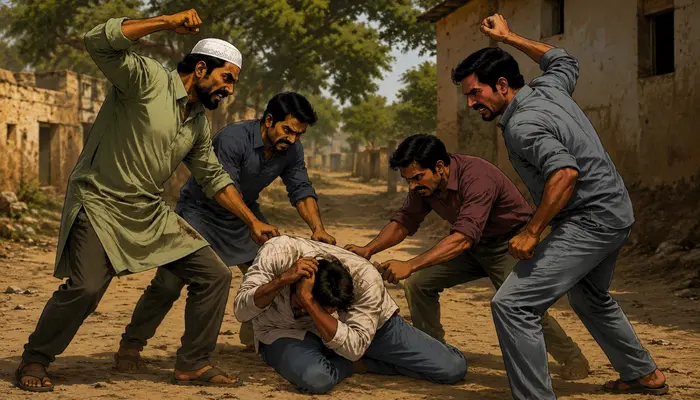
Case Summary
In the Ojhaul village under the Bahadurpur police station in Darbhanga district, Bihar, a Hindu man, Sunil Sahni, was brutally murdered by his Muslim wife's maternal uncle, Mohammad Mobin, due to an interfaith marriage. According to reports, the Hindu victim, Sunil, had married Sania, a Muslim woman from the same village, in an interfaith love marriage around three years earlier, in 2023, despite strong opposition from her family. Following the marriage, the couple relocated to Ahmedabad to avoid hostility and lived there until they returned to their native village two days before the incident. After their return, Sania visited her parental home while Sunil remained at his residence. In the early hours of the morning of 26 June 2026, a Muslim man named Mohammad Mobin, who was posted in Patna as a police sub-inspector and had recently returned to the village on leave, called Sunil on the pretext of inspecting preparations for a Muharram *tazia* near the village temple. Trusting him, Sunil went to the location, where Mobin and several others surrounded him. Mobin then repeatedly attacked Sunil with a sword, inflicting fatal injuries to his head and body, resulting in his death at the scene. Villagers stated that Mobin and Sunil had once shared a close friendship, but their relationship had deteriorated following the interfaith marriage. After ensuring that Sunil had died, Mobin used a firearm to shoot himself and sustained critical injuries. He was admitted to a private hospital in Darbhanga for treatment. Police launched an investigation to determine whether the weapon used was his service pistol or an illegal firearm. The incident created tension in the village, prompting heavy police deployment and forensic examination of the crime scene. Senior police officials, including the Darbhanga Senior Superintendent of Police, visited the site and initiated further legal proceedings.
Why it is Hate Crime ?
The first primary category selected in this case is- Men attacked for being associated with non-Hindu women. Within this, the subcategory selected is - Attacked by non-Hindu partner and/or her family. When Hindu men are in a relationship with non-Hindu women, there are cases where the man is forced to convert his religion and upon his refusal to do so, the partner or/and her family attacks the victim. Such relationships may be consensual with the religious identity of the non-Hindu woman known to the victim. Somewhere along the relationship, the non-Hindu woman or her family starts forcing/pressurizing the Hindu man to convert. In some of these cases, the association could be non-consensual as well or, the religious identity of the non-Hindu woman could be previously unknown to the Hindu victim. In such cases, the Hindu man is first forced/pressurized to change his religion by the non-Hindu woman or her family. The force/pressure could involve threats. The trigger for directing violence against the Hindu man is in these cases his refusal to comply and change his religion under threat and/or force. In other cases that have been documented, it is also seen that the Hindu partner is assaulted by the non-Hindu woman or her family simply for his relationship with the non-Hindu woman and by virtue of him following the Hindu faith and not the religion of the non-Hindu woman. In such cases, the relationship is consensual in most cases and the religion of both partners is known to the other. Often, in such cases, there is no direct force/pressure to convert either, however, the attack is a result of the Hindu man being in a relationship with the non-Hindu partner and not following her religion/following Hinduism specifically. Such cases are driven by specific religious motivations and against the religious identity of the victim and are therefore qualified as hate crimes. The second primary category selected is- Attack resulting in death. The subcategory selected is- Attacked for Hindu identity. In several cases, Hindus are attacked merely for their Hindu identity without any perceived provocation. A classic example of this category of religiously motivated hate crime is a murder in 2016. 7 ISIS terrorists were convicted for shooting a school principal in Kanpur because they got ‘triggered’ seeing the Kalava on his wrist and tilak that he had put. In this, the Hindu victim had offered no provocation except for his Hindu religious identity. The motivation for the murder was purely religious, driven by religious supremacy. Such cases where Hindus are targeted merely for their religious identity would be documented as a hate crime under this category. This case has been added to the hate crime database because the Hindu victim, Sunil Sahni, was brutally murdered by the maternal uncle of his Muslim wife because of their interfaith marriage. The available facts demonstrated that the killing was not a random act of violence or an ordinary interpersonal dispute but was directly connected to the victim's religious identity and his marriage to a Muslim woman. The sequence of events establishes a clear nexus between the violence inflicted upon the victim and his identity as a Hindu man who had entered into a consensual interfaith marriage. A significant aspect of this case is that Sunil Sahni and Sania had married approximately three years before the incident, despite opposition from the woman's family. Additionally, the couple were adults and capable of making their own decisions and life choices. Despite this, Sunil Sahni was brutally hacked to death with a sword, highlighting that the hostility was directed specifically at the victim for being Hindu. Such actions go far beyond personal outrage and reflect a deeper religious hostility. The fact that the hostility persisted even after three years demonstrates that the opposition was neither momentary nor the result of a spontaneous family disagreement. Rather, it reflected a continuing refusal to accept the marriage because it involved a Hindu man and a Muslim woman. The accused, Mohammad Mobin, deliberately lured Sunil to an isolated location on false pretext before he repeatedly attacked him with a sword, resulting in Sunil's death. The method adopted to execute the murder demonstrates planning and premeditation rather than an impulsive act committed in the heat of the moment. The fact that the victim was deceived into attending the meeting before being killed further reinforces the conclusion that the attack had been carefully orchestrated. The intensity and nature of the violence demonstrate not only a desire to cause grievous harm but also to punish him for daring to be in a relationship and marry a Muslim woman. The calculated and deliberate violence and its intensity underscore the profound hostility at the heart of this crime. This was not simply a matter of personal vengeance, but rather a stark manifestation of communal hatred. The prolonged hostility arising from the interfaith marriage is an important factor in assessing the motive behind the crime. Had the objection merely been personal or unrelated to religion, the passage of several years, the couple's relocation, and their continued married life would ordinarily have reduced tensions. Instead, the victim was killed immediately after returning to the village, proving that the grievance remained centred on the marriage and the religious identity. Since the marriage involved a Hindu man and a Muslim woman, religion formed an inseparable contextual element behind the hostility that ultimately culminated in murder. This incident falls into a broader and disturbing pattern where Hindu men are targeted specifically for being in relationships with Muslim women. These assaults are often framed as matters of "honour," but the underlying motivation is deeply religious. In the Islamic faith, a marriage is considered invalid if a Muslim woman marries a non-Muslim man who does not convert to Islam. In many such cases, the religious identity of the Hindu male partner, or his family, becomes the key trigger for violence, especially when there is no conversion to Islam. Even if conversion is not directly demanded in every case, the violence inflicted are often aimed at punishing the Hindu man for not adhering to Islamic norms in the context of a relationship with a Muslim woman. It reflects a broader ecosystem of intolerance, where Hindu men are seen as transgressors for engaging in interfaith relationships or marriages with Muslim women. Sunil Sahni's murder was not incidental; it was deliberate and symbolic, aimed at enforcing religious boundaries through violence. For these reasons, the case is being added to the tracker as a clear instance of a religiously motivated hate crime against a Hindu individual. Therefore, the victim was killed because of his position as the Hindu husband in an interfaith marriage. There is no indication that similar violence was directed towards the Muslim woman despite her equal participation in the marriage. Instead, the fatal violence was directed exclusively at the Hindu husband, reflecting a pattern observed in several comparable incidents where Hindu men bear the brunt of violent retaliation for entering consensual relationships with Muslim women. Overall, the available evidence demonstrates that the murder was directly connected to the victim's interfaith marriage and that his Hindu identity formed a significant component of the hostility directed against him. The premeditated nature of the attack, the sustained opposition to the marriage over several years, the deception employed to isolate the victim, and the selective targeting of the Hindu husband collectively establish that this was not merely an ordinary homicide but a religiously motivated hate crime arising from hostility towards a Hindu man for marrying a Muslim woman. For these reasons, this case has been included in the Hinduphobia Tracker database.
Victim Details
Total Victim
1
Deceased
1
Gender
- Male 1
- Female 0
- Third Gender 0
- Unknown 0
Caste
- SC/ST 0
- OBC 0
- General 1
- Unknown 0
Age Group
- Minor 0
- Adult 1
- Senior Citizen 0
- Unknown 0


Case Status
Complaint registered


Perpetrators Details
Perpetrators
Muslim Extremists
Perpetrators Range
One Person
Perpetrators Gender
male
 Sources




