Hindu family of four including minor, beaten and injured amidst ongoing persecution of Hindu minorities in Bangladesh
 Gopalganj District, Bangladesh
  24 June, 2026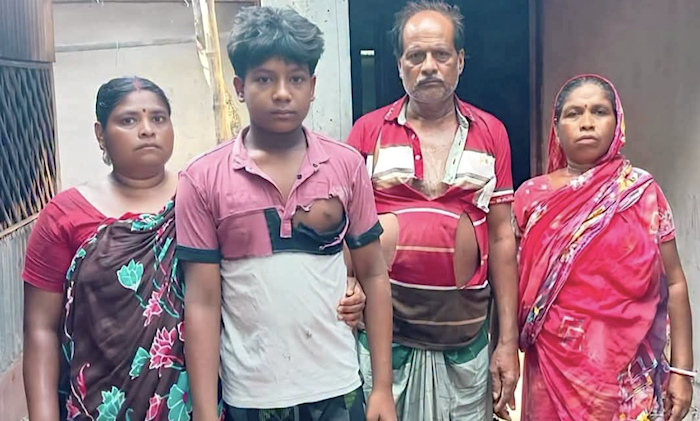
Case Summary
In Gopalganj's Kashiani upazila of Bangladesh, four members of a Hindu family, including a child, were brutally attacked and injured following a dispute connected to voting during the national parliamentary elections. The attack targeted members of the Biswas family, a minority Hindu household in Ramdia Purbapara village, and left multiple family members injured, including elderly individuals, a woman, and a teenage girl. The incident took place on 25th June 2026 in Ramdia Purbapara village under Bethuri union in Kashiani upazila. The injured were identified as Kshitish Biswas (65), his wife, Tulsi Biswas (50), their daughter, Iti Rani Biswas (30), and their granddaughter, Devaraj Biswas (15). All four victims received primary treatment at a local medical centre following the assault. According to the victim's family, there had been a long-standing dispute between the family of Kshitish Biswas and neighbouring Union Parishad Muslim member Ajibar Molya concerning voting during the most recent national parliamentary election. The disagreement persisted for a considerable period and culminated in violence on the afternoon of 25th June 2026. The family stated that people associated with Ajibar Molya systematically attacked Kshitish Biswas' granddaughter on Thursday afternoon. When other family members attempted to intervene and protect the child, they too were assaulted. The attackers used sticks and country-made weapons and beat the family members, resulting in injuries to four people from the same household, including a woman and a child. The attack left the elderly Kshitish Biswas and his wife, Tulsi Biswas, injured alongside their daughter and granddaughter. The assault on several generations of the same family, including an elderly couple and a minor, created fear and insecurity within the local Hindu community, which viewed the incident as another example of the vulnerability of minority Hindu families in rural Bangladesh. Following the attack, Ujjwal Biswas, the son of Kshitish Biswas, submitted a written complaint to Kashiani Police Station seeking legal action against those responsible for the assault on his family. Ajibar Molya stated that there had been a minor altercation among children over sports and that there had later been an exchange of words between women. However, the victim's family maintained that the attack stemmed from the long-standing dispute relating to voting during the parliamentary elections and that the assailants deliberately targeted members of their family. Kashiani Police Station Officer-in-Charge Mohammad Mahfuzur Rahman confirmed that the police had received the complaint from the victim's family and stated that action would be taken following an investigation into the incident. The attack occurred against the backdrop of continuing insecurity faced by Hindus in Bangladesh, where members of the minority community have repeatedly been subjected to violence, intimidation, attacks on homes and temples, and targeted assaults arising from political, social, and communal disputes. Incidents involving Hindu families frequently create fear among local communities because attacks on individual Hindu households often affect the wider sense of security of the minority community. This escalation of violence against Hindus in Bangladesh has unfolded in three distinct phases: first, following the ouster of Sheikh Hasina's government in August 2024; second, after the death of Sharif Osman Bin Hadi in December 2025; and third, in the immediate aftermath of the 13th National Parliamentary Election 2026. Following the ouster of Sheikh Hasina, multiple reports documented attacks on Hindu homes, temples, and religious institutions, alongside intimidation campaigns, arson, and mob assaults targeting minority neighbourhoods. The Hinduphobia Tracker has recorded 336 such incidents against the Hindu minority, underscoring the scale and persistence of anti-Hindu violence during this period. A further escalation occurred following the death of Sharif Osman Bin Hadi, a Muslim political activist and student leader known for his anti-Hindu and anti-India rhetoric. Hadi had been involved in political unrest after the fall of the Hasina government and was killed in Dhaka on 18th December 2025 during clashes. In the aftermath of his death, Hindu communities were blamed and subsequently targeted in retaliatory violence. Hindu homes were selectively set ablaze in multiple localities, forcing families to flee and leaving many displaced. The attacks appeared patterned rather than sporadic, with Muslim mobs focusing on Hindu neighbourhoods, properties, and religious symbols. Among the victims was Dipu Chandra Das, who was lynched to death and his body was set ablaze by a Muslim mob over false blasphemy allegations. The Hinduphobia Tracker documented 51 incidents of anti-Hindu violence in the period following Hadi's death alone. Such incidents underscored the vulnerability of the Hindu minority amid rising communal hostility and the weaponisation of religious accusations. Reports further indicated that posters and written materials calling for the extermination of Hindus were displayed in public spaces, signalling an alarming normalisation of genocidal rhetoric. When combined with acts of arson, vandalism, assault, and targeted intimidation, these developments suggested a coordinated environment of hostility aimed at terrorising the Hindu community and reinforcing majoritarian dominance. The third phase of violence was unleashed after the 13th National Parliamentary Election 2026. Within days of the announcement of results, Hindu families in districts such as Noakhali, Rangpur, Nilphamari, Sylhet, Thakurgaon, and Dinajpur reported coordinated attacks involving arson, looting, assault, and vandalism of temples and homes. In several instances, Hindu homes were selectively targeted, looted, and families were threatened with displacement.
Why it is Hate Crime ?
This case has been added to the tracker under the primary category - Attack not resulting in death. Within this, the subcategory selected is - Attacked for Hindu identity. In several cases, Hindus are attacked merely for their Hindu identity without any perceived provocation. A classic example of this category of religiously motivated hate crime is a murder in 2016. 7 ISIS terrorists were convicted for shooting a school principal in Kanpur because they got ‘triggered’ seeing the Kalava on his wrist and tilak that he had put. In this, the Hindu victim had offered no provocation except for his Hindu religious identity. The motivation for the murder was purely religious, driven by religious supremacy. Such cases where Hindus are targeted merely for their religious identity would be documented as a hate crime under this category. In this case, four members of a Hindu family, including a woman and a child, were attacked and injured in Gopalganj district of Bangladesh following a dispute connected to voting in the national parliamentary elections. The victims belonged to Bangladesh's vulnerable Hindu minority community and were assaulted by members of the Muslim-majority community. Although the immediate trigger of the incident was presented as a disagreement over voting and local political differences, the attack must be viewed within the wider environment of anti-Hindu hostility and persecution that has engulfed Bangladesh in recent years. At first glance, the incident may appear to stem from a local dispute unrelated to religion. However, the social and political context in which the attack occurred cannot be ignored. In Bangladesh, Hindu minorities have repeatedly been subjected to violence, intimidation, and coercion over matters that, on the surface, appear to involve land disputes, political disagreements, personal altercations, or local rivalries. Such disputes frequently assume a communal dimension because of the inherent vulnerability of Hindus as a religious minority living amid an environment where anti-Hindu prejudice and majoritarian hostility have become increasingly normalised. The fact that an entire Hindu family, including elderly members, a woman, and a child, was subjected to violence over a dispute purportedly linked to voting demonstrates that the incident extended far beyond an ordinary neighbourhood or political disagreement. Political differences do not ordinarily result in the collective targeting of multiple members of a single family across three generations. The assault on a child is particularly significant because the child could not have participated in the electoral process or been responsible for any political choice. The extension of the violence to every member of the household indicates that the family's political views alone were unlikely to have been the sole basis for the attack. Rather, the political disagreement appears to have served as the immediate pretext for an assault directed at the family as a whole. The collective nature of the violence suggests that the victims were targeted not merely as individuals involved in a dispute but as members of a vulnerable Hindu household. Such attacks reflect the disproportionate vulnerability of Hindus in Bangladesh, where even minor disagreements can escalate into violence against entire Hindu families. The readiness to assault every member of the household, irrespective of their individual involvement, points towards hostility directed at the family's communal identity rather than solely at the alleged political disagreement, reinforcing the perception of Hindus as vulnerable targets for collective intimidation and violence. The attack also carried broader implications for the local Hindu community. Violence against one Hindu household inevitably generates fear among other Hindu families because it reinforces the perception that they remain unprotected and susceptible to collective intimidation. Attacks against Hindu families over seemingly minor issues create an atmosphere of insecurity and serve as reminders of the precarious position occupied by Hindus in Bangladesh's social and political landscape. This incident must also be viewed against the backdrop of the sustained persecution faced by Hindus in Bangladesh since 2024. During this period, Hindu homes, businesses, temples, and religious institutions have repeatedly been subjected to attacks, arson, looting, vandalism, intimidation, and physical violence. The Hinduphobia Tracker has documented hundreds of such incidents, illustrating that anti-Hindu hostility has become a recurring feature of life for Bangladesh's Hindu minority. In such an environment, attacks on Hindu families cannot be viewed entirely in isolation from the broader pattern of communal hostility and insecurity. The assault on the Biswas family reinforced existing fears among Hindus living in Bangladesh that even ordinary disputes and political disagreements can expose them to violence because of their status as a vulnerable religious minority. The attack contributed to the atmosphere of insecurity surrounding Hindu families and reflected the broader pattern in which Hindu minorities continue to face intimidation, coercion, and violence in Bangladesh. Given the prevailing anti-Hindu persecution environment in Bangladesh and the continuing pattern of violence affecting vulnerable Hindu minorities, this case meets the threshold for inclusion in the Hinduphobia Tracker's hate crime database. Disclaimer: The Hinduphobia Tracker acknowledges that multiple perpetrators were involved in the assault on the Biswas family. However, as only Ajibar Molya was explicitly identified in the available reports, the perpetrator count has been recorded as 1 for documentation purposes only, while noting that additional unnamed associates also participated in the attack on the Hindu family.
Victim Details
Total Victim
4
Deceased
0
Gender
- Male 1
- Female 3
- Third Gender 0
- Unknown 0
Caste
- SC/ST 0
- OBC 0
- General 0
- Unknown 4
Age Group
- Minor 1
- Adult 3
- Senior Citizen 0
- Unknown 0


Case Status
Complaint filed


Perpetrators Details
Perpetrators
Muslim Extremists
Perpetrators Range
One Person
Perpetrators Gender
male
 Sources




