Hindu temples and homes looted and vandalised by Muslim mob after blasphemy accusation against Hindu youth
 Sunamganj District, Bangladesh
  22 June, 2026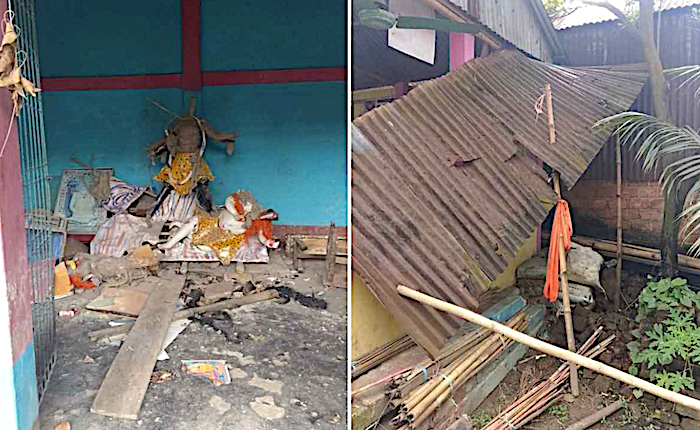
Case Summary
In Tahirpur Upazila of Sunamganj District, Bangladesh, multiple Hindu temples, homes, and businesses were attacked, vandalised, and looted by Muslim mobs operating under the banner of "Tawhidi Janata" after allegations surfaced that a young Hindu man had shared content that hurt Islamic religious sentiments. "Tawhidi Janata" (meaning "Revolutionary People") refers to largely unorganised vigilante Muslim groups that have repeatedly come under scrutiny for carrying out attacks on Hindus and acts of vandalism under the pretext of defending Islam. The violence was directed at the Hindu community in Garkati village and the adjoining Badaghat Bazaar area, resulting in the destruction of temples, damage to Hindu idols, attacks on Hindu-owned homes and commercial establishments, and the displacement of several Hindu families. According to local sources, tensions escalated after a screenshot allegedly linked to 18-year-old Deepta Roy, also known as Prince Roy, son of Nikhil Roy and a resident of Garkati village, began circulating on social media. The screenshot was claimed to contain material considered offensive to Islamic religious sentiments. At the time of the incident, Deepta Roy was an HSC examinee. Ripon Roy, a local schoolteacher, stated that the screenshot had originally been stored on Deepta Roy's mobile phone. However, discussions within the locality suggested that one of Deepta Roy's close friends had accessed the screenshot from his phone and later circulated it on Facebook. Following its circulation, tensions spread rapidly across the area. On the afternoon of 23 June 2026, hundreds of people gathered and launched coordinated attacks on Badaghat Bazaar and Garkati village. During the violence, several Hindu places of worship were vandalised, including the Garkati Kali Temple, the Durga Temple, the Nat Temple, and the Badaghat Kali Temple. The idol of Goddess Kali was also damaged during the attack. In addition to the attacks on temples, several houses and businesses belonging to Hindu families were vandalised and looted. Ketki Rani Roy, the mother of Deepta Roy, stated that a large mob attacked their house and family temple during the afternoon. She said that household belongings, including furniture, a motorbike, and a water tank, were looted. She further stated that the family's real estate office, located in front of their house and operated by Deepta Roy and his father, Nikhil Roy, was also vandalised. According to Ketki Rani Roy, several youths took her son away from their home before the attacks began. She later learned that he had been arrested by the police in connection with the viral social media post. She stated that shortly after his arrest, the Muslim mob attacked their house. Fearing further violence, several members of the family fled the area. Police subsequently registered a case against Deepta Roy under the Cyber Security Act. He was later produced before a court and remanded to judicial custody. The scale of the attacks created widespread fear among the local Hindu community. Several eyewitnesses and residents expressed reluctance to publicly identify those involved in the violence due to fear of reprisals. The affected Hindu families demanded a thorough investigation into the attacks, vandalism, and looting, along with strict legal action against those responsible. The incident occurred amid a continuing environment of insecurity for Hindus in Bangladesh, where attacks on Hindu temples, homes, businesses, and religious symbols have repeatedly followed allegations of blasphemy or insults to religious sentiments. The violence in Tahirpur followed a familiar pattern in which allegations directed against an individual member of the Hindu community resulted in collective punishment directed against Hindu places of worship and Hindu-owned properties. This escalation of violence against Hindus in Bangladesh has unfolded in three distinct phases: first, following the ouster of Sheikh Hasina's government in August 2024; second, after the death of Sharif Osman Bin Hadi in December 2025; and third, in the immediate aftermath of the 13th National Parliamentary Election 2026. Following the ouster of Sheikh Hasina, multiple reports documented attacks on Hindu homes, temples, and religious institutions, alongside intimidation campaigns, arson, and mob assaults targeting minority neighbourhoods. The Hinduphobia Tracker has recorded 336 such incidents against the Hindu minority, underscoring the scale and persistence of anti-Hindu violence during this period. A further escalation occurred following the death of Sharif Osman Bin Hadi, a Muslim political activist and student leader known for his anti-Hindu and anti-India rhetoric. Hadi had been involved in political unrest after the fall of the Hasina government and was killed in Dhaka on 18th December 2025 during clashes. In the aftermath of his death, Hindu communities were blamed and subsequently targeted in retaliatory violence. Hindu homes were selectively set ablaze in multiple localities, forcing families to flee and leaving many displaced. The attacks appeared patterned rather than sporadic, with Muslim mobs focusing on Hindu neighbourhoods, properties, and religious symbols. Among the victims was Dipu Chandra Das, who was lynched to death and his body was set ablaze by a Muslim mob over false blasphemy allegations. The Hinduphobia Tracker documented 51 incidents of anti-Hindu violence in the period following Hadi's death alone. Reports further indicated that posters and written materials calling for the extermination of Hindus were displayed in public spaces, signalling an alarming normalisation of genocidal rhetoric. When combined with acts of arson, vandalism, assault, and targeted intimidation, these developments suggest a coordinated environment of hostility aimed at terrorising the Hindu community and reinforcing majoritarian dominance. The third phase of violence was unleashed after the 13th National Parliamentary Election 2026. Within days of the announcement of results, Hindu families in districts such as Noakhali, Rangpur, Nilphamari, Sylhet, Thakurgaon, and Dinajpur reported coordinated attacks involving arson, looting, assault, and vandalism of temples and homes. In several instances, Hindu homes were selectively targeted, looted, and families were threatened with displacement.
Why it is Hate Crime ?
This case has been added to the tracker under the primary category - Attack not resulting in death. Within this, the subcategory selected is - Attacked over 'blasphemy'. Blasphemy essentially refers to the desecration of anything which is held sacred/holy to a group of people. However, for religious supremacist groups, the elements of ‘blasphemy’ are ever-changing, shifting and expanding – leading to infringement on the rights of other religious groups, freedom of speech and expression, threats and even physical violence. There are instances where blasphemy is also used as a dog whistle to target Hindus owing to intrinsic animosity towards Hinduism. There are several instances where stating truths as mentioned in the non-Hindu doctrine itself has led to unmitigated violence against Hindus. There have also been instances where non-Hindus have themselves created a ‘blasphemous’ situation, like placing a Quran in a temple, to use it as an excuse to attack Hindus. Essentially, Blasphemy charges are often made up and/or are used to shut down any form of criticism of non-Hindu faiths and as a tool to target Hindus. Any physical violence over Blasphemy charges against Hindus are foundationally based on animosity for Hindus and their faith owing to religious supremacist ideologies, therefore, such attacks would be documented as religious motivated hate crimes under this category. The other primary category selected in this case is - Attack on Hindu religious representations. The subcategory selected is - Attack on Temples. In Hinduism, a temple is the abode of the Deity. The Deity in the Temple is consecrated, thereby, making it a real, breathing entity. Hindus believe that not just the Deity but the temple premises itself are sacred to Hindus since Hindus hold the faith that the entire Temple space is an amalgamation of the divine energy of the deity. Given the central significance of Temples in Hindu Dharma, any attack against a Hindu Temple or its peripheral premises is an attack on the faith itself and is born out of animosity towards the faith, of which, the Temple is a central tenet. Any manner of attack against a Temple and/or its premises would therefore be considered a religiously motivated hate crime. Another subcategory selected for this case is - Desecration of Hindu religious symbol. Icons and symbols or a religious representation of a spiritual ideal are widely revered in Hinduism. Iconography is of vital significance in the Hindu milieu. It helps connect people’s spiritual beliefs with the real world. Iconography within the Hindu faith takes several shapes and forms. Murtis are of most significance to Hindus, to which daily rituals, prayers and offerings are done. Besides the murtis, there are several other symbols which have deep significance in the Hindu faith – the Om and Swastika for example. Since these Hindu religious symbols hold paramount importance in Hinduism, any desecration of symbols, icons, murtis, religious representations and manifestations, is driven by animosity towards the faith itself which manifests itself through these murtis, icons and symbols. Therefore, any desecration of these Hindu religious symbols and representations is considered religiously motivated hate crimes under this category. This case is a clear example of a religiously motivated hate crime directed against the Hindu community. The violence did not remain confined to the individual who was accused of hurting Islamic religious sentiments. Instead, it escalated into attacks on Hindu temples, Hindu homes, Hindu-owned businesses, and sacred Hindu symbols that had no connection whatsoever to the alleged act. The collective nature of the violence demonstrates that the incident was not merely about addressing an alleged offence but about punishing an entire religious community because one of its members was perceived to have insulted Islam. Even if one assumes for the sake of argument that the Hindu youth had committed an act that offended Islamic sentiments, Bangladesh possesses legal mechanisms through which such matters can be investigated and adjudicated. The existence of these legal avenues means that there was no conceivable justification for mobs to vandalise temples, loot Hindu homes, destroy businesses, or attack religious symbols belonging to unrelated members of the Hindu community. The decision to target Hindu places of worship and Hindu families therefore constituted an act of collective punishment rooted in religious animosity rather than a legitimate attempt to secure justice. The attacks demonstrated that the allegation of blasphemy served as a pretext for wider communal aggression against Hindus. In Bangladesh, blasphemy allegations have repeatedly functioned as a trigger for violence against Hindu minorities, where accusations against one individual rapidly transform into attacks on entire Hindu neighbourhoods, temples, and institutions. The threshold for mobilising violence against Hindus has often been extraordinarily low, with rumours, social media posts, hearsay, and unverified allegations becoming sufficient to provoke collective outrage and vigilante action. The present incident fits squarely within this established pattern in which accusations of offending Islamic sentiments become a justification for attacking Hindus as a community. The targeting of Hindu homes and businesses further demonstrates the religiously motivated nature of the violence. Once the Hindu youth had been taken into custody, there remained no reason to attack his family's residence or the property of other Hindus in the locality. The destruction and looting of Hindu homes and commercial establishments served no legal or investigative purpose. Instead, such attacks functioned as acts of intimidation designed to punish Hindu families, create insecurity, and send a message to the wider Hindu community that allegations concerning Islam could result in collective retaliation against all Hindus in the area. Particularly significant was the targeting of multiple Hindu temples and sacred symbols during the violence. The Garkati Kali Temple, Durga Temple, Nat Temple, and Badaghat Kali Temple were all attacked despite having no connection to the alleged act attributed to the Hindu youth. Temples are among the most sacred institutions in Hinduism. They are not merely physical structures but centres of worship, community life, cultural preservation, and spiritual continuity. By directing violence against temples, the perpetrators attacked institutions that embody the collective faith and religious identity of Hindus. The desecration of the idol of Kali Mata carried an especially serious religious dimension. In Hinduism, a consecrated murti is not regarded as a simple statue or decorative object but as a living embodiment of the deity following the ritual of Prana Pratishtha. Goddess Kali occupies a deeply revered place in Hindu religious life as a manifestation of divine power and protection. The damaging of her idol therefore represented an attack on an object of profound spiritual significance and amounted to an assault on the religious sentiments and identity of Hindu devotees. Acts of idol desecration have historically been used as instruments of humiliation and intimidation against Hindu communities. The destruction or damage of sacred images seeks to convey contempt towards Hindu beliefs and undermine the dignity of the community that worships those deities. By vandalising temples and damaging the idol of Kali Mata, the perpetrators did not merely destroy property; they attacked sacred symbols that lie at the heart of Hindu religious life and sought to collectively punish and intimidate the wider Hindu community. The attacks on temples and idols also demonstrate that the violence was directed against Hindu identity itself rather than solely against the individual at the centre of the allegations. Had the objective merely been to express anger towards one person, there would have been no reason to attack unrelated temples and sacred symbols. The deliberate targeting of Hindu religious institutions and objects reveals a deeper hostility towards Hinduism and its public expression. The violence therefore transcended any individual dispute and assumed the character of a broader attack on the Hindu community because of its religious identity. The incident must also be viewed within the wider environment of anti-Hindu persecution in Bangladesh. Over the past several years, allegations of blasphemy and insults to Islamic sentiments have repeatedly preceded attacks on Hindu homes, temples, businesses, and individuals. In numerous cases, rumours and accusations against individual Hindus have resulted in collective violence against entire Hindu communities. This pattern has created a climate in which Hindus remain uniquely vulnerable to mob attacks triggered by allegations that are often unverified and directed at isolated individuals. The present incident reflects this broader reality. The violence was not confined to the person accused of offending religious sentiments but extended to temples, idols, homes, and businesses belonging to the wider Hindu community. Such collective punishment demonstrates that the underlying animosity was directed not merely at an individual but at Hindus as a religious minority living in a Muslim-majority country. The attacks on Hindu families, the vandalism of multiple temples, and the desecration of sacred Hindu symbols reveal a clear pattern of hostility towards Hindu identity and institutions. The incident represents another example of how blasphemy allegations in Bangladesh become a vehicle for communal violence and collective punishment directed against Hindus, reinforcing the insecurity and vulnerability of the country's Hindu minority. Given Bangladesh's sustained anti-Hindu persecution environment, this case meets all thresholds for inclusion in the Hinduphobia Tracker's hate crime database.


Case Status
Complaint filed


Perpetrators Details
Perpetrators
Muslim Extremists
Perpetrators Range
Unknown
Perpetrators Gender
unknown
 Sources




