Hindu family attacked with rods and sticks for requesting Muslim neighbours not to beat drums outside their home during mourning, threatened with "Bangladesh-Pakistan style" violence
 Gonda, Uttar Pradesh, India
  18 June, 2026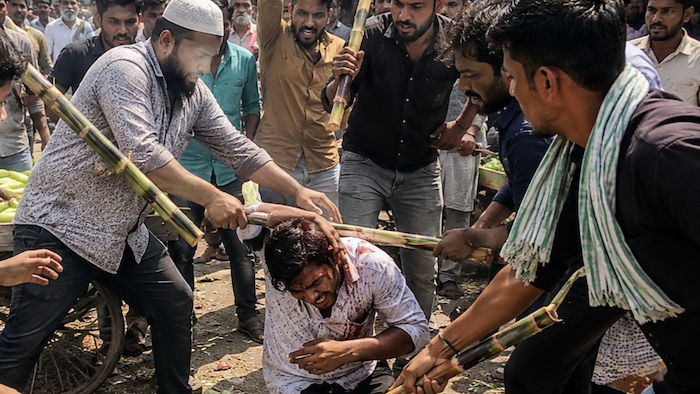
Case Summary
In Gonda district, Uttar Pradesh, members of a Hindu family were assaulted, abused, and threatened by a Muslim mob, who forcefully entered their home, hurled communal abuses, threatened them with 'Bangladesh and Pakistan style violence' before assaulting them with sticks and rods and vandalising their home. The assault was carried out after the Hindu family requested a group of Muslim men participating in a Muharram procession not to beat drums outside their house since they were mourning the death of a family member. According to the complaint filed by Shiva Purwar at the Karnailganj Police Station, his mother, Sarita Devi, had passed away on 19 June 2026, leaving the family in mourning. The complainant stated that at around 9 p.m. the same night, a group of individuals arrived outside their house during Muharram celebrations and began beating drums. The family requested the group to refrain from playing drums in front of their residence, explaining that a death had occurred in the household and they were observing mourning rites. According to the complaint, this request led to an altercation. The complainant stated that members of the group responded by hurling communal slurs, forcibly entering the house, assaulting family members, vandalising property, and issuing threats. The complaint further stated that the accused threatened to subject the family to "Bangladesh-Pakistan style" violence. According to the complaint, Ramawati, Rajan, Rinku, Lucky Jaiswal, Munna Maurya, and Kiran Maurya sustained injuries in the assault. The victim's family demanded strict legal action against those responsible and expressed concern that failure to take timely action could escalate tensions in the village. Following the complaint, Karnailganj Police initiated an investigation into the incident. Karnailganj Station House Officer Narendra Pratap Rai stated that police had been deployed in the village to maintain law and order and that further action would be taken based on the investigation's findings. At the time of documenting the incident, the police also stated that efforts were underway to resolve the matter through mutual settlement.
Why it is Hate Crime ?
This incident has been added to the database as a religiously motivated hate crime under several categories. The first is- Attack not resulting in death. Within this, the subcategory selected is- Communal attack/clash. Communal clash is a form of collective violence that involves clashes between groups belonging to different religious identities. For a communal clash between Hindus and non-Hindus to qualify as a religiously motivated hate crime, the trigger of the violence itself would have to be anti-Hindu in essence. For example, if there is a Hindu religious procession that comes under attack from a non-Hindu mob and after the initial attack, Hindus retaliate in self-defence, leading to a communal clash between the two religious communities. While at a later stage, both communities are involved in the clash/violence, the initial trigger of the violence was by the non-Hindu mob against the Hindus and therefore, it could safely be termed as an anti-Hindu violence. Further, the trigger would also have to be religiously motivated. In the cited example, the attack by the non-Hindu mob was against religious processions and therefore, can be concluded to be religiously motivated. In some cases, the trigger may be non-religious, however, it develops into religious violence against Hindus at a later stage. In such cases too, the foundational animosity towards Hindus becomes the motivating factor of the crime and therefore, it would be classified as a religiously motivated hate crime against Hindus under this category. The other subcategory is- Attacked for Hindu identity. In several cases, Hindus are attacked merely for their Hindu identity without any perceived provocation. A classic example of this category of religiously motivated hate crime is a murder in 2016. 7 ISIS terrorists were convicted for shooting a school principal in Kanpur because they got ‘triggered’ seeing the Kalava on his wrist and tilak that he had put. In this, the Hindu victim had offered no provocation except for his Hindu religious identity. The motivation for the murder was purely religious, driven by religious supremacy. Such cases where Hindus are targeted merely for their religious identity would be documented as a hate crime under this category. The second category selected is- Hate speech against Hindus, and within this, the subcategory selected is- Violent threats. Violent threats, explicit, implicit or implied, is the most dangerous form of hate speech since it goes beyond discriminatory and prejudicial language to express the intent of causing harm to an individual or a group of people based on their religious identity and faith. There could be several different kinds of threats that are issued to Hindus based on religious animosity. An explicit threat would mean the direct threat of violence towards an individual Hindu, a group of Hindus or Hindus at large. Physical violence, death threats, threats of destruction of property belonging to Hindus and threats of genocide would mean explicit threats against Hindus for their religious identity. Implicit threats may not be a direct threat but implied through the use of symbols of actions – for example – in the Nupur Sharma case, other than explicit threats, there were also implicit threats when Islamists took to the streets to burn and beat her effigies. It implies that they want to do the same to Nupur Sharma – thereby is considered an implicit threat. Violent threats can be delivered in person, through letters, phone calls, graffiti, or increasingly through social media and other online platforms. It would be important to understand that a threat – explicit or implicit, online or offline – to an individual who happens to be a Hindu does not qualify as a religiously motivated threat. Such a threat, while vile and dangerous, could be owing to non-religious reasons and/or personal animosity. To qualify as a religiously motivated threat, it would need to exhibit an indication that the individual is being targeted for religious reasons and/or owing to his/her religious identity as a Hindu. The Hindu family was not only assaulted by a Muslim mob but also attacked with communal slurs and threatened with severe violence, like that experienced by Hindus in Islamic nations like Bangladesh and Pakistan. They were targeted for something as small as requesting the Muslims to stop beating the drum while passing their house, since that day itself, they had lost a family member and were grieving her death. This was an innocent demand, not something that should have invited such a disproportionate response. The response escalated into physical assault, communal slurs, vandalism, and threats of "Bangladesh-Pakistan style" violence. The nature of these threats is significant because they were neither casual nor incidental. The Muslim mob specifically chose to threaten Hindus with "Bangladesh-Pakistan style" violence. The accused deliberately invoked countries where Hindu minorities are regularly facing targeted killings, mob attacks, forced displacement, sexual violence, and other forms of religious persecution. The use of this specific reference suggests a deliberate attempt to invoke a recognised pattern of anti-Hindu violence to intimidate the victims. It was a calculated attempt to instil fear by drawing upon the family's Hindu identity and reminding them of the kind of communal violence historically inflicted upon Hindus in those countries. This is also significant in understanding the nature of the assault. Had the confrontation been solely about the family's request to stop beating the drums, one would ordinarily expect threats or abuse related only to that disagreement. Instead, the accused resorted to communal slurs and invoked violence historically associated with Hindu minorities. This shift from a dispute over noise to threats rooted in the victims' religious identity suggests that the hostility was not directed merely at what the family had requested, but at who they were. The family's Hindu identity was central to the intimidation, and this was an act of communal hostility directed against Hindus. The reference to "Bangladesh-Pakistan style" violence also reflects a broader pattern in which communal rhetoric draws upon episodes of violence against Hindu minorities beyond India's borders to instil fear. By invoking such imagery during the assault, the threat sought to communicate consequences associated with the victims' religious identity rather than simply their conduct. Such disproportionate attacks that are launched by Islamists against Hindus are a form of symbolic aggression against the entire community that stems from an innate hatred for Hindus and their faith. Given that the fundamental motivation behind these actions is contempt for Hindus and their religion, this instance has been added to the tracker under the following category.


Case Status
Complaint filed


Perpetrators Details
Perpetrators
Muslim Extremists
Perpetrators Range
Unknown
Perpetrators Gender
male
 Sources




