Muslim writer on The Wire, portrays Hindu cultural presence in Indian army as extremism and a majoritarian agenda
 India
India  23 June, 2025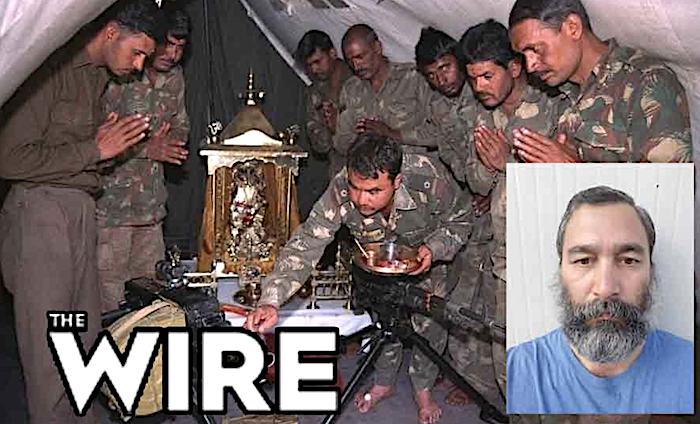
Case Summary
Hindu religious traditions and symbols practised within the Indian Armed Forces were portrayed as evidence of ideological extremism and institutional bias in an article published on 24th June 2025. The article questioned the presence of Hindi and Hindu-associated practices within the Army and presented them as signs of a supposed "Hinduisation" of the armed forces. The remarks targeted traditions and cultural practices closely associated with the Hindu majority and framed their presence in a national institution as inherently problematic. On 24th June 2025, Muslim author Ali Ahmed published an article titled 'Indian Army's New Found Love for Hindi and Hindutva Has Serious Consequences' on The Wire. In the article, he argued that the use of Hindi in the Indian Army's communications, academies and institutions was evidence of political control over the military and formed part of a broader agenda of "Hinduisation". He stated that the supposed self-imposition of Hindi in the Indian Army was occurring alongside a complementary Hinduisation agenda. The article repeatedly linked the use of Hindi with Hindutva and treated the adoption of the language in the armed forces as a sign of ideological capture. It described the Army's use of Hindi as a departure from secularism and portrayed the language, which had historically been adopted as part of post-independence Indianisation and national integration efforts, as a marker of majoritarian domination. The article further suggested that the military's acceptance of Hindi represented an embrace of a political project rooted in Hindu identity. Ali Ahmed also objected to Hindu religious practices undertaken by senior military officials. He criticised Army Chief General Upendra Dwivedi's visits to temples and wrote that such visits amounted to lending support to a nationalistic agenda. The article suggested that the Army Chief's temple visits set a precedent that would compel future military leaders to conform to a supposedly majoritarian ideological direction. The article further contrasted Hindu practices in the Army with Islamic practices, stating that activities such as army officers offering Namaz in Kashmir were viewed as social outreach, whereas visits by the Army Chief to Hindu temples were characterised as evidence of Hinduisation. It questioned the secular character of the armed forces on the basis of Hindu symbols, traditions and cultural practices while treating these expressions of Hindu religiosity as inherently suspect. The article also lamented the Bharatiya Janata Party's electoral success and argued that the military had aligned itself with a "majoritarian enterprise". It asserted that the armed forces had abandoned political neutrality and secularism due to their supposed embrace of Hindi and Hindu traditions. The piece presented the use of Hindi and the observance of Hindu traditions within the military as signs that the institution had become ideologically influenced by Hindutva. The article was published in the public domain and remained accessible online. No information emerged regarding any police complaint, criminal proceedings, or legal action arising from the publication of the article. The incident centred on the portrayal of Hindi and Hindu-associated traditions in the Indian Armed Forces as symbols of ideological extremism and institutional bias. By equating the use of Hindi and the practice of Hindu religious traditions with "Hinduisation" and majoritarian domination, the article directly targeted cultural and religious expressions associated with the Hindu community and framed their presence in a national institution as problematic rather than as elements of India's historical and civilisational identity.
Why it is Hate Crime ?
This case has been added to the tracker under the prime category of - Hate speech against Hindus. Under this, the sub-category selected is - Anti-Hindu subversion and prejudice. Hate speech is defined as any speech, gesture, conduct, writing, or display that is prejudicial against a specific individual and/or group of people, which is leading to or may lead to violence, prejudicial action or hate against that individual and/or group. Media plays a specific and overarching reach in perpetuating prejudicial attitudes towards a community owing to unfair, untrue coverage and/or misrepresentation/misinterpretation, selective coverage and/or omission of facts of/pertaining to issues affecting a specific religious group. This type of bias can dehumanise the victim group, making it easier for others to justify harmful actions against them, which aligns with the objectives of hate speech laws aimed at preventing such harm. It is often observed that the media takes a prejudicial stand against the Hindu community driven by their need to shield the aggressor community which happens to be a numeric minority, however, is the one perpetrating violence against Hindus. For example, the media is often quick to contextualise religiously motivated crimes against Hindus, omit or misrepresent facts that point towards religiously motivated hate crimes, justify and/or downplay religiously motivated hate crimes or simply present fake news to stereotype Hindus. Such media bias leads to the denial of persecution and is often used to dehumanise Hindus, leading to justification for violence against them. For example, the media covered several fake allegations of Hindus targeting Muslims and forcing them to chant Jai Shree Ram. Most of these cases were proved false and fabricated after police investigation. These fake news reports were subsequently never retracted or clarified. Such fake news led to the justification of violence and dehumanisation of Hindus based on the argument that since Hindus targeted Muslims and forced them to chant Jai Shree Ram, the dehumanisation of Hindus and violence against them was par for the course and merely a retaliation. Such media bias leads to prejudicial portrayal of Hindus and offers a justification for violence against them and therefore, is considered hate speech under this category. This case has been categorised added to the tracker because the remarks made by Muslim writer Ali Ahmed portrayed Hindu cultural and religious expressions as inherently suspect and incompatible with secular national institutions. By equating the use of Hindi and the presence of Hindu-associated traditions in the Indian Army with "Hinduisation" and ideological extremism, he framed symbols and practices associated with the Hindu majority not as legitimate elements of India's civilisational heritage but as evidence of communal capture and majoritarian domination. Such rhetoric does not merely criticise a policy or an institution; it pathologises expressions linked to Hindu identity and presents them as a threat to the secular fabric of the nation. A particularly significant aspect of the remarks is the treatment of Hindi and Hindu traditions as something inherently problematic when they appear within a national institution. Hindi was adopted in the armed forces and other state institutions as part of the broader process of Indianisation and national integration following independence, when the newly independent country sought to move away from the colonial dominance of English and develop indigenous symbols of national unity. By depicting the use of Hindi as proof of an extremist ideological agenda, the remarks ignored this historical context and instead communalised a language spoken by millions of Indians and deeply rooted in the country's cultural heritage. This approach effectively portrayed cultural expressions associated with the Hindu majority as illegitimate or dangerous merely because of their perceived connection with Hindu civilisation. The same prejudice was evident in the criticism directed towards Hindu religious practices observed by senior military officials. Temple visits and the personal religious observances of Hindu officers were represented as evidence of institutional bias and ideological transformation rather than as the exercise of individual religious freedom. Such a standard treats Hindu religiosity as uniquely problematic and implies that expressions of Hindu faith in public life are incompatible with secularism. This creates a discriminatory framework in which Hindu traditions are viewed with suspicion and are denied the same legitimacy routinely afforded to the public expressions of other faiths. The remarks also carried a broader implication that the increased visibility of Hindu traditions and cultural symbols in public institutions constituted a form of majoritarian aggression. This effectively delegitimised the cultural identity of the Hindu majority and presented ordinary manifestations of Hindu heritage as something from which national institutions must distance themselves. By framing Hindu civilisational symbols as evidence of ideological extremism, the comments reinforced the notion that Hindu identity itself is inherently exclusionary or dangerous. Such rhetoric contributes to prejudice against Hindus by portraying their cultural and religious expressions as a threat to democratic and secular values. Public figures and commentators play an important role in shaping public perceptions, and characterising Hindu-associated traditions as signs of extremism fosters hostility towards Hindus and normalises suspicion of their participation in public life. It encourages the perception that Hindu identity and national belonging are incompatible and that visible expressions of Hindu culture in state institutions are inherently illegitimate. For these reasons, the incident reflects anti-Hindu subversion and prejudice. The remarks targeted symbols, traditions and practices associated with Hindu civilisation and portrayed them as manifestations of ideological extremism rather than recognising them as elements of India's historical and cultural heritage. By stigmatising Hindu expressions in public institutions and treating them as inherently problematic, the comments demonstrated bias against Hindu identity and contributed to the delegitimisation of Hindu religious and cultural presence in national life.


Case Status
Complaint not filed


Perpetrators Details
Perpetrators
Muslim Extremists
Perpetrators Range
One Person
Perpetrators Gender
male
 Sources




