Minor Hindu students targeted for religious conversion by Christian teacher, kalavas cut and Hindu deities denigrated
 Basti, Uttar Pradesh, India
  23 June, 2026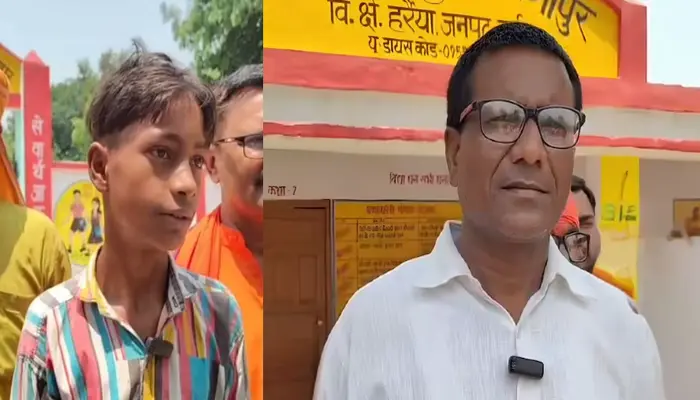
Case Summary
In Jogipur village under the Harraiya police station limits of Basti district, Uttar Pradesh, minor Hindu students were targeted for religious conversion by a Christian teacher identified as Gyan Das. The accused also insulted Hindu deities, denigrated Sanatan traditions, and cut the raksha sutra and kalava tied around the wrists of Hindu students. According to complaints submitted by local Hindu organisations, including the Vishwa Hindu Parishad (VHP) and the Vishwa Hindu Mahasangh, assistant teacher Gyan Das forcibly cut the raksha sutra and kalava worn by Hindu students. The complaints further stated that he repeatedly made derogatory remarks about Hindu gods, goddesses, and Sanatan Dharma, encouraging students to develop contempt for their own religion. He reportedly told the children that "God does not exist" and that "Hinduism is a sham." The complaints also stated that Gyan Das had sacred trees on the school premises felled despite their religious significance in Hinduism and fostered hostility towards students belonging to upper-caste Hindu communities. It was further stated that he attempted to influence students to embrace Christianity. The school's headmaster, Hanuman Prasad Verma, stated that he had repeatedly objected to Gyan Das's conduct. According to the headmaster, the accused responded by threatening to implicate him under the Scheduled Castes and Scheduled Tribes (Prevention of Atrocities) Act. The incident triggered protests by Hindu organisations, which described the teacher's conduct as an attack on the religious beliefs of Hindu children and demanded strict legal as well as departmental action. Vishwa Hindu Mahasangh district president Akhilesh Singh stated that insulting children's religious beliefs within an educational institution was unacceptable and warned that such actions would not be tolerated. Following the complaints, District Basic Education Officer Anoop Kumar ordered a departmental inquiry, stating that no individual had the right to harm students' religious sentiments or discriminate against them on religious grounds within a school. Police also registered a case against Gyan Das after receiving complaints that he had cut the children's sacred threads and had sacred trees felled on the school campus. Circle Officer Swarnima Singh confirmed that an investigation had been initiated and stated that further legal action would be taken based on its findings. The accused teacher was subsequently taken into custody as part of the ongoing proceedings.
Why it is Hate Crime ?
This case has been added to the tracker under the primary category of - Predatory Proselytisation. Within it, the sub-category selected is - Proselytisation by grooming, brainwashing, manipulation or subtle indoctrination, with the tertiary category being - Conversion of minor. Religious brainwashing essentially means the often subtle and forcible indoctrination to induce someone to give up their religious beliefs to accept contrasting regimented ideas. Religious grooming or brainwashing also involves propaganda and manipulation. It involves the systematic effort, driven by religious malice and indoctrination, to persuade “non-believers’ to accept allegiance, command, or doctrine to and of a contrasting faith. Cases of such grooming or brainwashing are far more nuanced than direct threats, coercion, inducement and violence. In such cases, it is often seen that there is repeated, subtle and continual manipulation of the victim to induce disaffection towards their own faith and acceptance of the contrasting faith of the perpetrator. While subtle indoctrination is widely acknowledged as predatory, an element which is often understated in such conversions or the attempts of such conversion is the role of loyalty and trust which might develop between the perpetrator and the victim. Fiduciary relationships are often abused to affect such religious conversion. For example, an educator transmitting religious doctrine of a competing faith to a Hindu student. The Hindu student is likely to accept what the teacher is transmitting owing to existence of the fiduciary relationship. The exploitation of the fiduciary relationship to religiously indoctrinate victims would also be included in this category. Since the underlying animosity towards the victim’s faith forms the basis of predatory proselytization, such cases are considered religiously motivated hate crimes. The other sub-category selected here is - Attempting to convert/converting by denigrating Hinduism. In several cases, Hindus are converted or an attempt is made to convert Hindus by denigrating their faith, Hinduism. In such cases, the Hindus associate with the non-Hindu perpetrators often by choice and then, the attempt to convert them by insulting their faith, showing the faith down etc begins. An example of this would be a non-Hindu gathering where the Hindus are attending the gathering of their own free will. However, once they attend the gathering, there is an explicit attempt to convert them by abusing their faith and hailing the faith of the perpetrator. The denigration of the Hindu faith is often based on misrepresentation of the Hindu faith, its doctrine and scriptures and insult to espoused traditions if not blatant lies about Hindu beliefs and ways. Such conversions or attempts at conversions are driven by animosity towards the Hindu faith and are therefore documented as religiously motivated hate crimes. The other sub-category selected here - Harassment, threats, coercion for conversion. Harassment covers a wide range of behaviours of an offensive nature. It is commonly understood as behaviour that demeans, humiliates, and intimidates a person, including threats and coercion. Harassment and threats, in this case, find their root on discriminatory grounds which has the effect of nullifying a person’s rights or infringing upon his freedom to exercise his right specifically owing to the victim’s religious identity. Verbal and physical threats and psychological or physical harassment are often used against Hindu victims because they choose to practice their professed religion. Religious harassment also includes forced and involuntary conversions by harassment, threats or coercion. Coercion includes intimidatory tactics like force-feeding a Hindu victim beef to convert to another religion, forceful circumcision etc. In several cases documented, non-Hindu perpetrators or those who harbour specific animosity towards Hinduism, harass victims simply based on their religious identity. Such cases often also include harassment to ensure the Hindu victim abandons his/her professed religion and adopts the religion of the perpetrator. Such cases where Hindu victims are harassed to convert to the perpetrator’s religion are rooted in animosity towards the victim’s religious identity and are therefore documented as religiously motivated hate crimes. The second primary category selected here is - Attack on Hindu religious representations. Within it, the sub-category selected here is - Desecration of Hindu religious symbol. Icons and symbols or a religious representation of a spiritual ideal are widely revered in Hinduism. Iconography is of vital significance in the Hindu milieu. It helps connect people’s spiritual beliefs with the real world. Iconography within the Hindu faith takes several shapes and forms. Murtis are of most significance to Hindus, to which daily rituals, prayers and offerings are done. Besides the murtis, there are several other symbols which have deep significance in the Hindu faith – the Om and Swastika for example. Since these Hindu religious symbols hold paramount importance in Hinduism, any desecration of symbols, icons, murtis, religious representations and manifestations, is driven by animosity towards the faith itself which manifests itself through these murtis, icons and symbols. Therefore, any desecration of these Hindu religious symbols and representations is considered religiously motivated hate crimes under this category. The third primary category selected here is - Hate speech against Hindu. Within it, the sub-category selected here is - Anti-Hindu slurs, mocking faith. Anti-Hindu slurs and the deliberate mocking of the Hindu faith owing to religious animosity involve the usage of derogatory terms, stereotypes, or offensive references to religious practices, symbols, or figures. One of the common anti-Hindu slurs used against Hindus is “cow-worshipper” and “cow piss drinker”. The intention of using this term is to demean and mock Hindus as a group and their religious beliefs since Hindus consider the cow holy. Additionally, some symbols and the slurs attached to them have a historical context that exacerbates the insult, hate, stereotyping, dehumanisation and oppression against Hindus. Cow worship has been used for centuries to denigrate Hindus, insult their faith and oppress Hindus specifically as a religious group. There has been overwhelming documentation about how cow slaughter has been used to persecute Hindus with cow meat being thrown in temples and places of worship. There has also been overwhelming documentation where cow meat (beef) has been force-fed to Hindus to either forcefully convert them to Islam or denigrate their faith. Apart from cow worship, the Swastika – which holds deep religious significance for the Hindus – has also been misinterpreted and distorted to use as a slur against Hindus. Similarly, the worship of the Shivling has been used by supremacist ideologies and religions to denigrate Hindus owing to religious animosity. Such slurs and denigration stem out of inherent animosity and hate towards Hindus and their faith, therefore, it is categorised as hate speech targeted at Hindus specifically owing to their religious identity. The other sub-category selected here is - Restriction/ban on Hindu practices. Within it, the sub-category selected here is - Restriction on expression of Hindu identity. An example of the state-affected prejudicial and targeted orders against the Hindu community would be a government denying the right of a Hindu or a group of Hindus to hold a religious procession owing to the animosity of non-Hindu groups. Denial of the religious right of the Hindus to assuage the non-Hindu group which harbours animosity to a point where it could lead to violence against Hindus is not only a failure of law and order but is a prejudicial order against Hindus, denying them their fundamental rights to express their religious identity. An example of a hate crime against Hindus by a non-Hindu would be a non-Hindu institution forcing its Hindu employees to abandon religious symbols that a Hindu would wear as an expression of faith owing to inherent prejudice against the faith professed by the victim or a non-Hindu group of people restricting a Hindu group from constructing a place of worship simply because the demography of the area in which the temple is being built is dominated by non-Hindus. Such actions are driven by religious animosity and/or prejudice against Hindus and their faith and would therefore be categorized as a hate crime. This case has been categorised as a hate incident targeting Hindus because minor Hindu students were singled out, made to remove or had their *raksha sutra* and *kalava* cut, and were pressured to convert to Christianity by their school teacher. Firstly, such mandates stand as a clear example of religious intolerance and a hate crime against Hindu children and their faith. It goes beyond mere disciplinary action and constitutes targeted hostility towards Hindu students for their religious identity, raising serious concerns about the safety and protection of Hindus in educational institutions. Schools are expected to provide a neutral environment where children of all faiths can participate without discrimination; therefore, targeting visible markers of a particular religion would represent differential treatment based on religious identity. Secondly, it is important to note here that the victim was a minor, which means the element of consent and genuine change of conscience was missing ab initio. Minors, due to their young age and lack of maturity, are particularly vulnerable to manipulation and coercion. They may not have the ability to fully understand the implications of converting to another religion, and the Christian perpetrator purposely targeted and exploited this vulnerability of the victim. Since this case exemplifies the use of coercion and manipulation to achieve religious conversion, it is a blatant act of religious hate, which is why it has been documented here in the hate tracker. Thirdly, the teacher made derogatory remarks about Hindu deities and Sanatan traditions and attempted to cultivate negative perceptions of Hindu beliefs among students. He also claimed that “God doesn’t exist, Hinduism is a sham.” This goes beyond religious debate or proselytisation; it constitutes an act of incitement and insult directed at the core beliefs of the Hindu community. Such remarks are designed to demean and undermine the faith of Hindus and intend to create an inferiority complex in the minds of the victims against their own faith. This fosters an environment of hostility and disrespect towards the Hindu community and Hindu deities. These acts of insulting Hinduism stem from Christian theology, which harbours disdain and hatred for polytheistic faiths, and which categorises Hindus as ‘polytheists’, thereby fostering hatred against them. Such actions make the religiously motivated nature of the crime even more evident. Such conduct go beyond a personal expression of opinion and constitute the use of a position of authority to disparage the religious beliefs of Hindu children. Given the inherent power imbalance between teachers and students, such actions exert psychological pressure on minors, undermine their religious identity, and create a hostile educational environment for children belonging to the targeted faith. Fourth, it was also revealed that that trees which are regarded as sacred in Hindu tradition were cut on the school premises. In Hinduism, several trees, such as the Peepal, Banyan, and Neem, hold deep religious and cultural significance and are often revered as symbols of divinity, life, and spiritual continuity. The felling of such trees within a government school formed part of the broader pattern of conduct against Hindu community, as it involved deliberate desecration of objects of religious significance associated with Hinduism. When viewed alongside the removal of Hindu students' kalavas and the denigration of Hindu deities, this aspect further contributed to the religious nature of the offence that symbols and practices associated with the Hindu faith were being singled out within an educational institution, thereby reinforcing the perception of hostility towards the religious identity of Hindu students. Fifth, the accused cut the Raksha Sutra and Kalava tied on the hands of the Hindu students. The Raksha sutra and Kalava are not merely decorative things; they hold profound spiritual and cultural significance for Hindus. They are emblems of Hindu religious identity, often worn during prayers, rituals, and as a daily affirmation of faith. Forcing Hindu students to remove these religious symbols is a deliberate effort to erase their religious identity and expression. Such an act is deeply disrespectful and constitutes a direct attack on the values and practices of Hinduism. This incident reflects a blatant restriction on the religious expression of Hindu children. The message it sends is that Hindu symbols are not welcome in the school and that these symbols would be forcibly removed if Hindu students display them. This not only violates a Hindu child’s fundamental right to practise and express his religion but also creates an atmosphere of fear and suppression, where Hindu children may feel compelled to conceal their faith. Such actions are common tactics in environments where subtle or overt pressure is used to alienate Hindu children from their religious identity. It serves as the first step in a larger pattern of grooming, where consistent ridicule, punishment, and forced removal of Hindu symbols and practices make a child more susceptible to abandoning their faith and embracing another under pressure. These are deliberate actions to facilitate the gradual suppression of Hindu practices to erode the child’s confidence in their own religion over time, normalising the idea that Hindu identity must be hidden or discarded to fit in. These are meant to alienate Hindu children from their own faith. Such actions are rooted in bias and disdain for Hinduism, its adherents, and its practices, making it a religiously motivated crime. The fact that the victims are minors, who are not yet cognitively developed to critically resist such pressure, makes this even more serious, since their impressionable minds are far easier to manipulate and reshape against their own faith. Sixth, it was also revealed that attempts were made to influence students towards Christianity. Pressuring Hindu individuals to discard their religious faith and embrace another was a direct attack on their religious identity and dignity. It was not a matter of personal choice; it was coercion rooted in hostility towards the victim's Hindu identity. Such an attempt reflects religious animosity because the act was not simply about personal differences but about erasing the victim’s Hindu faith, making it a religiously motivated crime. Taken together, the accused's conduct demonstrates a consistent pattern directed specifically at the Hindu identity of the victims rather than isolated or unrelated acts. The denigration of Hindu deities, the removal of Hindu religious symbols, the cutting of trees regarded as sacred in Hindu tradition, and the attempts to influence minor Hindu students towards Christianity collectively demonstrate that the victims were targeted because of their religion. The fact that these acts occurred within a school, where children are expected to learn in an environment free from religious discrimination and where teachers exercise considerable authority over impressionable minors, further aggravates the seriousness of the incident. Viewed in its entirety, the case reflects not merely individual misconduct but conduct that targeted Hindu religious identity, religious expression, and freedom of conscience, making it appropriate for documentation as a hate incident against Hindus. Disclaimer: The Hinduphobia Tracker records incidents based on when an event occurred or when the victim's ordeal began. It is important to clarify that none of the media sources covering this case has specified the exact date when the accused began pressuring students to convert. Therefore, for documentation purposes, we have recorded the date based on when the incident was reported in the media, 24 June 2026.


Case Status
Complaint filed


Perpetrators Details
Perpetrators
Christian Extremists
Perpetrators Range
One Person
Perpetrators Gender
male
 Sources




