Dalit Hindu families induced to abandon faith in Christian conversion racket in Kanpur Dehat
 Kanpur Dehat, Uttar Pradesh, India
  24 June, 2026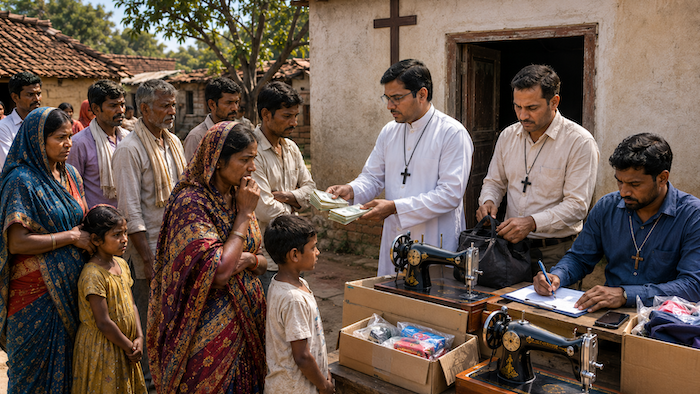
Case Summary
A Hindu man from Akbarpur in Kanpur Dehat, Uttar Pradesh, stated that he and other economically vulnerable Hindus were drawn into a network that operated under the guise of skill development training and subsequently faced efforts to convert them to Christianity. The case centred on allegations that inducements and welfare benefits were used to target poor and Dalit Hindus and move them away from their faith. The matter later expanded into an investigation into an organised conversion network operating across states. The conversion activities were linked to Navakanti Society, an organisation based in Machilipatnam, Andhra Pradesh, and an institution operating under the name Nitya Academy in Akbarpur. The organisation was accused of identifying economically vulnerable Hindus, particularly poor and Dalit individuals, and attracting them through promises of money, hand pumps, free sewing machines, and skill development opportunities. The inducements were allegedly presented as welfare and training initiatives but were used as a means to facilitate religious conversion. One of the Hindu victims, Rambharose, a resident of Nibouli village, stated that he had fallen victim to the network's activities. He subsequently approached the police and filed a complaint against several individuals associated with the organisation. Those named in the case included Daniel Sharad Singh, who served as the accountant and manager of Navakanti Society and resided near ITI Mountain School in Sipri Bazaar, Jhansi, pastor Hariom Tyagi, a resident of Patepur, principal Savitri Sharma, the wife of Ashok Sharma and a resident of Nehru Nagar in Akbarpur, and another individual connected to the institution. The complaint stated that the organisation had lured Hindus with financial incentives and material assistance and had carried out religious conversions under the guise of skill development training. The activities were described as a coordinated effort that specifically targeted individuals facing economic hardship and used promises of social and financial support to bring them into contact with the organisation's conversion programme. Following the complaint, the police registered a case under the Uttar Pradesh Prohibition of Unlawful Conversion of Religion Act. The investigation focused on the activities of the institution and the role of the individuals associated with it in conducting conversions under the cover of educational and welfare programmes. On 10th January 2026, three individuals named in the case were sent to jail in connection with the investigation. Subsequently, all three were granted bail by the High Court approximately two months before the present proceedings. However, the director of the organisation remained absconding and had not been arrested by the police. The investigation also identified Palli Gond Abraham Kantilal, the director of Navakanti Society, as a key figure connected to the organisation. He was originally from Jhansi and was residing in Machilipatnam, Andhra Pradesh. His lawyer later filed an anticipatory bail petition before the court of the Additional District Judge First in connection with the case. After hearing arguments from both the prosecution and the defence, the court rejected the anticipatory bail plea of Palli Gond Abraham Kantilal. The rejection of the plea marked the latest development in the case concerning the alleged conversion network that operated in Akbarpur by targeting poor and Dalit Hindus through promises of financial assistance and skill development programmes. The investigation into the activities of the organisation and the individuals associated with it remained ongoing.
Why it is Hate Crime ?
This case has been added to the tracker under the primary category - Predatory Proselytisation. Within this, the sub-category selected is- Conversion/attempts to convert by inducement. Predatory Proselytisation is not just limited to threat, harassment, force and violence, but it also has contours of stealth. In several cases, the Hindu victim is exploited to convert, with non-Hindus taking advantage of their poverty. In such cases, the Hindu victim who is suffering financially is offered monetary benefits, including lucrative offers for jobs, health treatment, education, etc, to induce the victim into changing his/her religion. In such cases, the religious identity of the victim and the aim to disenfranchise him from his faith form the heart of the crime. Also, taking advantage of and exploiting an individual’s economic vulnerabilities is widely acknowledged as exploitation, forms of which are often penalised by law. Such cases therefore are considered religiously motivated hate crimes since the victim’s religious identity forms the very heart of the crime itself. This case has been added to the tracker because it involved the organised targeting of poor and Dalit Hindu families for conversion to Christianity through inducements and deceptive promises made under the guise of skill development and social welfare activities. The victims in this case were not approached at random. The conversion network specifically focused on economically vulnerable Hindus, particularly poor and Dalit families who were facing financial hardship and social marginalisation. They were offered money, hand pumps, free sewing machines, and other material benefits in exchange for abandoning their faith. Such inducements are not acts of charity or humanitarian assistance. They constitute a calculated attempt to exploit vulnerable sections of the Hindu community by leveraging their economic circumstances to secure religious conversions. The religious significance of this targeting lies in the deliberate selection of Hindus who were perceived as being susceptible due to their poverty and limited resources. The objective was not merely to provide welfare assistance but to create dependency and use material incentives as a pathway to religious conversion. By linking economic assistance and skill development opportunities with conversion, the perpetrators sought to place vulnerable Hindu families in a position where changing their faith appeared to be the means of obtaining financial security and social support. Particularly significant is the fact that the victims belonged to poor and Dalit Hindu communities. Across many such cases, socially and economically disadvantaged Hindus are targeted because their circumstances make them more vulnerable to inducements and promises of a better life. The exploitation of poverty and social deprivation for religious conversion demonstrates that the perpetrators viewed these communities as suitable targets for proselytisation precisely because of their vulnerabilities. Such conduct strips individuals of genuine religious choice and transforms economic hardship into an instrument for religious change. The conversion activities were also carried out under the guise of skill development training and educational programmes. Presenting conversion efforts as welfare initiatives enabled the perpetrators to gain access to vulnerable Hindu families and build trust within the community. The use of ostensibly charitable programmes as a vehicle for religious conversion is significant because it conceals the true objective of proselytisation behind activities that appear to be aimed at social upliftment. This method of operation demonstrates a deliberate attempt to penetrate Hindu communities and gradually facilitate religious change through inducement and dependency rather than through informed and voluntary conviction. The individuals named in the case included a pastor and persons associated with an organisation that was alleged to have been engaged in conversion activities. The involvement of religious functionaries and a structured organisation indicates that the conversion efforts were not isolated acts but formed part of an organised campaign directed towards vulnerable Hindu communities. The Christian faith places considerable emphasis on evangelisation and the expansion of the faith through proselytisation. In pursuit of conversion objectives, certain missionary groups have, in numerous documented instances, employed inducements such as money, employment opportunities, education, medical assistance, and other material benefits to encourage conversion among economically disadvantaged populations. Such methods do not constitute genuine expressions of religious conviction but instead seek to engineer religious change by exploiting conditions of vulnerability and dependency. The cumulative effect of these actions demonstrates a direct targeting of Hindus as a religious community. The victims were selected because they were Hindus belonging to poor and socially marginalised sections of society, and efforts were undertaken to persuade them to abandon their faith through material inducements and promises of a better life. Such conduct reflects a fundamental disregard for the religious identity, traditions, and beliefs of the Hindu community and seeks to replace that identity with adherence to another faith. This systematic attempt to erode the religious foundations of vulnerable Hindu families and facilitate their conversion to Christianity through inducements and deceptive welfare activities demonstrates clear religious motivation. The actions were directed specifically at Hindus because of their faith and sought to weaken and alter their religious identity through exploitation of their economic circumstances. For these reasons, the incident meets the threshold of a religiously motivated hate crime and has been included in the Hinduphobia Tracker. Disclaimer: The Hinduphobia Tracker records incident dates based on when a crime occurs rather than when it is reported in the media. However, in this case, the available media reports do not specify the exact date of when the inducements for conversion started. Accordingly, the date on which the incident was published in the media, 25th June 2026, has been adopted as the indicative incident date for documentation purposes only.


Case Status
Arrested


Perpetrators Details
Perpetrators
Christian Extremists
Perpetrators Range
From 5 to 10
Perpetrators Gender
both
 Sources




