Documented incidents of Hindu women facing deception and coercive conversion dismissed by leftist publication as 'Hindutva myth'
 India
India  22 June, 2026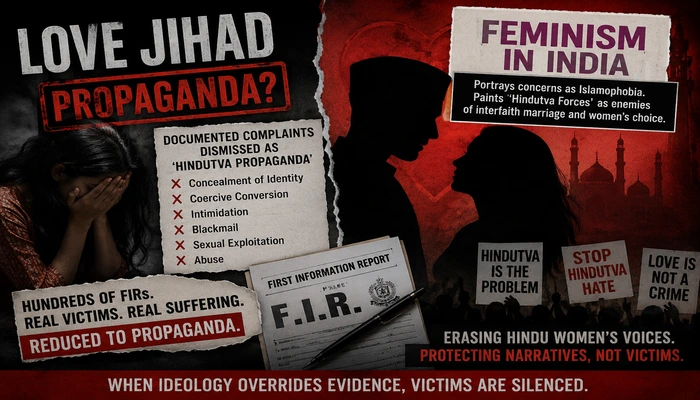
Case Summary
An article published by Feminism in India reviewing Sameena Dalwai's book Love Jihad: A Feminist Retelling characterised "love jihad" as a "carefully constructed Hindutva propaganda" and argued that the phenomenon has been manufactured to demonise Muslim men and fuel Islamophobia rather than to address any genuine pattern of religiously motivated targeting. The article asserted that claims of Muslim men deceiving Hindu women into relationships and marriage for the purpose of religious conversion are part of a conspiracy narrative propagated by Hindutva organisations and amplified through the media, films, social media campaigns, and WhatsApp messages. According to the article, "love jihad" is intrinsically linked to the broader Hindutva theory of "demographic jihad", which it described as a false claim that Muslims are attempting to alter India's religious demography by converting Hindu women through marriage. It argued that India's religious composition has remained broadly stable since Independence and maintained that the narrative is driven not by evidence of organised religious conversion but by communal politics. The article further claimed that concerns surrounding "love jihad" are rooted in patriarchal anxieties over Hindu women's sexuality, family honour, and autonomy rather than any organised campaign targeting Hindu women. It argued that the narrative simultaneously infantilises Hindu women by portraying them as incapable of making independent decisions and demonises Muslim men by constructing them as inherently predatory. According to the article, Hindu women are positioned as symbols of community honour whose relationships are monitored and controlled under the pretext of protecting them from Muslim men. Throughout the article, interfaith relationships involving Hindu women and Muslim men are portrayed as ordinary expressions of personal choice that have been unfairly politicised by what it describes as "Hindutva forces." The author argues that opposition to such relationships stems from communal prejudice rather than concerns over deception, coercion, or religious conversion. Drawing upon examples from the author's own family, the article presents interfaith marriages as longstanding examples of India's syncretic social fabric and contends that contemporary campaigns against "love jihad" are, in reality, attempts to stigmatise interfaith marriages and police the personal choices of Hindu women. In doing so, the article frames organisations and individuals raising concerns over deceptive interfaith relationships as adversaries of interfaith marriage itself rather than as those responding to documented complaints of identity concealment, coercive conversion, intimidation, or abuse. The article also contended that opposition to interfaith relationships is an extension of broader moral policing in Indian society rather than a response to documented cases of deception or coercive conversion. It cited instances of couples being harassed in public spaces by Hindu organisations and political workers and argued that campaigns against "love jihad" have resulted in increased surveillance of Hindu women and restrictions on their personal autonomy. Referring to anti-conversion legislation enacted in several Indian states, the article asserted that these laws are effectively "anti-love jihad laws" rooted in Hindutva politics rather than legitimate legal responses to complaints of coercive religious conversion. It further argued that social media accounts documenting interfaith relationships and alleged cases of "love jihad" function as instruments of communal surveillance by collecting and publicising information about interfaith couples. The article praised Sameena Dalwai's book for attempting to dismantle what it repeatedly described as the "bogey" of love jihad and for challenging the notion that Muslim patriarchy is uniquely oppressive. It also criticised the view that interfaith marriages involving Muslim men and Hindu women represent a coordinated religious campaign, arguing instead that such relationships have historically existed in India and are being politicised by Hindutva organisations. The publication attracted criticism from several commentators, who argued that by portraying "love jihad" solely as propaganda, the article dismissed and delegitimised the experiences of Hindu women who have filed police complaints alleging concealment of religious identity, coercive religious conversion, blackmail, intimidation, sexual exploitation, forced marriage, and violence in interfaith relationships. Critics further argued that the article overlooked numerous First Information Reports, police investigations, charge sheets, judicial proceedings, and victim testimonies documenting such allegations across multiple states. They contended that by reducing all such cases to products of Hindutva propaganda and Islamophobia, the article erased the lived experiences of Hindu victims and disregarded documented complaints that have resulted in criminal investigations and prosecutions under various provisions of criminal law, including anti-conversion statutes. It is also important to note that this was not the first instance in which Sameena Dalwai faced criticism over her remarks and conduct concerning Hindu identity. The OP Jindal Global University professor had previously courted controversy after publicly objecting to the chanting of "Jai Shri Ram" on campus and facing accusations of discriminating against Hindu students. Dalwai also came under scrutiny for defending former Delhi University professor Achin Vanaik, who made remarks critical of Hinduism and Hindutva during a 2023 lecture at OP Jindal Global University. In an email responding to criticism of the event, Dalwai urged the critic to attend the lecture before objecting and accused them of having a "narrow view of suffering". She also dismissed reports of Hamas atrocities against Israeli civilians as "fake news" spread by Indian "troll armies" and wrote that she regularly heard "Jai Shri Ram" being chanted on campus, adding that she wanted to react but remained silent "in favour of peace". Her defence of Vanaik, along with her own earlier objections to Hindu religious expression on campus, has previously drawn criticism over her views concerning Hinduism and Hindutva.
Why it is Hate Crime ?
This case has been added to the database under the primary category- Hate speech against Hindus. Within this, the first subcategory selected is- Anti-Hindu subversion and prejudice and the tertiary category selected is- Anti-Hindu fake news and downplaying. Hate speech is defined as any speech, gesture, conduct, writing, or display that is prejudicial against a specific individual and/or group of people, which is leading to or may lead to violence, prejudicial action or hate against that individual and/or group. Media plays a specific and overarching reach in perpetuating prejudicial attitudes towards a community owing to unfair, untrue coverage and/or misrepresentation/misinterpretation, selective coverage and/or omission of facts of/pertaining to issues affecting a specific religious group. This type of bias can dehumanise the victim group, making it easier for others to justify harmful actions against them, which aligns with the objectives of hate speech laws aimed at preventing such harm. It is often observed that the media takes a prejudicial stand against the Hindu community driven by their need to shield the aggressor community which happens to be a numeric minority, however, is the one perpetrating violence against Hindus. For example, the media is often quick to contextualise religiously motivated crimes against Hindus, omit or misrepresent facts that point towards religiously motivated hate crimes, justify and/or downplay religiously motivated hate crimes or simply present fake news to stereotype Hindus. Such media bias leads to the denial of persecution and is often used to dehumanise Hindus, leading to justification for violence against them. For example, the media covered several fake allegations of Hindus targeting Muslims and forcing them to chant Jai Shree Ram. Most of these cases were proved false and fabricated after police investigation. These fake news reports were subsequently never retracted or clarified. Such fake news led to the justification of violence and dehumanisation of Hindus based on the argument that since Hindus targeted Muslims and forced them to chant Jai Shree Ram, the dehumanisation of Hindus and violence against them was par for the course and merely a retaliation. Such media bias leads to prejudicial portrayal of Hindus and offers a justification for violence against them and therefore, is considered hate speech under this category. The other subcategory selected is- Denial or mocking of genocide/large-scale persecution. Denial or mocking of genocide/large-scale persecution/ethnic cleansing refers to the act of denying or minimising the fact of the ethnic cleansing and/or genocide and/or religious persecution of Hindus. This often involves denying the scale, mechanisms, religious intent, or even the occurrence of the ethnic cleansing and/or genocide and/or religious persecution of Hindus. Hate speech of this kind involves the dissemination of falsehoods that deny or distort established historical facts or mock the suffering of Hindus by saying that they deserved the persecution, motivated by Hinduphobia. Denying such atrocities is not only about the denial of facts or rewriting/revising history, but it also delegitimises the religiously motivated persecution of Hindus, the religious hate/motivation/animosity that led to the persecution, and dehumanises Hindus as a religious group. Such denial of ethnic cleansing and/or genocide and/or religious persecution of Hindus not only denies the suffering but also paves the way for future/present atrocities and hate speech, inciting prejudice and violence against Hindus. It also provides a justification for violence by delinking religious animosity from religiously motivated crimes committed against Hindus. Since such denial and/or mocking of genocide/ethnic cleansing/atrocities motivated by religious animosity leads to present and future ramifications of creating more hate speech, violence, dehumanisation and delegitimisation, it would be considered hate speech under this category. This case has been documented as a hate incident because the article does not merely critique the term "love jihad" or question specific cases. Instead, it dismisses the phenomenon in its entirety as a product of "Hindutva propaganda", despite the existence of numerous documented complaints, police investigations, First Information Reports, chargesheets, judicial proceedings, and victim testimonies confirming concealment of religious identity, coercive religious conversion, intimidation, blackmail, sexual exploitation, and abuse perpetrated through deceptive relationships targeting Hindu victims. By reducing all such complaints to propaganda, the article effectively delegitimises the experiences of Hindu victims and presents their allegations as manifestations of communal prejudice rather than grievances deserving independent examination. This dismissal is particularly significant given the scale of documented complaints. Over the past one and a half years alone, the Hinduphobia Tracker has documented more than 1,250 incidents involving concealment of religious identity, coercive religious conversion, intimidation, blackmail, sexual exploitation, forced marriage, and other forms of abuse targeting Hindu women. This figure is not exhaustive. The Hinduphobia Tracker documents only those incidents that can be corroborated through credible sources, and many cases are likely to remain unrecorded due to underreporting, social stigma, fear of retaliation, victims choosing not to approach law enforcement, or the absence of public reporting. Even with these limitations, the documented number remains extremely large. Against this backdrop, portraying the entire phenomenon as "Hindutva propaganda" dismisses the lived experiences of a large number of Hindu victims whose complaints have been formally recorded through police complaints, investigations, court proceedings, and other contemporaneous documentation. Another significant aspect of the article is its repeated use of the term "Hindutva forces" as the primary explanatory framework through which concerns about coercive religious conversion and deceptive interfaith relationships are dismissed. Rather than engaging with documented complaints on their individual merits, the article attributes these concerns to what it describes as a broader project of Hindutva extremism, Islamophobia, and patriarchal control. In doing so, it portrays organisations, activists, journalists, and citizens raising such concerns not as responding to documented victim accounts but as participants in a communal campaign against Muslims. This framing employs "Hindutva" as a broad label that extends beyond criticism of a political ideology and functions as a shorthand for dismissing concerns raised by Hindus about issues affecting their community. By framing the entire phenomenon as "Hindutva propaganda", the article encourages readers to dismiss documented complaints by Hindu victims as politically motivated rather than evaluating the facts of each case independently. As a result, the focus shifts from examining the facts of individual cases to discrediting the concerns themselves through ideological labelling. The repeated invocation of "Hindutva" in such discourse is also significant. 'Hindutva' is often used as a euphemism to make the targeting of Hindus more palatable. Hindutva is essentially a unifying ideology for Hindus, which became imperative for Hindus to find and preserve their cultural identity, which was being eroded and attacked due to Islamic invasions, British colonisation, Christian theological impositions and conversions. Hindutva is not a destructive ideology, as some attempt to portray, but one that is used as a unifying edifice for Hindus. Hindutva is also often used as a euphemism to target Hindus on the whole and their religious identity and faith. It is essentially semantic jugglery to confuse Hindus into believing that their own persecution by supremacists is somehow 'justified' because the specific victims espoused an ideology (Hindutva) which deserves the onslaught. The fact that the use of 'Hindutva' is merely to mask animosity towards Hindus was evident from the "Dismantling Global Hindutva" conference held in the USA, where speakers unabashedly spoke about how Hindutva and Hinduism are indistinguishable and therefore, to "dismantle Hindutva" one would have to "dismantle Hinduism". The practices of targeting Hindus and their religious and cultural identity, and justifying that victimisation and dehumanisation by using euphemisms like "Hindutva", stem from inherent animosity and hostility towards Hindus. In this case, the label "Hindutva" is not used merely to critique a political ideology but to characterise documented complaints of deception, coercive conversion, and abuse involving Hindu victims as products of communal propaganda. By doing so, the article shifts the focus away from the evidence underlying individual cases and towards discrediting the concerns themselves through ideological labelling. The article also reframes opposition to the deceptive and coercive relationship between a Hindu woman and a Muslim man as opposition to interfaith marriage itself. It presents what it describes as "Hindutva forces" as adversaries of interfaith relationships and personal choice while overlooking the distinction between consensual interfaith marriages and cases in which victims have alleged deception regarding religious identity, coercive conversion, blackmail, or abuse. By collapsing these distinct categories into a single narrative of communal prejudice, the article risks obscuring the experiences of individuals who have approached law enforcement with allegations of criminal conduct. This framing is particularly significant because public discourse plays an important role in shaping how victims are perceived. When documented complaints by Hindu victims are characterised in advance as products of propaganda or communal politics, there is a risk that their testimonies will be discounted not on the basis of evidence but because of the ideological label attached to them. Such treatment can discourage scrutiny of individual allegations and contribute to the marginalisation of victims who seek legal remedies. For these reasons, this incident has been documented as a case of anti-Hindu prejudice in media representation. By dismissing an entire category of documented victim complaints as "Hindutva propaganda", framing those raising such concerns as motivated by communal hostility, and conflating concerns about deception and coercive conversion with opposition to interfaith marriage itself, the article is viewed by critics as fostering prejudice against Hindus and delegitimising the experiences of Hindu victims. It is also important to view this framing in light of Sameena Dalwai's prior conduct and public remarks regarding Hindu identity. Dalwai has previously faced criticism after objecting to the chanting of "Jai Shri Ram" on the OP Jindal Global University campus and over allegations of discriminatory treatment of Hindu students. She also defended professor Achin Vanaik after his remarks attacking Hinduism and Hindutva, while herself describing the chanting of "Jai Shri Ram" on campus as something she wanted to oppose but chose not to for the sake of peace. These earlier instances provide relevant context to her treatment of the "love jihad" discourse, where documented concerns involving Hindu women are again dismissed through the broad label of "Hindutva". Viewed together, her earlier remarks and conduct raise concerns about a recurring pattern of hostility towards Hindu religious expression and the concerns of Hindus, rather than an isolated disagreement over the term "love jihad".


Case Status
Unknown


Perpetrators Details
Perpetrators
Others
Perpetrators Range
One Person
Perpetrators Gender
female
 Sources




