Hindu community vilified through fabricated social media narrative of extremism using edited Bangladesh video
 India
India  20 June, 2026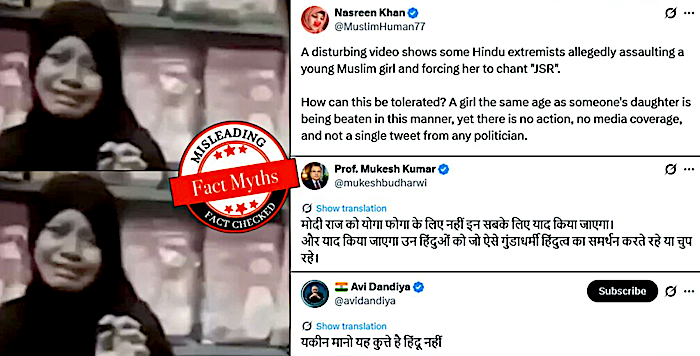
Case Summary
A fabricated communal narrative vilifying Hindus gained widespread circulation on social media after a video from Bangladesh was falsely portrayed as an incident from India. The viral claim alleged that "Hindu extremists" had assaulted a young Muslim girl and forced her to chant "Jai Shri Ram", falsely depicting Hindus as violent religious fanatics and portraying one of Hinduism's most revered religious chants as a symbol of terror. Although no such incident had occurred, the fabricated narrative collectively maligned Hindus by falsely associating their religious identity, beliefs, and devotional expressions with communal violence and child abuse. Among those who amplified the false claim was The News Minute Editor-in-Chief Dhanya Rajendran, who reshared a post by Congress supporter Sarayu Pani describing the purported incident as a "horrendous and shameful act" committed to "terrorise a young child." The original post further asserted that "Jai Shri Ram" had become a form of "brand terrorism", thereby branding a sacred Hindu religious slogan as synonymous with extremism and violence. The misinformation was subsequently amplified by numerous social media users, activists, journalists, and political commentators, many of whom presented the fabricated video as evidence of anti-Muslim violence in India. Several posts accused Hindu organisations, the BJP, and the Modi government of fostering religious extremism and enabling attacks on minorities, while others claimed the video demonstrated how Hindu extremists routinely targeted Muslims in the name of religion. As the narrative spread, it further entrenched the false portrayal of Hindus and Hindu religious expressions as inherently violent and intolerant. Subsequent fact-checks and reverse image searches established that the entire narrative was false. Investigations traced the video to Bangladesh, where it had first appeared on social media in September 2025. The earliest identified uploads were found on Bangladeshi Facebook pages, including one published on 16 September 2025. The girl in the video was identified as Anika, and the incident related to an allegation of theft at Mirpur College Market in Bangladesh. Additional uploads from Bangladeshi social media platforms dated 17 September 2025 further confirmed that the incident had taken place entirely in Bangladesh and had no connection whatsoever to India. Fact-checkers also established that the original video contained no chants of "Jai Shri Ram." The audio heard in the version circulated in India had been digitally superimposed to create the false impression that the girl was being forced to chant a Hindu religious slogan. After the video's Bangladesh origin was established and the fabricated communal narrative was exposed, the repost shared by Dhanya Rajendran was removed from her social media profile. However, no visible correction, clarification, or public apology was issued to those who had viewed and shared the misinformation. By the time the falsehood was debunked, the fabricated claim portraying Hindus as violent religious extremists and branding "Jai Shri Ram" as a slogan of terror had already spread widely across social media, reinforcing prejudice against Hindus through demonstrably false allegations.
Why it is Hate Crime ?
This case has been added to the tracker under the prime category of - Hate speech against Hindus. Under this, the sub-category selected is - Anti-Hindu subversion and prejudice. Within this, the tertiary categories selected are - Anti-Hindu fake news or downplaying, and Mislabelling/Misrepresentation of perpetrator's religion as Hindu. Hate speech is defined as any speech, gesture, conduct, writing, or display that is prejudicial against a specific individual and/or group of people, which is leading to or may lead to violence, prejudicial action or hate against that individual and/or group. Media plays a specific and overarching reach in perpetuating prejudicial attitudes towards a community owing to unfair, untrue coverage and/or misrepresentation/misinterpretation, selective coverage and/or omission of facts of/pertaining to issues affecting a specific religious group. This type of bias can dehumanise the victim group, making it easier for others to justify harmful actions against them, which aligns with the objectives of hate speech laws aimed at preventing such harm. It is often observed that the media takes a prejudicial stand against the Hindu community driven by their need to shield the aggressor community which happens to be a numeric minority, however, is the one perpetrating violence against Hindus. For example, the media is often quick to contextualise religiously motivated crimes against Hindus, omit or misrepresent facts that point towards religiously motivated hate crimes, justify and/or downplay religiously motivated hate crimes or simply present fake news to stereotype Hindus. Such media bias leads to the denial of persecution and is often used to dehumanise Hindus, leading to justification for violence against them. For example, the media covered several fake allegations of Hindus targeting Muslims and forcing them to chant Jai Shree Ram. Most of these cases were proved false and fabricated after police investigation. These fake news reports were subsequently never retracted or clarified. Such fake news led to the justification of violence and dehumanisation of Hindus based on the argument that since Hindus targeted Muslims and forced them to chant Jai Shree Ram, the dehumanisation of Hindus and violence against them was par for the course and merely a retaliation. Such media bias leads to prejudicial portrayal of Hindus and offers a justification for violence against them and therefore, is considered hate speech under this category. This case has been added to the tracker because it involved the deliberate creation and amplification of a false communal narrative that portrayed Hindus and a sacred Hindu religious slogan as symbols of extremism and violence. The misinformation did not arise from a misunderstanding of an event in India. It was built around an unrelated video from Bangladesh that was digitally altered and falsely presented as evidence of Hindu extremists forcing a Muslim girl to chant "Jai Shri Ram". By fabricating an anti Hindu hate crime where none existed, the narrative sought to depict Hindu religious expression as inherently threatening and violent, thereby fostering hostility and prejudice towards the Hindu community. Particularly significant is the fact that the original video had no connection whatsoever to India or to Hindu religious slogans. The clip had circulated in Bangladesh since September 2025 and related to an entirely different incident. Fact check investigations established that the audio containing "Jai Shri Ram" slogans had been added separately before the video was circulated on Indian social media. The deliberate insertion of a sacred Hindu chant into an unrelated video transformed an ordinary criminal incident into a fabricated communal narrative in which Hindus were cast as perpetrators of religious intimidation. "Jai Shri Ram" is one of the most revered devotional expressions in Hinduism and is used by millions of Hindus as an invocation of Lord Ram, a central deity in the Hindu faith. Falsely presenting this sacred chant as an instrument of terror and coercion directly stigmatised a core expression of Hindu religiosity and associated Hindu devotional practices with extremism and violence. The impact of such misinformation extends far beyond a single false social media post. By portraying Hindu slogans as tools of terror and presenting Hindus as aggressors targeting minorities, the narrative reinforced existing prejudices and contributed to broader anti Hindu stereotypes. False communal narratives of this nature create public hostility towards Hindus, legitimise suspicion towards visible expressions of Hindu faith, and encourage the perception that Hindu religious symbols are inherently threatening. Such portrayals damage the reputation of the wider Hindu community because they attribute acts of religious hatred to Hindus without any factual basis and create enduring negative impressions even after the misinformation has been debunked. The case also involved the false attribution of religious identity to the purported perpetrators. The religious identities of the individuals involved in the original incident in Bangladesh remain unconfirmed. Despite this, the edited and circulated version of the clip explicitly portrayed the incident as one committed by 'Hindu extremists' in India. This was not a correction of an existing fact or an error regarding identities. It was the deliberate construction of a communal narrative that assigned Hindu identities to unnamed individuals in order to depict Hindus as perpetrators of religious persecution. The false representation of the perpetrators as Hindu was therefore central to the spread of the misinformation and was necessary to sustain the fabricated allegation of anti-Muslim violence. The mislabelling of the perpetrators' religion is particularly significant because it transformed an unrelated incident into a story of Hindu extremism and religious hatred. By assigning Hindu identities to unidentified individuals and falsely linking them to coercive religious conduct, the narrative manufactured communal guilt and portrayed Hindus collectively as intolerant and violent. Such conduct reflects religious animosity because it deliberately exploits religious identities to create prejudice against a specific community. The objective was not to report an incident accurately but to construct and amplify a narrative in which Hindus and Hindu religious expressions appeared inherently oppressive and dangerous. The actions of those who amplified the false claim further magnified its impact. The misinformation was circulated by prominent public figures and journalists, giving legitimacy to a fabricated account that vilified Hindus and associated a sacred Hindu slogan with terrorism. Even after the video's Bangladesh origin was established and the claim was exposed as false, no comparable effort was made to repair the damage caused by the original narrative. By that stage, the misinformation had already reached a wide audience and contributed to the dissemination of anti-Hindu prejudice. Therefore, the deliberate editing of an unrelated Bangladesh video to insert "Jai Shri Ram" slogans, the fabrication of a communal narrative portraying Hindu extremists as perpetrators, the false assignment of Hindu identities to unconfirmed individuals, and the widespread amplification of the misinformation demonstrate a clear pattern of anti-Hindu prejudice and religious hostility. The incident targeted Hindu religious symbols and identities through deliberate distortion and false attribution, creating and spreading a fabricated narrative that vilified Hindus as a community. For these reasons, this case has been added to the Hinduphobia Tracker's hate speech database. Disclaimer: The Hinduphobia Tracker records incident dates based on when a crime occurs, not when it is reported in the media. However, in this case, the available media reports do not specify the exact date on which the edited video and false claims from the original video were first circulated by Indian social media users and journalists. Accordingly, the date on which the incident was published in the media, 21st June 2026, has been adopted as the indicative incident date for documentation purposes only.


Case Status
Complaint not filed


Perpetrators Details
Perpetrators
Others
Perpetrators Range
From 2 To 5
Perpetrators Gender
female
 Sources




