Hindu employees selectively dismissed from their jobs; victims say Muslim owner paid Hindus lower salaries, denied bonuses, and favoured Muslim employees
 Moradabad, Uttar Pradesh, India
  22 June, 2026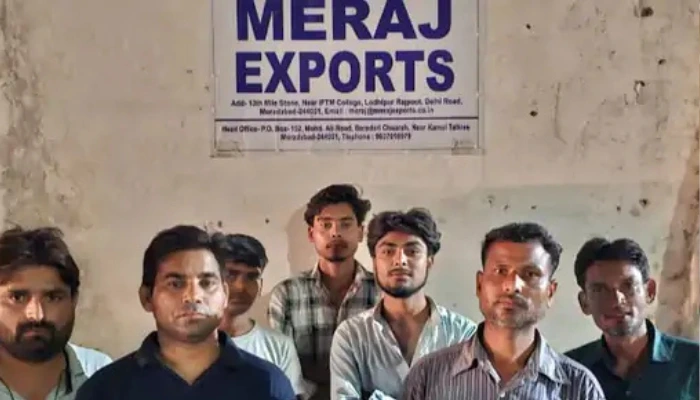
Case Summary
In Moradabad, Uttar Pradesh, more than 12 Hindu employees were selectively removed from their jobs at an export factory owned by a Muslim businessman after they were told they would no longer be allowed to work there. The Hindu employees stated that on Tuesday (23 June 2026) afternoon, the factory owner's son, Samad Hussain alias Ponty, called all the Hindu employees to his cabin and told them, "I will not make you work. You all should leave the factory." The victims further stated that the Human Resources official, Suhail, subsequently terminated all the Hindu employees. Most of the affected employees had worked at the factory for over two decades, with some serving for 20–26 years. Following their dismissal, the Hindu employees staged a protest outside the Mehraj Export factory, demanding justice and protesting what they described as discriminatory treatment. According to the Hindu employees, the incident occurred at Mehraj Export, located on Delhi Road in Moradabad. The factory employed around 30–35 workers, nearly half of whom were Hindus. Vijaypal Singh, a resident of Lodhipur Rajput who had worked at the factory for 26 years, stated that all Hindu employees were summoned together and told to leave the factory. The employees who stated that they were dismissed included Shani Sharma, Satendra Kumar, Kaushal Kumar, Vijaypal Singh, Sanjay Kumar, Abhishek, Lalit Kumar, Munnu, Rajpal Singh and Lalla Valmiki, among others. The dismissed Hindu employees also stated that the management had engaged in long-standing discrimination in wages. Satendra Kumar stated that despite working at the factory for 22 years, he received a monthly salary of only ₹13,470, whereas Muslim employees with fewer years of service were paid between ₹15,000 and ₹35,000 for similar work. The Hindu employees further stated that the factory had traditionally paid a bonus equivalent to one month's salary on Eid to all employees. However, this year (2026), they stated that only Muslim employees received the Eid bonus, while Hindu employees were informed that their bonus would be paid later. They stated that even after Eid al-Fitr, the promised bonus had not been paid. According to the employees, the factory did not have a Diwali bonus policy, and bonuses were given only on Eid, making the denial of the Eid bonus to Hindu employees a departure from previous practice. The factory owner, Zulfiqar Hussain alias Babbu, father of Samad Hussain, denied dismissing any employees and claimed that his son had spoken in anger after defects were found in goods shipped to the United States. He further claimed that no employee had been formally dismissed. However, the Hindu employees rejected this version of events and stated that they had been selectively terminated because they were Hindus. Zulfiqar further claimed that the employees had left the factory on their own after the incident and that he had attempted to persuade them to stay. He also acknowledged that their bonuses were pending and stated that they would be paid soon.
Why it is Hate Crime ?
In this case, the primary category selected is: Attack not resulting in death. The subcategory selected is: Attacked for Hindu identity. In several cases, Hindus are attacked merely for their Hindu identity without any perceived provocation. A classic example of this category of religiously motivated hate crime is a murder in 2016. 7 ISIS terrorists were convicted for shooting a school principal in Kanpur because they got ‘triggered’ seeing the Kalava on his wrist and tilak that he had put. In this, the Hindu victim had offered no provocation except for his Hindu religious identity. The motivation for the murder was purely religious, driven by religious supremacy. Such cases where Hindus are targeted merely for their religious identity would be documented as a hate crime under this category. This case is a clear example of a religiously motivated hate crime, as Hindu employees were selectively targeted and dismissed from their jobs by the Muslim factory owner's son solely because of their religious identity. The information provided by the victims further stated that Hindu employees, despite having significantly more years of service and experience than several Muslim employees, were paid lower salaries. They also stated that while Muslim employees received Eid bonuses, Hindu employees were denied the same benefit. The selective dismissal of Hindu employees, coupled with the disparity in wages and bonuses based on religion, amounted to religious discrimination in the workplace and constituted a clear case of a religiously motivated hate crime targeting Hindu employees because of their faith. The selective dismissal of only Hindu employees demonstrated that this was not a routine workplace dispute or a random employment decision but a case in which religion was the distinguishing factor. The only common characteristic shared by all those who were removed from their jobs was that they were Hindus. When employees belonging to a single religious community are singled out for dismissal while others are retained, it clearly demonstrates religious discrimination at play rather than ordinary disciplinary action. Such selective targeting of Hindu employees on the basis of their religious identity reflected hostility towards them because of their faith and made this a clear case of a religiously motivated hate crime. Some may argue that the dismissals were connected to defects found in goods exported to the United States. However, if the dismissals had genuinely been based on responsibility for defective goods, the disciplinary action would reasonably have been applied uniformly to all employees found responsible, irrespective of their religion. Instead, in this case, only Hindu employees were removed from their jobs, while Muslim employees were not subjected to similar action. This selective attribution of responsibility to one religious community indicated that the dismissals were directed at Hindu employees because of their religious identity rather than being a neutral workplace decision, thereby making it a clear case of a religiously motivated hate crime. The selective removal of Hindu employees from their jobs also had consequences extending beyond the immediate loss of employment. Employment is the primary means through which individuals support themselves and their families. By dismissing only Hindu employees while retaining Muslim employees, the action disproportionately affected the livelihood and economic security of the Hindu community. Such religiously selective deprivation of employment opportunities deepened the vulnerability of the affected Hindu employees and reflected hostility directed at them because of their faith, making it a clear case of a religiously motivated hate crime. Religious discrimination of this nature also has a wider social and psychological impact on the victims. When individuals are treated differently in their workplace solely because of their religious identity, it undermines their dignity, sense of security, and equal standing within society. Such treatment fosters fear and insecurity among members of the Hindu community, creating the perception that they may face unequal treatment or exclusion because of their faith. Consequently, the selective targeting of Hindu employees in this case amounted to more than workplace discrimination; it constituted a religiously motivated attack on the equal rights and dignity of Hindu employees. The additional complaints made by the Hindu employees further strengthened the evidence of religious discrimination in this case. Beyond their selective dismissal, the victims stated that they were subjected to differential treatment throughout their employment because of their Hindu identity. They stated that Hindu employees received lower salaries despite having greater experience and longer years of service than several Muslim employees and were denied bonuses that were granted to Muslim employees. Such differential allocation of wages and employment benefits on the basis of religion reflected bias, prejudice, and partiality against Hindu employees while extending preferential treatment to Muslim employees. A workplace should treat all employees equally, irrespective of their religion, caste, creed, or gender. However, the pattern described by the victims showcased that employment conditions and financial benefits were not administered on an equal basis but were influenced by religious identity. Such religiously differentiated treatment demonstrated sustained discrimination against Hindu employees and reinforced that this was not an isolated employment dispute but a clear case of religiously motivated bias and hostility, making it a clear case of a religiously motivated hate crime. This case reflected a pattern of religiously motivated targeting of Hindus in their workplace, where Hindu employees face selective dismissals, discrimination, pressure to convert, harassment, forced removal or suppression of religious symbols, and professional victimisation in professional environments. The Hinduphobia Tracker has previously documented over 40 such incidents across different sectors, in which Hindu individuals faced adverse treatment due to their religious identity in professional settings. These documented cases included incidents reported across various educational institutions, corporate workplaces, and service-sector environments, involving organisations such as Tata Consultancy Services Nashik, Tata Consultancy Services Chennai, Jamia Millia Islamia University, Al-Falah University, Aligarh Muslim University, Lulu Mall, Air India, Wipro, Tech Mahindra, Pantaloons, Lenskart among others, where religiously motivated discrimination, coercion, or hostility towards Hindu employees or students were recorded. Viewed collectively, these cases reflected a recurring pattern of religious hostility in workplace environments, where Hindu employees experience unequal treatment, coercive pressure regarding their faith, and targeted discrimination linked to their religious identity. Overall, this case met multiple indicators of a religiously driven hate crime. Therefore, it is being added to the Hinduphobia Tracker’s hate crime database. Disclaimer: The perpetrator count in this case has been recorded as three. This includes factory owner Zulfiqar Hussain alias Babbu, his son Samad Hussain alias Ponty, who informed the Hindu employees that they would no longer be allowed to work at the factory, and the Human Resources official, Suhail, who terminated all the Hindu employees following the instruction. As these three individuals were identified as having played direct roles in the discriminatory actions against the Hindu employees, the perpetrator count has been recorded as '3' for documentation purposes.
Victim Details
Total Victim
12
Deceased
0
Gender
- Male 12
- Female 0
- Third Gender 0
- Unknown 0
Caste
- SC/ST 1
- OBC 0
- General 1
- Unknown 10
Age Group
- Minor 0
- Adult 12
- Senior Citizen 0
- Unknown 0


Case Status
Unknown


Perpetrators Details
Perpetrators
Muslim Extremists
Perpetrators Range
From 2 To 5
Perpetrators Gender
male
 Sources




