Historic Hindu temple in Netrakona targeted for theft and idol vandalism amidst ongoing persecution of Hindus in Bangladesh
 Netrokona District, Bangladesh
  24 June, 2026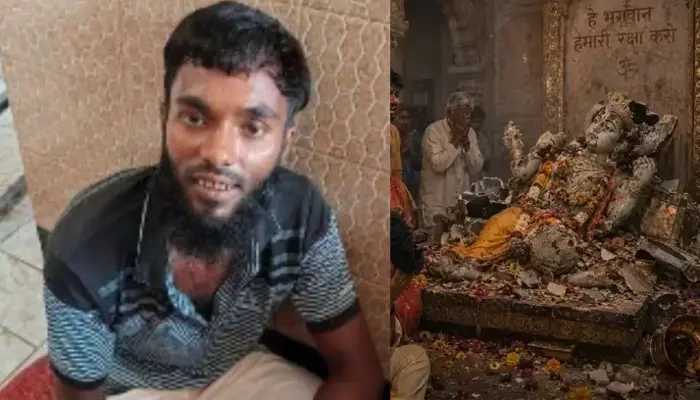
Case Summary
In the Netrokona district of Bangladesh, a Hindu temple was targeted for theft and attempted desecration of its idols by a man. According to reports, the incident took place on 25 June 2026, when the youth entered the historic Kali temple in Durga Bazar with the intention of committing theft. During the attempt, he tried to vandalise the consecrated idols inside the temple. Realising what was happening, residents and Hindu devotees apprehended him. The matter was immediately reported to the local administration and police. Upon receiving the information, police arrived at the scene, brought the situation under control, and took the accused into custody. The incident has created tension in the area. Police said that legal action is being taken after a thorough investigation. The looting and desecration of the Hindu temple occurred amid a broader climate of insecurity faced by the Hindu minority in Bangladesh, where Hindu places of worship, temples, idols, homes and businesses have repeatedly been subjected to attacks, vandalism, arson, looting and intimidation. This escalation of violence against Hindus in Bangladesh has unfolded in three distinct phases: first, following the ouster of Sheikh Hasina's government in August 2024; second, after the death of Sharif Osman Bin Hadi in December 2025; and third, in the immediate aftermath of the 13th National Parliamentary Election 2026. Following the ouster of Sheikh Hasina, multiple reports documented attacks on Hindu homes, temples, and religious institutions, alongside intimidation campaigns, arson, and mob assaults targeting minority neighbourhoods. The Hinduphobia Tracker has recorded 336 such incidents against the Hindu minority, underscoring the scale and persistence of anti-Hindu violence during this period. A further escalation occurred following the death of Sharif Osman Bin Hadi, a Muslim political activist and student leader known for his anti-Hindu and anti-India rhetoric. Hadi had been involved in political unrest after the fall of the Hasina government and was killed in Dhaka on 18th December 2025 during clashes. In the aftermath of his death, Hindu communities were blamed and subsequently targeted in retaliatory violence. Hindu homes were selectively set ablaze in multiple localities, forcing families to flee and leaving many displaced. The attacks appeared patterned rather than sporadic, with Muslim mobs focusing on Hindu neighbourhoods, properties, and religious symbols. Among the victims was Dipu Chandra Das, who was lynched to death and his body was set ablaze by a Muslim mob over false blasphemy allegations. The Hinduphobia Tracker documented 51 incidents of anti-Hindu violence in the period following Hadi's death alone. Such incidents underscored the vulnerability of the Hindu minority amid rising communal hostility and the weaponisation of religious accusations. Reports further indicated that posters and written materials calling for the extermination of Hindus were displayed in public spaces, signalling an alarming normalisation of genocidal rhetoric. When combined with acts of arson, vandalism, assault and targeted intimidation, these developments suggested a coordinated environment of hostility aimed at terrorising the Hindu community and reinforcing majoritarian dominance. The third phase of violence was unleashed after the 13th National Parliamentary Election 2026. Within days of the announcement of results, Hindu families in districts such as Noakhali, Rangpur, Nilphamari, Sylhet, Thakurgaon and Dinajpur reported coordinated attacks involving arson, looting, assault and vandalism of temples and homes. In several instances, Hindu homes were selectively targeted, looted and families were threatened with displacement. The attempted theft and attempted vandalism at the historic Durga Bazar Kali Temple occurred within this wider environment of sustained insecurity facing Hindu religious institutions and the Hindu minority community in Bangladesh.
Why it is Hate Crime ?
This case has been added to the tracker under the primary category - Attack on Hindu religious representations. Within this, the subcategory selected is - Attack on temples. In Hinduism, a temple is the abode of the Deity. The Deity in the Temple is consecrated, thereby, making it a real, breathing entity. Hindus believe that not just the Deity but the temple premises itself are sacred to Hindus since Hindus hold the faith that the entire Temple space is an amalgamation of the divine energy of the deity. Given the central significance of Temples in Hindu Dharma, any attack against a Hindu Temple or its peripheral premises is an attack on the faith itself and is born out of animosity towards the faith, of which, the Temple is a central tenet. Any manner of attack against a Temple and/or its premises would therefore be considered a religiously motivated hate crime. The other sub-category selected here is - Desecration of Hindu religious symbols. Icons and symbols or a religious representation of a spiritual ideal are widely revered in Hinduism. Iconography is of vital significance in the Hindu milieu. It helps connect people’s spiritual beliefs with the real world. Iconography within the Hindu faith takes several shapes and forms. Murtis are of most significance to Hindus, to which daily rituals, prayers and offerings are done. Besides the murtis, there are several other symbols which have deep significance in the Hindu faith – the Om and Swastika for example. Since these Hindu religious symbols hold paramount importance in Hinduism, any desecration of symbols, icons, murtis, religious representations and manifestations, is driven by animosity towards the faith itself which manifests itself through these murtis, icons and symbols. Therefore, any desecration of these Hindu religious symbols and representations is considered religiously motivated hate crimes under this category. \ This case has been added to the Hinduphobia Tracker because it involved the theft and vandalism of a Hindu temple dedicated to Goddess Kali, resulting in an attack on a sacred place of worship and the desecration of religious idols central to the Hindu faith. The accused entered the historic Durga Bazar Kali Temple in Netrakona with the intention of committing theft and, during the course of the intrusion, attempted to vandalise the idols installed inside the temple. The incident, therefore, extended beyond an ordinary attempted theft, as it directly targeted a Hindu religious institution and its sacred objects of worship. The primary religious marker in this case was the targeting of a Hindu temple. Hindu temples are not merely physical structures but consecrated spaces where devotees perform daily worship, celebrate festivals, preserve religious traditions, and maintain a spiritual connection with their deities. The temple in question was dedicated to Goddess Kali, one of the most revered deities in Hinduism, worshipped as the embodiment of divine power, protection, and the destruction of evil. By unlawfully entering the temple with criminal intent and attempting to vandalise the sacred idols housed within it, the accused violated a place of profound religious significance for the local Hindu community. Such an intrusion into a sacred Hindu space directly affected the sanctity of the temple and the religious sentiments of its devotees. The second religious marker was the attempted vandalisation of the temple idols. In Hinduism, consecrated idols (murtis) are not regarded as decorative objects or symbolic representations but as living embodiments of the divine following the ritual of Pran Pratishtha. They constitute the focal point of worship, devotion, and religious rituals performed by devotees. Any deliberate attempt to damage or desecrate such idols amounts to an attack on sacred objects of worship and the religious beliefs associated with them. Even though the vandalism was interrupted before extensive damage could occur, the attempt itself represented a deliberate act directed against consecrated Hindu deities inside a place of worship and was capable of causing deep distress and outrage among devotees. This incident must also be viewed within the broader context of the continuing vulnerability of Hindu religious institutions in Bangladesh. Hindu temples across the country have repeatedly faced incidents of vandalism, idol desecration, theft, arson, and intimidation, creating an atmosphere of insecurity for the country's Hindu minority. In such a context, an attempted theft accompanied by an effort to vandalise temple idols cannot be viewed in isolation, as the selection of a Hindu place of worship as the target carries significance beyond the immediate criminal act. Such incidents undermine the security of temples, disrupt religious practice, and reinforce fears among Hindu devotees regarding the safety of their places of worship. The attempted theft and vandalism at the Durga Bazar Kali Temple therefore, constituted an attack on a sacred Hindu place of worship and its consecrated idols, affecting both the sanctity of the temple and the religious sentiments of the Hindu community associated with it. Given Bangladesh's sustained environment of anti-Hindu persecution and the repeated targeting of Hindu religious institutions, this case meets the threshold for inclusion in the Hinduphobia Tracker's hate crime database.


Case Status
Arrested


Perpetrators Details
Perpetrators
Unknown
Perpetrators Range
One Person
Perpetrators Gender
male
 Sources




