Sacred idols of Hindu deities desecrated, meat and fish thrown inside temple premises by miscreants in Raipur, Chhattisgarh
 Raipur, Chhattisgarh, India
  22 June, 2026
Case Summary
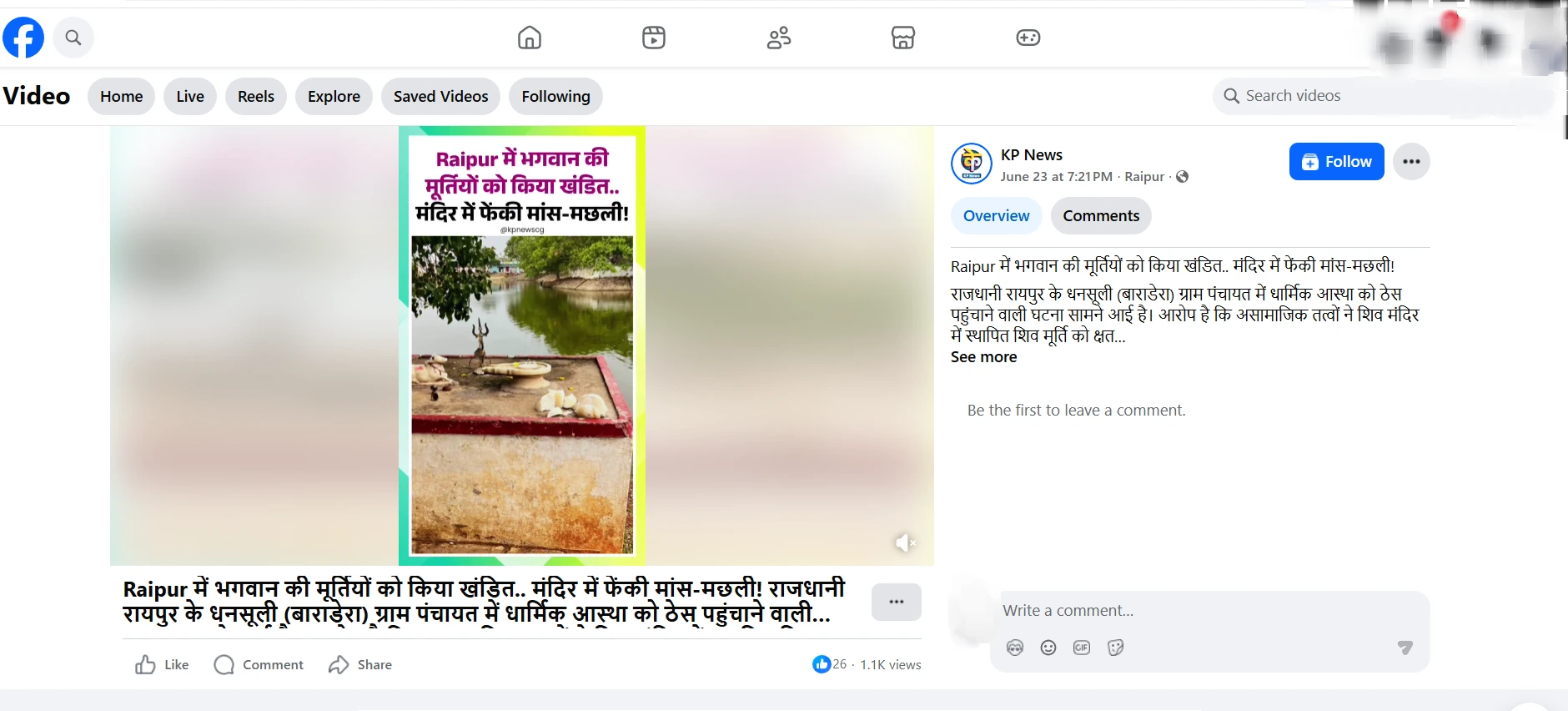
In Raipur, Chhattisgarh, a Hindu temple was targeted, and the sacred Shivalinga and Shani Dev idols were desecrated by unidentified miscreants. The accused also threw meat and fish inside the premises of the Shitala Mata Mandir. According to media reports, the incident occurred in Dhansuli (Baradera) Gram Panchayat in the capital city of Raipur. The accused entered the temple premises and vandalised the Shivalinga, causing damage to it. Simultaneously, the silver eyes of a Shani Dev idol were plucked out, and the eyes were damaged. Local residents also stated that the accused threw meat and fish inside the shrine of the Shitala Mata temple. When news of the incident came to light, it caused tension and outrage among local Hindus. They stated that they had no clue as to who had committed the act. Following the incident, local Hindus demanded strict action against the perpetrators. They registered a complaint at the Vidhan Sabha Police Station. At the time of writing this report, despite the complaint, the police had not issued any public statement regarding the case.
Case Images
Why it is Hate Crime ?
In this case, the primary category selected is: Attack on Hindu religious representations. The subcategory selected is: Desecration of Hindu religious symbols. Icons and symbols or a religious representation of a spiritual ideal are widely revered in Hinduism. Iconography is of vital significance in the Hindu milieu. It helps connect people’s spiritual beliefs with the real world. Iconography within the Hindu faith takes several shapes and forms. Murtis are of most significance to Hindus, to which daily rituals, prayers and offerings are done. Besides the murtis, there are several other symbols which have deep significance in the Hindu faith – the Om and Swastika for example. Since these Hindu religious symbols hold paramount importance in Hinduism, any desecration of symbols, icons, murtis, religious representations and manifestations, is driven by animosity towards the faith itself which manifests itself through these murtis, icons and symbols. Therefore, any desecration of these Hindu religious symbols and representations is considered religiously motivated hate crimes under this category. The other subcategory selected is: Attack on Temples. In Hinduism, a temple is the abode of the Deity. The Deity in the Temple is consecrated, thereby, making it a real, breathing entity. Hindus believe that not just the Deity but the temple premises itself are sacred to Hindus since Hindus hold the faith that the entire Temple space is an amalgamation of the divine energy of the deity. Given the central significance of Temples in Hindu Dharma, any attack against a Hindu Temple or its peripheral premises is an attack on the faith itself and is born out of animosity towards the faith, of which, the Temple is a central tenet. Any manner of attack against a Temple and/or its premises would therefore be considered a religiously motivated hate crime. The other subcategory selected is: Defiling religious customs. Sanatan Dharma is not a religion of one book, which is to say that while it has religious scriptures that form the central tenets of the faith, there are several traditions followed through thousands of years, mostly passed from generation to generation orally. There are several such customs and traditions that are followed by various Hindus and Hindu sects. Defiling of these traditions and customs is a breach of an individual or group’s religious practices. Such practices can range from dietary restrictions like not eating non-vegetarian food for a certain period of the year, not eating non-vegetarian food at all, not eating beef since the cow is considered holy in Hinduism, the sanctity of religious customs followed in the house (like many ISCKON devotees), etc. Any malicious action leading to the breach of such traditions or defilement of these traditions owing to animosity towards the faith or for the sake of activism stems not only from the lack of faith in the religion itself but also from disregard for the faith of the devotees who follow the customs/traditions and implicit bias against the faith, the tradition itself. Since these specific traditions are central to the faith of the devotees of that specific sect of Hindus, any non-compliance with these traditional rules would be considered a religiously motivated hate crime. This case is a clear example of a religiously motivated hate crime, as the miscreants deliberately desecrated sacred Hindu religious symbols by damaging the Shivalinga and plucking out the silver eyes of the Lord Shani Dev idol. They further defiled the sanctity of the temple by throwing meat and fish inside the temple premises. The combination of desecrating revered religious idols and deliberately polluting a sacred place of worship demonstrates conduct directed at insulting and violating Hindu religious beliefs and practices, making this a clear case of a religiously motivated hate crime. In Hinduism, temple idols (murtis) are not regarded merely as artistic representations but as sacred embodiments of the deities following ritual consecration (Prana Pratishtha). Every component associated with a consecrated deity, including its ornaments, jewellery, weapons, clothing, crown, eyes, and other sacred adornments, is considered an integral part of the deity and is venerated with deep reverence by devotees. The Shivalinga, in particular, is among the most sacred symbols in Hinduism, representing Lord Shiva and serving as a central object of worship in countless temples across India and the world. Consequently, the deliberate desecration of the Shivalinga and the silver eyes of the Lord Shani Dev idol was not merely an act of vandalism or damage to property, but a direct attack on sacred religious symbols that hold profound spiritual significance for millions of Hindus. Such actions deeply offended and hurt the religious sentiments of the Hindu community, constituted an act of religious hostility directed at Hinduism, and amounted to a direct attack on the Hindu faith and the religious identity of its devotees, making this a clear case of a religiously motivated hate crime. Hindu temples are among the holiest institutions in Hinduism, serving as sacred spaces where devotees worship, perform rituals, celebrate festivals, and maintain a spiritual connection with the divine. They are revered places whose sanctity is preserved through strict religious customs and rituals. Consequently, an attack on temple idols is also an attack on the temple ecosystem as a whole, as the sanctity of the temple is intrinsically linked to its consecrated deities. Acts of vandalism and desecration within a temple constitute an affront to Hindu religious sentiments, undermine the sanctity of a place of worship, and create fear among the Hindu community regarding the safety and security of their religious shrines. Such conduct, therefore, amounts to a clear religiously motivated attack on a Hindu place of worship. Hindu temples observe strict principles of ritual purity and sanctity, which form an essential part of Hindu religious practice and worship. Items such as meat, fish, alcohol, intoxicants, and other substances regarded as ritually impure are not permitted within temple premises because they are considered incompatible with the sacred nature of these places of worship and violate the religious purity that devotees are expected to uphold. The deliberate act of throwing meat and fish inside the temple premises, therefore, carried religious significance far beyond mere vandalism or trespass. It constituted a conscious act of defilement intended to desecrate the sanctity of the temple and insult religious practices that are fundamental to Hindu worship. Such conduct hurt the religious sentiments of Hindu devotees, reflected hostility towards Hindu religious beliefs, and amounted to a clear case of a religiously motivated hate crime targeting both the temple and the wider Hindu community. Overall, the deliberate desecration of sacred Hindu religious symbols, including the Shivalinga and the silver eyes of the Lord Shani Dev idol, together with the defilement of the temple premises through the throwing of meat and fish, amounted to a clear act of desecration of both sacred Hindu religious symbols and the sanctity of a Hindu temple. Taken together, these acts constituted a clear case of a religiously motivated hate crime. Although the perpetrators had not been identified at the time of writing, the nature of the acts committed clearly indicated hostility directed towards Hindu religious beliefs, sacred symbols, and places of worship. Therefore, this case warranted inclusion in the Hinduphobia Tracker's hate crime database. Disclaimer: The Hinduphobia Tracker records incidents based on the date on which the crime occurred rather than the date on which it was reported by the media. However, in this case, the available media reports did not specify the exact date on which the incident took place. Accordingly, 23 June 2026, the date on which the incident was first reported in the media, has been used as the indicative incident date solely for documentation and record-keeping purposes. This date should not be interpreted as the confirmed date of the occurrence of the incident.


Case Status
Complaint filed


Perpetrators Details
Perpetrators
Unknown
Perpetrators Range
Unknown
Perpetrators Gender
unknown
 Sources




