Hindu women targeted by conversion gang in Kota; 40,000 obscene videos depicting them with explicit religious symbols found on Muslim man's phone
 Kota, Rajasthan, India
  25 June, 2026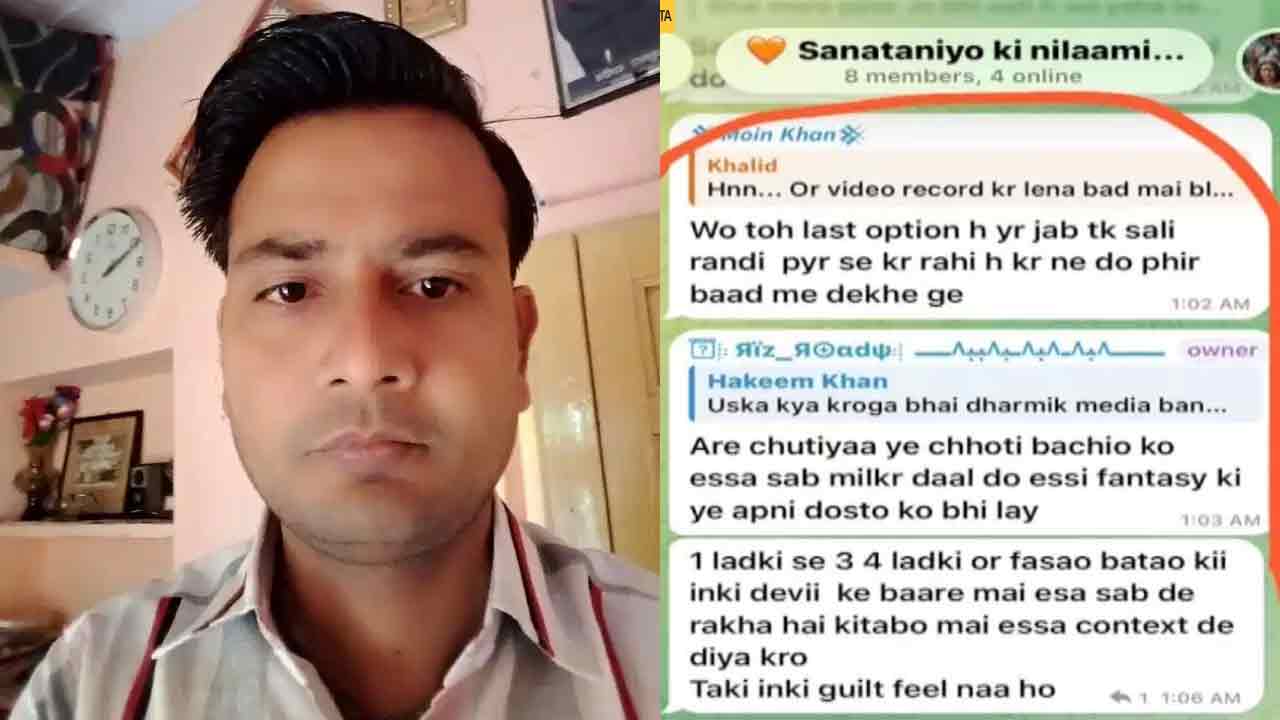
Case Summary
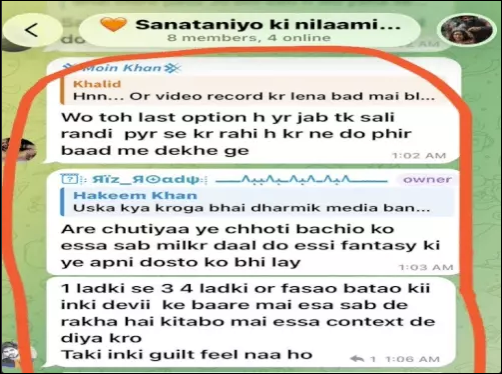
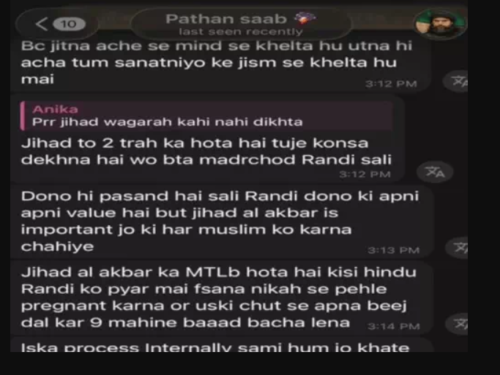
In Kota, Rajasthan, police uncovered an organised network targeting Hindu women and minor girls for religious conversion after a Muslim man, identified as Moin Khan was arrested. The arrest was made based on a complaint lodged by the Hindu organisation Bajrang Dal after they found over 40,000 obscene videos depicting Hindu girls with explicit religious symbols, including sindoor, mangalsutra, bindis, and other markers of Hindu identity, in the accused's phone. The accused and his gang were luring Hindu women and girls into relationships, then blackmailing them for conversion. Moin Khan was associated with several Telegram, WhatsApp, Snapchat, and Discord groups, including channels named "Sanataniyon Ki Nilami", “Pathan Saheb”, “Auction of Sanatanis”, “Dominance of Muslim Sandos”, “Telegram Interfaith”, and “Inter Love Zone”, where discussions centred on targeting Hindu girls and women for conversion through "love jihad" and "rape jihad". The accused also talked about impregnating and converting Hindu girls to Islam under the name of "jihad." Bajrang Dal confirmed that the material was being created, collected, and circulated to humiliate Hindu women, blackmail victims, and facilitate further targeting of Hindu girls for the explicit purpose of conversion to Islam. Audio recordings recovered from the phone reportedly contained conversations about sexually exploiting married Hindu women while ensuring that their mangalsutras and sindoor remained visible in the recordings. The conversations also included derogatory remarks about Hindu deities. According to the complaint, the material was intended not only to exploit individual victims but also to insult Hindu religious symbols and denigrate Hinduism. The complainant further stated that the accused maintained contact for several years with individuals linked to Pakistan through encrypted social media platforms, including Telegram, Snapchat, and Discord. According to Bajrang Dal, these networks were engaged in identifying, grooming, converting, and exploiting Hindu girls and women. One audio recording reportedly featured a Pakistan-based individual discussing the activities and confirming his involvement. Bajrang Dal further said that the online groups promoted a coordinated strategy referred to as "Jihad al Akbar", under which Muslim men were encouraged to lure Hindu girls into relationships, impregnate them before marriage, and subsequently compel them to convert to Islam. The organisation also stated that converted Hindus were used to identify and lure other Hindu girls and women into the network. According to the complaint, the groups discussed creating obscene content featuring Hindu women with visible religious symbols, recording such material to blackmail victims, and sharing it across multiple online channels. The complainant further stated that several such channels promoting sexual exploitation of Hindu women were being operated from Pakistan. According to Bajrang Dal, Moin Khan was born a Hindu and was originally known as Manish Sharma. The organisation stated that he had converted to Islam and had come under suspicion following complaints received through its helpline regarding his activities. At the time of documenting this incident, the police were investigating the circumstances surrounding Manish Sharma's conversion to Islam, the authenticity of the digital evidence recovered from his devices, and the cross-border links connected to the case. Based on the complaint filed on 15 June 2026, Udyog Nagar Police registered a case against Moin Khan under multiple provisions of the Bharatiya Nyaya Sanhita and the Information Technology Act. Police subsequently arrested the accused and launched an investigation into his activities, including his suspected links with individuals based in Pakistan.
Case Images
Why it is Hate Crime ?
This incident has been added to the database under various categories. The first is- Predatory Proselytisation. Within this, the subcategory selected is- Harassment, threats, coercion for conversion. Harassment covers a wide range of behaviours of an offensive nature. It is commonly understood as behaviour that demeans, humiliates, and intimidates a person, including threats and coercion. Harassment and threats, in this case, find their root on discriminatory grounds which has the effect of nullifying a person’s rights or infringing upon his freedom to exercise his right specifically owing to the victim’s religious identity. Verbal and physical threats and psychological or physical harassment are often used against Hindu victims because they choose to practice their professed religion. Religious harassment also includes forced and involuntary conversions by harassment, threats or coercion. Coercion includes intimidatory tactics like force-feeding a Hindu victim beef to convert to another religion, forceful circumcision etc. In several cases documented, non-Hindu perpetrators or those who harbour specific animosity towards Hinduism, harass victims simply based on their religious identity. Such cases often also include harassment to ensure the Hindu victim abandons his/her professed religion and adopts the religion of the perpetrator. Such cases where Hindu victims are harassed to convert to the perpetrator’s religion are rooted in animosity towards the victim’s religious identity and are therefore documented as religiously motivated hate crimes. The second subcategory selected is- Attempting to convert/converting by denigrating Hinduism. Harassment covers a wide range of behaviours of an offensive nature. It is commonly understood as behaviour that demeans, humiliates, and intimidates a person, including threats and coercion. Harassment and threats, in this case, find their root on discriminatory grounds which has the effect of nullifying a person’s rights or infringing upon his freedom to exercise his right specifically owing to the victim’s religious identity. Verbal and physical threats and psychological or physical harassment are often used against Hindu victims because they choose to practice their professed religion. Religious harassment also includes forced and involuntary conversions by harassment, threats or coercion. Coercion includes intimidatory tactics like force-feeding a Hindu victim beef to convert to another religion, forceful circumcision etc. In several cases documented, non-Hindu perpetrators or those who harbour specific animosity towards Hinduism, harass victims simply based on their religious identity. Such cases often also include harassment to ensure the Hindu victim abandons his/her professed religion and adopts the religion of the perpetrator. Such cases where Hindu victims are harassed to convert to the perpetrator’s religion are rooted in animosity towards the victim’s religious identity and are therefore documented as religiously motivated hate crimes. The other subcategory is- Proselytisation by grooming, brainwashing, manipulation or subtle indoctrination. Within this, the tertiary categories are- Pattern of targeting Hindus and Conversion of minors. Religious brainwashing essentially means the often subtle and forcible indoctrination to induce someone to give up their religious beliefs to accept contrasting regimented ideas. Religious grooming or brainwashing also involves propaganda and manipulation. It involves the systematic effort, driven by religious malice and indoctrination, to persuade “non-believers’ to accept allegiance, command, or doctrine to and of a contrasting faith. Cases of such grooming or brainwashing are far more nuanced than direct threats, coercion, inducement and violence. In such cases, it is often seen that there is repeated, subtle and continual manipulation of the victim to induce disaffection towards their own faith and acceptance of the contrasting faith of the perpetrator. While subtle indoctrination is widely acknowledged as predatory, an element which is often understated in such conversions or the attempts of such conversion is the role of loyalty and trust which might develop between the perpetrator and the victim. Fiduciary relationships are often abused to affect such religious conversion. For example, an educator transmitting religious doctrine of a competing faith to a Hindu student. The Hindu student is likely to accept what the teacher is transmitting owing to existence of the fiduciary relationship. The exploitation of the fiduciary relationship to religiously indoctrinate victims would also be included in this category. Since the underlying animosity towards the victim’s faith forms the basis of predatory proselytization, such cases are considered religiously motivated hate crimes. The next category is- Attack not resulting in death, and within this, the subcategory selected is- Attacked for Hindu identity. In several cases, Hindus are attacked merely for their Hindu identity without any perceived provocation. A classic example of this category of religiously motivated hate crime is a murder in 2016. 7 ISIS terrorists were convicted for shooting a school principal in Kanpur because they got ‘triggered’ seeing the Kalava on his wrist and the tilak that he had put. In this, the Hindu victim had offered no provocation except for his Hindu religious identity. The motivation for the murder was purely religious, driven by religious supremacy. Such cases where Hindus are targeted merely for their religious identity would be documented as a hate crime under this category. The other primary category relevant here is- Hate speech against Hindus, and within this, the subcategory is- Anti-Hindu slurs, mocking faith. Anti-Hindu slurs and the deliberate mocking of the Hindu faith owing to religious animosity involve the usage of derogatory terms, stereotypes, or offensive references to religious practices, symbols, or figures. One of the common anti-Hindu slurs used against Hindus is “cow-worshipper” and “cow piss drinker”. The intention of using this term is to demean and mock Hindus as a group and their religious beliefs since Hindus consider the cow holy. Additionally, some symbols and the slurs attached to them have a historical context that exacerbates the insult, hate, stereotyping, dehumanisation and oppression against Hindus. Cow worship has been used for centuries to denigrate Hindus, insult their faith and oppress Hindus specifically as a religious group. There has been overwhelming documentation about how cow slaughter has been used to persecute Hindus with cow meat being thrown in temples and places of worship. There has also been overwhelming documentation where cow meat (beef) has been force-fed to Hindus to either forcefully convert them to Islam or denigrate their faith. Apart from cow worship, the Swastika – which holds deep religious significance for the Hindus – has also been misinterpreted and distorted to use as a slur against Hindus. Similarly, the worship of the Shivling has been used by supremacist ideologies and religions to denigrate Hindus owing to religious animosity. Such slurs and denigration stem out of inherent animosity and hate towards Hindus and their faith, therefore, it is categorised as hate speech targeted at Hindus specifically owing to their religious identity. This case constitutes a religiously motivated hate crime because Hindu women were systematically identified and targeted for religious conversion, sexual exploitation, and humiliation on the basis of their religious identity. The facts of the case indicate that the victims were not chosen at random. The online networks were specifically dedicated to targeting Hindu girls and women, demonstrating that their Hindu identity formed the basis of victim selection. A particularly significant aspect of the case is the organised nature of the operation. According to the complaint, multiple Telegram, WhatsApp, Snapchat, and Discord groups were being used to identify Hindu girls and women, lure them into relationships and exploit them sexually with the ultimate aim to convert them to Islam. The discussions among members of the network centred specifically on Hindu women, indicating that religion was not incidental but the defining criterion for selecting victims. The recovery of more than 40,000 obscene videos and images depicting Hindu girls and women with visible Hindu religious symbols further reinforces the communal nature of the offence. The victims' sindoor, mangalsutra, bindis, Om pendants, and other Hindu religious markers were reportedly kept clearly visible in the recordings. Their religious identity was therefore not concealed but deliberately highlighted, making the humiliation inseparable from their identity as Hindu women. The audio conversations recovered from the accused's phone provide further insight into the network's objective. The conversations included discussions about sexually exploiting Hindu women while ensuring that their Hindu religious symbols remained visible in the recordings. They also contained derogatory remarks about Hindu deities. This demonstrates that the objective extended beyond the exploitation of individual victims. It sought to humiliate Hindu women because they were Hindu and simultaneously denigrate Hindu religious symbols and beliefs. The complaint further states that Hindu women were lured into relationships, pressured to convert to Islam, and blackmailed using intimate photographs and videos. Such methods are designed to isolate victims, break their resistance, and make them more vulnerable to religious conversion. The complaint also states that converted Hindus were used to identify and lure other Hindu girls into the network, indicating a structured mechanism through which the targeting could be expanded. The reported links with Pakistan-based individuals further strengthen the indication that the activities were not isolated acts of sexual exploitation but formed part of a broader campaign directed specifically against Hindu women. The stated objective of circulating such material was to insult Hindu religious symbols, denigrate Hinduism, and facilitate the conversion of Hindu women on a larger scale. Religious conversion is a matter of individual conscience and free choice. When Hindu women are specifically identified, groomed, sexually exploited, blackmailed, and pressured to convert because of their religious identity, the conduct ceases to be an interpersonal offence and becomes an act of religiously motivated victimisation. The purpose here is not emotional or personal but strategic. The ultimate goal is to alienate the victim from her Hindu faith and assimilate her into a different religious identity. Once that goal is achieved, the victim is frequently discarded, as her "use" in this ideological mission is considered complete. This pattern stems from a supremacist interpretation of Abrahamic religious doctrine, where those who do not follow the same faith are viewed as inferior, impure, or needing to be corrected. In such a worldview, conversion is not an invitation but an obligation. The non-believer is not respected as different, but is dehumanised until they conform. As a result, Hindus are often targeted not for personal reasons but because of their religious identity. The violence, manipulation, and betrayal involved in these cases are not isolated acts of cruelty but manifestations of an underlying ideological hostility towards Hinduism, its traditions, and its followers. This is why such cases must be recognised and documented as religiously motivated hate crimes. The victims are not just exploited individuals; they are Hindus targeted for being Hindu. Disclaimer: Hinduphobia Tracker acknowledges the involvement of multiple individuals operating as part of an organised network. However, only Moin Khan has been named as an accused in the First Information Report and arrested at the time of writing. Accordingly, the perpetrator count has been recorded as one.


Case Status
Arrested


Perpetrators Details
Perpetrators
Muslim Extremists
Perpetrators Range
One Person
Perpetrators Gender
male
 Sources




