Tribal Hindus discriminated and excluded from government scheme due to their faith identity, while benefits given to tribal Christians in Gujarat
 Songadh, Gujarat, India
  21 June, 2026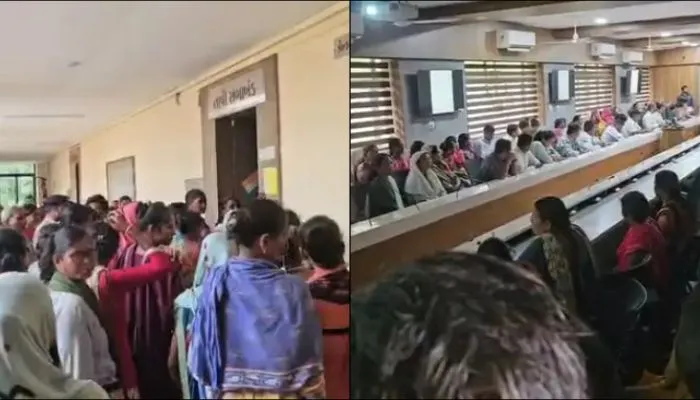
Case Summary
In the Tapi district of Gujarat, several Hindu tribal women from multiple villages in Songadh taluka stated that they were being discriminated against in the allocation of Pradhan Mantri Awas Yojana (PMAY, a government housing scheme) benefits. They revealed that housing assistance under the scheme was being provided only to converted Christian tribal families while Hindu tribal families were being excluded. The issue came to light when a large group of women from Chimer, Medha, Dhanmoli and Khanjar villages reached the District Collector’s office during a district-level public grievance programme held on Monday, 22 June 2026. They submitted a formal representation and demanded justice, stating that despite long-standing government welfare schemes, many poor and genuinely eligible tribal Hindu families were still denied proper housing due to their Hindu identity. In their complaint, the women stated that at the local implementation level of the Pradhan Mantri Awas Yojana and other welfare schemes, housing benefits were being extended mainly to converted Christian families, while Hindu tribal families were being deliberately and continuously excluded. They stated that due to this pattern of allocation, several eligible poor households were deprived of housing assistance. The protesting women further said they had repeatedly raised these concerns with local authorities over time, but had not received any meaningful response. According to them, despite decades of welfare programmes, the basic housing needs of many families in the region remained unmet. Local Hindu leaders, as cited in the complaint, stated that during village-level surveys conducted for housing schemes, the general public was not properly informed, and key information was not transparently shared. They further stated that only influential individuals connected to local leadership were repeatedly selected for benefits, with some families receiving housing assistance more than once, while many needy households continued to remain without shelter. After the representation was submitted, the administration concluded the ‘welcome’ programme by providing only general guidance regarding the housing scheme, which led to dissatisfaction among the tribal Hindu women present. The women stated that they were not satisfied with procedural guidance alone and demanded a permanent solution. They called for equal and fair allocation of housing benefits to all eligible beneficiaries and urged the administration to take concrete action in response to the concerns raised. Notably, Pradhan Mantri Awas Yojana (PMAY) is a flagship Government of India housing initiative launched to ensure “Housing for All” by providing financial assistance and subsidies to economically weaker sections, low-income groups, and other eligible beneficiaries for constructing or improving pucca houses with basic amenities such as sanitation, electricity, and water supply, with implementation carried out through central and state coordination in both rural and urban areas.
Why it is Hate Crime ?
In this case, the primary category selected is: Attack not resulting in death. The subcategory selected is: Attacked for Hindu identity. In several cases, Hindus are attacked merely for their Hindu identity without any perceived provocation. A classic example of this category of religiously motivated hate crime is a murder in 2016. 7 ISIS terrorists were convicted for shooting a school principal in Kanpur because they got ‘triggered’ seeing the Kalava on his wrist and tilak that he had put. In this, the Hindu victim had offered no provocation except for his Hindu religious identity. The motivation for the murder was purely religious, driven by religious supremacy. Such cases where Hindus are targeted merely for their religious identity would be documented as a hate crime under this category. This incident from Tapi district, Gujarat, establishes a documented case of institutional religious discrimination against Hindu tribals in the administration of government welfare programs. Hindu tribal families were systematically excluded from receiving housing benefits under the Pradhan Mantri Awas Yojana (PMAY), while these exact benefits were granted to converted Christian tribal families. This pattern of exclusion based on religious affiliation demonstrates differential treatment by state authorities and highlights a targeted disadvantage imposed on Hindu tribals. The evidence indicates direct partiality and systemic bias in the distribution of public welfare resources, where access to essential state support was determined by religious identity rather than objective need. State welfare schemes operate under strict constitutional and legal mandates of equal eligibility, which dictate that any individual or family meeting the established socio-economic criteria must receive uniform, non-discriminatory treatment, completely irrespective of their religion, belief, or community identity. Under the framework of governance, the state is legally and ethically bound to maintain absolute neutrality and secular objectivity when executing public welfare programs, a principle that carries even greater weight in flagship initiatives like the Pradhan Mantri Awas Yojana (PMAY), which are explicitly designed to uplift economically vulnerable, marginalised, and historically disadvantaged tribal populations. In this specific instance, however, the administrative machinery deviated entirely from these core tenets; qualified Hindu tribal families, despite meeting every requisite socio-economic benchmark, were systematically denied access to housing benefits, while converted Christian tribal families were actively accommodated and prioritised within the allocation framework. This selective distribution of public resources represents a direct violation of the principle of equality before the law, as enshrined in constitutional guarantees, and marks a severe breakdown of neutral governance. By allowing religious identity to override objective, verifiable socio-economic criteria, the implementing authorities transformed a need-based poverty alleviation scheme into a tool of targeted exclusion, establishing a dangerous precedent where state-administered welfare is improperly influenced by religious affiliation. This demonstrates an institutional religious hostility toward Hindus by weaponising state resources into a mechanism of targeted economic deprivation. This hostility is structurally manifested through the deliberate creation of an administrative hierarchy that treats Hindu identity as a disqualifying factor for basic survival necessities, effectively replacing objective, need-based criteria with identity-based discrimination. By withholding state-mandated housing benefits exclusively from the Hindu population, the administrative apparatus exerts immense, coercive socio-economic pressure on a highly vulnerable demographic, sending a clear signal that maintaining their faith results in systemic neglect and the erasure of their legal entitlements. Ultimately, this selective denial of public welfare goes beyond mere bureaucratic failure; it represents an active, quiet animus that leverages the power of the state to penalise Hindu citizens for their religious identity and exacerbate the marginalisation of the Hindu tribal community. This exclusionary practice produces severe social and structural impacts on the affected Hindu tribal communities. When the allocation of essential resources like institutional housing is tied to religious affiliation, it enforces systemic marginalisation and alienates the Hindu community from civic structures. This institutional bias essentially portrays that adhering to Hindu religious identity serves as a direct barrier to receiving state entitlements. For vulnerable populations, such discriminatory frameworks generate acute socio-economic pressure and identity-based insecurity, effectively leveraging state resources in a manner that incentivises religious conversion as the sole mechanism to avoid administrative neglect. Consequently, since this case meets several parameters of a religiously driven hate crime, it is being added to the hate crime database of the Hinduphobia Tracker. Disclaimer: The Hinduphobia Tracker records incident dates based on when the victim’s ordeal is understood to have begun, rather than the date of media reporting. However, in the present case, media reports did not specify the exact date from which the exclusion of Hindu tribal families from the scheme benefits had begun. Henceforth, for documentation purposes, the date on which the matter came to light, 22 June 2026, when Hindu tribal women presented their complaint before the District Collector’s office, is being used as the indicative incident date.


Case Status
Complaint filed


Perpetrators Details
Perpetrators
State and Establishment
Perpetrators Range
Unknown
Perpetrators Gender
unknown
 Sources




