Hindu minor girl found dead in pond after kidnapping in Bangladesh amidst ongoing persecution of Hindu minorities
 Tangail District, Bangladesh
  19 June, 2026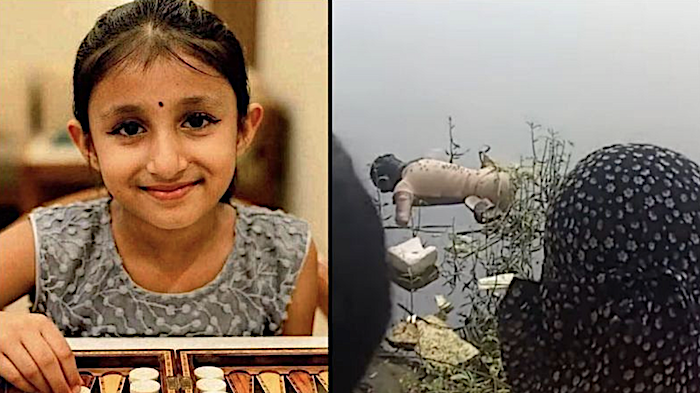
Case Summary
An eight year old Hindu girl disappeared from her home in Sakhipur, Tangail district, Bangladesh, and never returned. Two days later, her body was recovered from a pond in the municipality. The child had vanished suddenly, triggering a frantic search by her family and widespread concern in the area. The deceased, Senjuti, was the daughter of Falu Chandra Malu, a Hindu resident of the Mandirpara area of Sakhipur Municipality. She was a second grade student at Sakhipur Adarsh Shishu Kanan Pre Cadet School and lived with her family in Sakhipur, Tangail district. On the afternoon of 20th June 2026, at around 4 pm, the Hindu girl went missing from her home. When she did not return, her family immediately began searching for her in different locations across the area. As the hours passed without any trace of the child, concern and panic spread among family members and local residents. On the night of 20th June 2026, Senjuti's father, Falu Chandra Malu, approached Sakhipur Police Station and filed a general diary regarding the disappearance of his daughter. The search for the child continued throughout the following day, with relatives and residents attempting to locate her. On the night of 21st June 2026, members of the girl's family received a telephone call demanding a ransom of three lakh taka in exchange for Senjuti's release. The call indicated that the child had been abducted and was being held by those demanding money from her family. The ransom demand came after the child had already been missing for more than a day and intensified fears regarding her safety. In the early hours of 22nd June 2026, local residents noticed the body of a child floating in the Upazila Parishad pond in Sakhipur Municipality. They informed the police, who arrived at the scene and recovered the body at around 8.30 am. The deceased was identified as eight year old Hindu girl Senjuti. The discovery of the child's body brought an end to the search that had gripped the area for two days. Her father, Falu Chandra Malu, stated that his daughter had been killed and her body had been thrown into the pond. He demanded justice and sought the apprehension and punishment of those responsible for her death. Police subsequently sent the body to Tangail General Hospital for a post mortem examination. An investigation was initiated to determine the circumstances surrounding the kidnapping and death of the minor Hindu girl and to identify those responsible. Legal proceedings and further investigation into the case remained underway. This escalation of violence against Hindus in Bangladesh unfolded in three distinct phases. The first followed the ouster of Sheikh Hasina's government in August 2024. During this period, attacks on Hindu homes, temples, and religious institutions were documented across multiple districts. Hindu neighbourhoods faced intimidation campaigns, arson attacks, mob violence, and destruction of property. The Hinduphobia Tracker documented 336 incidents targeting Hindus during this period, highlighting the scale of violence faced by the minority community. A second phase emerged following the death of Sharif Osman Bin Hadi on 18th December 2025. Hadi, a Muslim political activist known for anti-Hindu and anti-India rhetoric, was killed during clashes in Dhaka. Following his death, Hindu communities were subjected to retaliatory attacks in several areas. Hindu homes were set on fire, families were displaced, and Hindu neighbourhoods faced organised violence. The Hinduphobia Tracker documented 51 incidents of anti-Hindu violence during this period alone. Among the victims was Dipu Chandra Das, who was lynched and his body burned following false blasphemy accusations. Reports from this period also documented public displays of material calling for the extermination of Hindus. Combined with incidents of arson, vandalism, assault, intimidation, and attacks on religious sites, these developments reflected a broader environment of hostility directed towards Bangladesh's Hindu minority. A third phase of violence emerged following the 13th National Parliamentary Election 2026. In the aftermath of the election results, Hindu families in districts including Noakhali, Rangpur, Nilphamari, Sylhet, Thakurgaon, and Dinajpur reported attacks involving looting, arson, assault, vandalism of homes, and destruction of temples. Hindu properties were selectively targeted, and families faced threats of displacement. These incidents further reinforced concerns regarding the security of Hindu communities across the country.
Why it is Hate Crime ?
This case was added to the tracker under the primary category - Attack resulting in death. The subcategory selected was - Attacked for Hindu identity. In several cases, Hindus are attacked merely for their Hindu identity without any perceived provocation. A classic example of this category of religiously motivated hate crime is a murder in 2016. 7 ISIS terrorists were convicted for shooting a school principal in Kanpur because they got ‘triggered’ seeing the Kalava on his wrist and tilak that he had put. In this, the Hindu victim had offered no provocation except for his Hindu religious identity. The motivation for the murder was purely religious, driven by religious supremacy. Such cases where Hindus are targeted merely for their religious identity would be documented as a hate crime. Under this category, cases where the attack led to the death of the Hindu victim/s would be documented. This case has been added to the tracker because the victim was an eight-year-old Hindu girl belonging to a religious minority community that has faced sustained and widespread persecution in Bangladesh. The murder of a minor Hindu child cannot be viewed in isolation from the broader environment in which it occurred. Since 2024, Bangladesh has witnessed repeated incidents of violence, intimidation, attacks on Hindu homes and temples, forced displacement, and targeted crimes against members of the Hindu minority community. Within such an environment, Hindu identity itself has become a marker of vulnerability, where ordinary acts of daily life, including the safety of women and children, have increasingly been overshadowed by fear and insecurity. The killing of a minor Hindu girl carries a particularly grave religious dimension because children represent the most defenceless and vulnerable section of any community. Violence resulting in the death of a Hindu child extends beyond the immediate victim and inflicts collective trauma upon the wider Hindu community. Such incidents reinforce the perception that even young Hindu children are not insulated from harm despite their complete inability to pose any threat or participate in social, political, or communal disputes. The destruction of a child's life therefore generates fear that Hindu identity alone may be sufficient to render even the most vulnerable members of the minority community susceptible to violence. Although the available information does not contain an explicit declaration of religious motive behind the kidnapping and killing, the absence of an openly articulated anti-Hindu statement does not negate the possibility of religious targeting in a context of entrenched persecution. Patterns of communal violence often operate through an atmosphere where hostility towards a minority community becomes normalised and embedded within society. In such circumstances, perpetrators do not necessarily need to proclaim anti-Hindu motives for Hindu victims to be selected or for crimes against them to acquire a religious dimension. The prevailing environment itself shapes vulnerabilities and influences the risks faced by members of the targeted community. The fact that the victim was a young Hindu girl is particularly significant within Bangladesh's contemporary anti-Hindu landscape. Attacks and acts of violence affecting Hindu children create disproportionate fear because they symbolise that an entire community, including its most vulnerable members, remains exposed to danger. Crimes against Hindu minors resonate far beyond the individual victim and contribute to a broader sense of insecurity among Hindu families, who are left with the perception that neither childhood nor family life offers protection from violence. This case must therefore be assessed within the wider context of the persecution faced by Hindus in Bangladesh, where repeated attacks against the minority community have created a persistent climate of fear and vulnerability. The death of a minor Hindu girl during this period cannot be divorced from that reality. The victim's status as a member of a persecuted religious minority, combined with the broader pattern of anti-Hindu hostility and insecurity prevailing across the country, supports the conclusion that this case constitutes probable religious targeting and warrants documentation within the wider record of violence faced by Hindus in Bangladesh. Given Bangladesh's sustained anti-Hindu persecution environment, this case meets all thresholds for inclusion in the Hinduphobia Tracker's hate crime database.
Victim Details
Total Victim
1
Deceased
1
Gender
- Male 0
- Female 1
- Third Gender 0
- Unknown 0
Caste
- SC/ST 0
- OBC 0
- General 0
- Unknown 1
Age Group
- Minor 1
- Adult 0
- Senior Citizen 0
- Unknown 0


Case Status
Complaint filed


Perpetrators Details
Perpetrators
Unknown
Perpetrators Range
Unknown
Perpetrators Gender
unknown
 Sources




