Hindu religious sentiments outraged as multiple idols belonging to the Shiva family vandalised inside Hindu temple
 Iglas, Uttar Pradesh, India
  22 June, 2026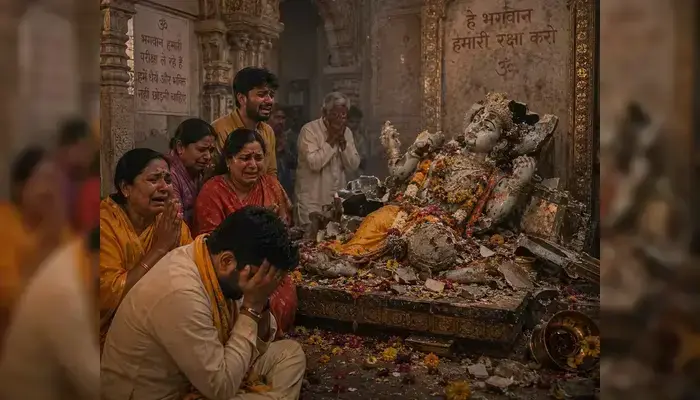
Case Summary
In Kaimavali village under the Iglas area of Uttar Pradesh, Hindu religious sentiments were hurt after a temple priest vandalised multiple idols belonging to the Shiva family inside a Hindu temple. The incident occurred at the Shiva temple established by a local resident, Kanhaiyalal, where Swami Vishweshwaranand, a native of Ahmednagar in Maharashtra, had been serving as the priest since 22 February 2026. Villagers who arrived at the temple for darshan on 23 June 2026 discovered that idols associated with Lord Shiva's family had been damaged, creating shock and outrage among devotees. The destruction of the sacred idols disturbed the religious atmosphere of the village and triggered tensions among residents. Following the discovery, the priest initially attempted to mislead villagers by attributing the vandalism to unknown individuals. However, after sustained questioning, he admitted to having damaged the idols himself. He told police that he had embraced sanyas decades earlier and worshipped only Lord Shiva. He further said that he did not consider the other deities of the Shiva family to be in harmony with his beliefs and therefore broke the idols, except for Lord Shiva. His actions sparked anger among villagers, many of whom called the desecration of the sacred idols an act of disrespect towards Hindu religious traditions and beliefs. After receiving information about the incident, police reached the temple and took the priest into custody. A complaint was lodged by Kanhaiyalal, following which a case was registered against the accused. Police authorities stated that legal action was initiated, and the priest was sent to jail. The incident attracted significant attention in the area, with villagers expressing strong resentment over the destruction of the revered idols and the disruption caused at a place of Hindu worship.
Why it is Hate Crime ?
This case has been added to the tracker under the primary category of - Attack on Hindu religious representation. Within it, the sub-category selected here is - Desecration of Hindu religious symbols. Icons and symbols or a religious representation of a spiritual ideal are widely revered in Hinduism. Iconography is of vital significance in the Hindu milieu. It helps connect people’s spiritual beliefs with the real world. Iconography within the Hindu faith takes several shapes and forms. Murtis are of most significance to Hindus, to which daily rituals, prayers and offerings are done. Besides the murtis, there are several other symbols which have deep significance in the Hindu faith – the Om and Swastika for example. Since these Hindu religious symbols hold paramount importance in Hinduism, any desecration of symbols, icons, murtis, religious representations and manifestations, is driven by animosity towards the faith itself which manifests itself through these murtis, icons and symbols. Therefore, any desecration of these Hindu religious symbols and representations is considered religiously motivated hate crimes under this category. This case has been added to the tracker because it involved the deliberate desecration and destruction of consecrated Hindu deities inside a Hindu temple, causing an insult to the religious sentiments of Hindu devotees and disrupting the sanctity of a sacred place of worship. In Hinduism, temple idols are not regarded as mere decorative objects or symbolic representations. Through the process of consecration (Pran Pratishtha), they are revered as living embodiments of the divine and serve as focal points of worship for devotees. The intentional destruction of such idols therefore, constitutes not only damage to religious property but also an act that directly undermines the faith, beliefs, and devotional practices associated with those deities. A particularly significant aspect of this incident was that the accused priest selectively targeted and destroyed the idols of the Shiva family while leaving the idol of Lord Shiva intact. By his own admission, he acted because he personally accepted only Lord Shiva and rejected the other deities. This was not a case of accidental damage, negligence, or a spontaneous outburst. Rather, it was a conscious act motivated by hostility towards specific Hindu deities that were objects of worship in the temple. Such conduct amounted to an attack on sacred figures revered by devotees and represented an attempt to impose the priest's personal theological preferences through the physical destruction of religious icons that others held sacred. The incident also carried a broader communal and religious dimension because Hindu worship is often centred on the interconnected reverence of deities and divine families. Deliberately desecrating idols worshipped by devotees because of personal dislike or rejection of those deities displayed disregard for the religious beliefs of the Hindu community that visited the temple. The act was therefore not merely directed at stone or metal idols but at the faith and devotional sentiments attached to them. Further, the temple and its idols were not the personal property of the priest. The temple existed as a place of worship for devotees, and the idols were installed for public veneration. As the appointed custodian of the temple, the priest was entrusted with the responsibility of preserving and serving the sacred space, not exercising ownership over it. If he genuinely believed that he could not perform worship involving certain deities, he had several lawful and respectful alternatives available to him. He could have declined the role of priest in the first place, resigned from his position, or informed the temple management and devotees of his objections. If he believed the idols should no longer remain in that temple, established Hindu religious traditions provide procedures for respectfully relocating or ceremonially transferring consecrated idols to another temple. Instead of pursuing any of these legitimate options, he chose to vandalise and destroy the sacred images. The deliberate destruction of consecrated Hindu idols entrusted to his care transformed a personal theological preference into an act that harmed a place of worship and offended the religious sentiments of devotees. For these reasons, the incident was categorised as a hate crime targeting Hindu religious beliefs, sacred symbols, and places of worship.


Case Status
Arrested


Perpetrators Details
Perpetrators
Others
Perpetrators Range
One Person
Perpetrators Gender
male
 Sources




