Hindu religious landmark covered with cloth, devotees barred from worship by district administration in Muzaffarnagar during Muharram procession
 Muzaffarnagar, Uttar Pradesh, India
  22 June, 2026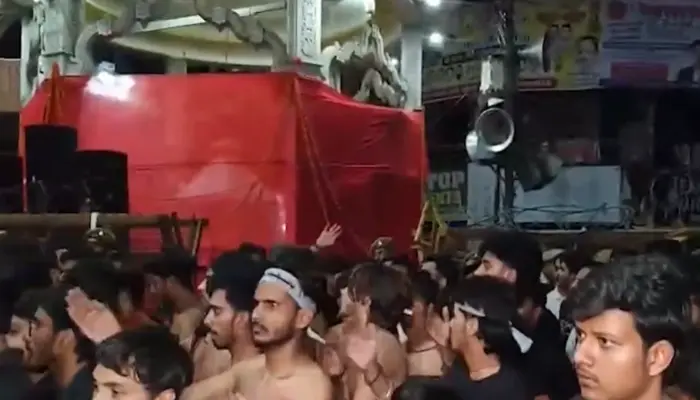
Case Summary
In Muzaffarnagar, Uttar Pradesh, the Shiv Chowk, a prominent Hindu religious landmark associated with the worship of Bhagwan Shiva, was covered with cloth by the district administration during a Muharram procession on 23 June 2026. Furthermore, Hindu devotees were also restricted from performing worship and religious rituals at the site while the procession passed through the area. According to reports, the Muharram procession commenced from Moti Mahal and travelled through Khalapar and Shiv Chowk along its designated route on 23 June 2026, drawing participation from a large number of Muslims. Under the guise of security arrangements, the district administration erected barricades around Shiv Chowk, deployed additional police personnel and stationed senior police and administrative officials at key points along the route. Visuals from the event showed the Shiv Chowk structure/temple covered with red cloth while the procession moved through the locality under police supervision. Furthermore, Hindu devotees were also restricted from performing any ritual or worship at the site during the procession. The police officials claimed that the measure was undertaken to maintain law and order, prevent any untoward incident and ensure that the religious sentiments of all communities were respected. Muzaffarnagar Additional Superintendent of Police Siddharth Kumar Mishra said that extensive security arrangements had been made for the procession, which was regarded as one of the city's major Muharram events. He further said that sensitive locations along the route were closely monitored and that the procession concluded peacefully without any reported disturbance. The covering of Shiv Chowk, widely regarded as a significant symbol of Hindu faith in Muzaffarnagar, attracted public attention and generated discussion on social media, where videos and photographs of the cloth-covered structure circulated widely following the event.
Why it is Hate Crime ?
This case has been added to the tracker under the primary category of - Restriction/ban on Hindu practices. Within it, the sub-category selected here is - Administration restricting religious practice. In several cases, it is seen that the administration/state disallows a religious practice owing to prejudicial orders and concerns, targeted specifically against the Hindu community. Such restriction/prohibition would be considered documented as a hate crime because the orders are often a result of pressure by groups that harbour animosity towards Hinduism and Hindus. Often, the restriction by the authorities is driven by bias, hostility, or prejudice against the specific community being stopped from holding a religious practice, by pressure groups that harbour animosity towards Hindus, intrinsic to their faith. Since practices are intrinsic to the faith of the Hindus, such prejudicial restriction is considered a curtailing of the fundamental rights of the Hindu community. In several cases, for example, the authorities ban a Hindu religious practice due to pressure from groups opposed to the religion. In other instances the prohibition is selectively enforced against one religious group (Hindus) while others are allowed to proceed. There are still other cases where the authorities preemptively restrict a religious practice by Hindus because those who hold animosity towards Hindus may get “provoked” leading to them being violent, thereby assuaging the sentiments of those who hold animosity towards Hindus by curtailing the religious rights of Hindus. Such acts and orders are prejudiced, indicating discriminatory motives owing to the capitulation to groups that harbour animosity towards Hindus and therefore, would be categorized as a religiously motivated hate crime since the original pressure leading to the order itself is a result of hatred/bias/prejudice/religious hate against Hindus. The other sub-category selected here is - Attack on Hindu religious representations. Within it, the sub-category selected here is - Desecration of Hindu religious symbols. Icons and symbols or a religious representation of a spiritual ideal are widely revered in Hinduism. Iconography is of vital significance in the Hindu milieu. It helps connect people’s spiritual beliefs with the real world. Iconography within the Hindu faith takes several shapes and forms. Murtis are of most significance to Hindus, to which daily rituals, prayers and offerings are done. Besides the murtis, there are several other symbols which have deep significance in the Hindu faith – the Om and Swastika for example. Since these Hindu religious symbols hold paramount importance in Hinduism, any desecration of symbols, icons, murtis, religious representations and manifestations, is driven by animosity towards the faith itself which manifests itself through these murtis, icons and symbols. Therefore, any desecration of these Hindu religious symbols and representations is considered religiously motivated hate crimes under this category. This case has been included in the Hinduphobia tracker because it involved the concealment of a prominent Hindu religious site and the restriction of Hindu religious practices at that site in order to facilitate a Muslim religious procession and appease the Muslim community. Shiv Chowk is not merely a public landmark but one of the most significant symbols of Hindu faith in Muzaffarnagar, associated with the worship of Bhagwan Shiva and revered by countless Hindu devotees. The decision of the district administration to cover the Shiv Chowk structure with cloth during the Muharram procession effectively obscured a visible Hindu religious symbol from public view and interfered with the normal religious character of the site. The restriction on Hindu devotees from performing worship and religious rituals at the location further transformed the incident from a mere administrative arrangement into a matter directly affecting the religious rights and freedoms of Hindus. A particularly troubling aspect of the incident was that the burden of maintaining public order was placed upon a Hindu religious site and its devotees rather than upon the Muslims, who would potentially object or cause ruckus to its visibility or continued functioning. Instead of ensuring that the Muharram procession proceeded peacefully alongside an existing and visible Hindu religious landmark, the administration chose to conceal the Hindu structure from public view and limit access to it. Such an approach implicitly treated the continued visibility of a Hindu religious symbol as a potential problem requiring administrative intervention. This is significant because the temple and the associated religious symbol were permanent fixtures of the locality that predated the procession route and formed an established part of the area's religious landscape. Such an approach resulted in differential treatment, where Hindu religious expression was restricted while Muslim procession continued uninterrupted. The incident also amounted to a symbolic desecration and insult to a revered Hindu religious symbol. In Hindu tradition, temples, shrines, and sacred representations of deities are not mere physical structures but embodiments of divine presence and objects of veneration. The Shiv Chowk structure is intrinsically linked with the worship of Bhagwan Shiva and occupies a sacred place in the religious consciousness of local Hindus. Covering the shrine with cloth and rendering it inaccessible to devotees during the passage of a Muslim religious procession effectively obscured and diminished its sacred visibility in the public sphere. Such treatment of a sacred Hindu site was not merely as an administrative measure but as a profound affront to the dignity, sanctity, and public expression of Hindu religious identity, thereby causing deep hurt to Hindu religious sentiments. The restriction imposed on Hindu devotees further strengthens the basis for inclusion in the tracker. The issue extended beyond the physical covering of a structure and affected the ability of Hindus to engage in customary acts of worship at a site held sacred by them. The temporary denial of religious access transformed the incident from a symbolic act into a tangible restriction on the exercise of Hindu religious practices. When Hindus are prevented from openly accessing or worshipping at their religious site in order to accommodate the Muslim religious observance, it showcases religious animosity towards Hindu religious sentiments and a preference towards Islam. The district administration claimed that the measures were necessary to maintain law and order and to respect the sentiments of all communities. However, the practical outcome of these measures was that a Hindu religious symbol was hidden from public view and Hindu religious activity at the site was curtailed. This created an imbalance whereby the religious procession proceeded unhindered while the visibility and accessibility of a Hindu sacred site were restricted. Such actions showcase institutional prejudice against Hindu religious expression because the accommodation of Muslim religious procession came at the expense of the Hindu community's ability to freely display and practise its faith. Accordingly, this case has been added to the Hinduphobia tracker as an instance of institutional discrimination against Hindu religious expression and anti-Hindu prejudice. The incident demonstrates how the actions of the Muzaffarnagar district administration under the guise of security or communal management disproportionately burden Hindu religious institutions and devotees, resulting in the restriction of Hindu worship, the suppression of Hindu religious visibility, and the erosion of the principle of equal treatment of all faiths in public spaces.


Case Status
Unknown


Perpetrators Details
Perpetrators
State and Establishment
Perpetrators Range
Unknown
Perpetrators Gender
unknown
 Sources




