320 Hindu families discriminated against amid ongoing persecution of Hindu minorities in Bangladesh, deprived of food and medical assistance for last 4 months
 Cox's Bazar District, Bangladesh
  17 June, 2026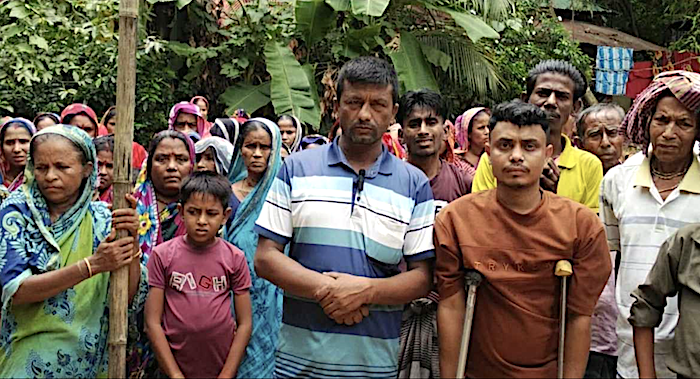
Case Summary
In Cox's Bazar district of Bangladesh, 320 Hindu refugee families residing in the Kutupalong area of Ukhia upazila stated that they had been deprived of food assistance, medical care, and other forms of humanitarian support for four consecutive months, leaving hundreds of families in severe hardship. According to the affected families, the deprivation of aid began after their names were removed from the food assistance list in 2026. The affected families said that they had been surviving without regular food rations, access to healthcare, or other essential humanitarian services for several months. Many of the families were residing in rented accommodation outside the refugee camp and were struggling to secure their basic needs. Members of the Hindu Rohingya community, including Asis Sheel and Susudhan Dhar, stated that they had not received food assistance or medical services for an extended period despite repeatedly raising the issue with the relevant authorities. They said that no effective measures had been taken to restore the aid previously available to them. Local resident Babul Sharma also raised concerns about the condition of the affected families and stated that the matter required immediate humanitarian attention because hundreds of people had been left without essential assistance for an extended period. The affected families stated that they had submitted both written and verbal complaints to the Camp In-Charge (CIC) of the Kutupalong Hindu Rohingya Camp, Shariful Islam. Despite approaching the authorities on multiple occasions, they said that no permanent solution had been provided and that the deprivation of food and medical support had continued. The affected families appealed to the relevant government authorities and humanitarian organisations to investigate the matter and restore access to food assistance, healthcare, and other basic services necessary for their survival. The incident occurred against the backdrop of continuing insecurity faced by minority Hindu communities in Bangladesh. This escalation of violence against Hindus in Bangladesh has unfolded in three distinct phases: first, following the ouster of Sheikh Hasina's government in August 2024; second, after the death of Sharif Osman Bin Hadi in December 2025; and third, in the immediate aftermath of the 13th National Parliamentary Election 2026. Following the ouster of Sheikh Hasina, multiple reports documented attacks on Hindu homes, temples, and religious institutions, alongside intimidation campaigns, arson, and mob assaults targeting minority neighbourhoods. The Hinduphobia Tracker has recorded 336 such incidents against the Hindu minority, underscoring the scale and persistence of anti-Hindu violence during this period. A further escalation occurred following the death of Sharif Osman Bin Hadi, a Muslim political activist and student leader known for his anti-Hindu and anti-India rhetoric. Hadi had been involved in political unrest after the fall of the Hasina government and was killed in Dhaka on 18th December 2025 during clashes. In the aftermath of his death, Hindu communities were blamed and subsequently targeted in retaliatory violence. Hindu homes were selectively set ablaze in multiple localities, forcing families to flee and leaving many displaced. The attacks appeared patterned rather than sporadic, with Muslim mobs focusing on Hindu neighbourhoods, properties, and religious symbols. Among the victims was Dipu Chandra Das, who was lynched to death and his body was set ablaze by a Muslim mob over false blasphemy allegations. The Hinduphobia Tracker documented 51 incidents of anti-Hindu violence in the period following Hadi's death alone. Such incidents underscored the vulnerability of the Hindu minority amid rising communal hostility and the weaponisation of religious accusations. Reports further indicated that posters and written materials calling for the extermination of Hindus were displayed in public spaces, signalling an alarming normalisation of genocidal rhetoric. When combined with acts of arson, vandalism, assault, and targeted intimidation, these developments suggested a coordinated environment of hostility aimed at terrorising the Hindu community and reinforcing majoritarian dominance. The third phase of violence was unleashed after the 13th National Parliamentary Election 2026. Within days of the announcement of results, Hindu families in districts such as Noakhali, Rangpur, Nilphamari, Sylhet, Thakurgaon, and Dinajpur reported coordinated attacks involving arson, looting, assault, and vandalism of temples and homes. In several instances, Hindu homes were selectively targeted, looted, and families were threatened with displacement.
Why it is Hate Crime ?
This case has been added to the tracker under the primary category - Attack not resulting in death. Within this, the subcategory selected is - Attacked for Hindu identity. In several cases, Hindus are attacked merely for their Hindu identity without any perceived provocation. A classic example of this category of religiously motivated hate crime is a murder in 2016. 7 ISIS terrorists were convicted for shooting a school principal in Kanpur because they got ‘triggered’ seeing the Kalava on his wrist and the tilak that he had put. In this, the Hindu victim had offered no provocation except for his Hindu religious identity. The motivation for the murder was purely religious, driven by religious supremacy. Such cases where Hindus are targeted merely for their religious identity would be documented as a hate crime under this category. This case has been included in the tracker because Hindus were discriminated against solely on the basis of their identity. As many as 320 Hindu Rohingya families, a religious minority within an already persecuted refugee population, were deprived of food aid, medical assistance, and other essential humanitarian services. The victims were not merely refugees facing general hardship; they belonged to a distinct Hindu community that had historically endured discrimination and persecution both in Myanmar and after seeking refuge in Bangladesh. The prolonged denial of basic necessities to such a large number of Hindu families acquires a clear religious dimension because it affected an identifiable minority community whose vulnerability stems directly from its religious identity. The religious significance of this case is heightened by the fact that Hindu Rohingyas constitute a minority within a minority. Unlike the overwhelmingly Muslim Rohingya refugee population, Hindu Rohingyas occupy an exceptionally precarious position, lacking the demographic strength and communal support structures available to larger groups. Their dual status as refugees and as a religious minority makes them particularly susceptible to exclusion, neglect, and discriminatory treatment. The fact that hundreds of Hindu families remained deprived of food and medical care for months created conditions that threatened not merely their welfare but their ability to live with dignity and security. The denial of food and humanitarian assistance carries consequences that extend far beyond administrative inconvenience. Access to food, healthcare, and humanitarian relief is a fundamental human right, particularly for displaced populations dependent on external support for survival. When hundreds of Hindu families are left without such necessities for prolonged periods, the impact is severe and deeply harmful, exposing already vulnerable individuals to hunger, illness, insecurity, and destitution. In the context of a persecuted religious minority, the deprivation of essential aid inevitably assumes greater significance because it disproportionately burdens a community that already faces systemic vulnerability and marginalisation. This incident also occurred within a broader environment of sustained anti-Hindu hostility in Bangladesh. Since 2024, Hindus in Bangladesh have faced repeated attacks on homes, temples, businesses, and community institutions, alongside incidents of intimidation, displacement, assault, and social exclusion. The cumulative effect of these incidents has been the creation of an atmosphere in which Hindu communities increasingly perceive themselves as insecure and vulnerable. Against such a backdrop, the prolonged deprivation of humanitarian assistance affecting hundreds of Hindu families cannot be viewed in isolation from the wider experiences of marginalisation and persecution faced by Hindus in the country. The scale of the incident is particularly significant. The fact that approximately 320 Hindu Rohingya families were simultaneously deprived of essential assistance demonstrates that the matter affected an entire community rather than a handful of isolated individuals. The suffering experienced by such a large number of families underscores the precarious position occupied by Hindu minorities in Bangladesh and highlights the serious consequences that arise when vulnerable religious communities are denied access to basic necessities. The targeting of Hindu Rohingyas in this case therefore reflects the unique vulnerability of a minority community living within a Muslim-majority country during a period of heightened anti-Hindu hostility and insecurity. The prolonged deprivation of food, medical care, and humanitarian support inflicted hardship upon hundreds of Hindu families and further reinforced their sense of exclusion and insecurity. When viewed against the broader backdrop of sustained persecution faced by Hindus in Bangladesh, the incident demonstrates how religious minorities remain particularly susceptible to conditions that threaten both their survival and their ability to live with dignity. Given Bangladesh's sustained anti-Hindu persecution environment, this case meets all thresholds for inclusion in the Hinduphobia Tracker's hate crime database. Disclaimer: The affected families stated that they had been deprived of essential aid for approximately 4 months prior to the report's publication. Since no precise incident date is currently available, the tracker records incident dates based on when the crime occurred, not when it was reported or published. In this case, 18th March 2026 has been used as the indicative incident date, derived by back-calculation 4 months from the article publication date of 18th June 2026. This date has been recorded for documentation purposes only. Disclaimer: In this case, 320 families were affected. However, the exact number of individuals in each family is not specified. Due to this lack of clarity, we have relied on the most recent Bangladesh census data, which indicates that the average family size is approximately 4.3 members per household. To ensure a standardised estimation, we have opted to consider an average of 4 members per family. Based on this approach, the estimated total number of victims in this case is 1280.
Victim Details
Total Victim
1280
Deceased
0
Gender
- Male 0
- Female 0
- Third Gender 0
- Unknown 1280
Caste
- SC/ST 0
- OBC 0
- General 0
- Unknown 1280
Age Group
- Minor 0
- Adult 0
- Senior Citizen 0
- Unknown 1280


Case Status
Unknown


Perpetrators Details
Perpetrators
Others
Perpetrators Range
Unknown
Perpetrators Gender
unknown
 Sources




