Hindu temple targeted, sacred idol of revered Hindu deity desecrated by miscreants in Bulandshahr, Uttar Pradesh
 Bulandshahr, Uttar Pradesh, India
  21 June, 2026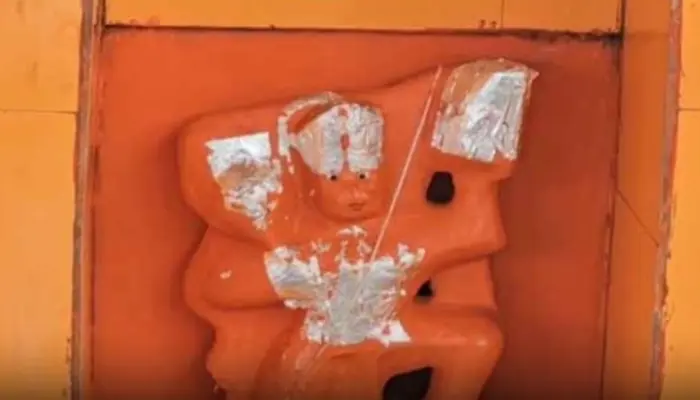
Case Summary
In Nehrupur Chungi, Khurja Nagar Kotwali area of Bulandshahr, Uttar Pradesh, a Hindu temple was targeted and a sacred idol of Lord Hanuman was vandalised by unidentified miscreants on 22 June 2026. The incident came to light on the morning of 22 June 2026 at the ancient Hanuman–Shanidev temple located near the telephone exchange at Nehrupur Toll Plaza on the Grand Trunk Road in the Khurja city area. A devotee, identified as Vijay Saini, a resident of Subhash Marg, arrived at the temple for morning worship and found the idol of Lord Hanuman broken and lying on a stone nearby. He immediately alerted others, after which the news spread rapidly in the locality. As soon as the information surfaced, a large number of local residents and Rashtriya Bajrang Dal workers reached the spot and expressed strong anger, demanding strict action against those responsible. The atmosphere in the area became tense for some time as people gathered in protest. According to local residents, a stone suspected to have been used in damaging the idol was also found within the temple premises. They described the incident as a deliberate and premeditated act and reiterated demands for the immediate arrest of those responsible. Following the incident, a crowd gathered at the temple complex and raised slogans demanding action. Hindu organisations, including Bajrang Dal workers, urged the administration to treat the matter seriously to maintain law and order and social harmony. Upon receiving information, senior administrative and police officials reached the site, including the Sub-Divisional Magistrate Pratiksha Pandey, Tehsildar Sachin Verma, Superintendent of Police (Rural) Antariksh Jain, Circle Officer Shobhit Kumar, and police teams from several stations, including Arnia and Khurja Rural Police Station. They conducted an on-site inspection and interacted with the public, assuring strict action and maintaining calm. After discussions, the protesting groups were eventually pacified. The administration also assured that CCTV cameras would be installed and strengthened within the temple premises, and that a new idol would be reinstalled following proper religious rituals. Locals also demanded enhanced long-term security arrangements for the temple. In parallel, police examined CCTV footage not only from the temple premises but also from the Patri area in front of the temple. Preliminary investigation further indicated that a portion of the lower section of the approximately two-and-a-half-foot idol had been damaged. Earlier inputs from the investigation indicated that three suspects were seen in CCTV footage, and efforts were underway to identify and trace them. Officials stated that the case remained under active investigation and expressed confidence that those responsible would be identified and apprehended soon.
Why it is Hate Crime ?
In this case, the primary category selected is: Attack on Hindu religious representations. The subcategory selected is: Desecration of Hindu religious symbol. Icons and symbols or a religious representation of a spiritual ideal are widely revered in Hinduism. Iconography is of vital significance in the Hindu milieu. It helps connect people’s spiritual beliefs with the real world. Iconography within the Hindu faith takes several shapes and forms. Murtis are of most significance to Hindus, to which daily rituals, prayers and offerings are done. Besides the murtis, there are several other symbols which have deep significance in the Hindu faith – the Om and Swastika for example. Since these Hindu religious symbols hold paramount importance in Hinduism, any desecration of symbols, icons, murtis, religious representations and manifestations, is driven by animosity towards the faith itself which manifests itself through these murtis, icons and symbols. Therefore, any desecration of these Hindu religious symbols and representations is considered religiously motivated hate crimes under this category. The other subcategory selected is: Attack on Temples. In Hinduism, a temple is the abode of the Deity. The Deity in the Temple is consecrated, thereby, making it a real, breathing entity. Hindus believe that not just the Deity but the temple premises itself are sacred to Hindus since Hindus hold the faith that the entire Temple space is an amalgamation of the divine energy of the deity. Given the central significance of Temples in Hindu Dharma, any attack against a Hindu Temple or its peripheral premises is an attack on the faith itself and is born out of animosity towards the faith, of which, the Temple is a central tenet. Any manner of attack against a Temple and/or its premises would therefore be considered a religiously motivated hate crime. In this case, the vandalisation of a sacred idol of Lord Hanuman inside a Hindu temple in Bulandshahr constitutes a religiously motivated hate crime. The perpetrators specifically targeted a revered Hindu religious symbol within a place of worship, making the act far more than ordinary vandalism. The deliberate desecration of a sacred idol demonstrates hostility towards a central object of Hindu faith and worship. In Hinduism, murtis (sacred idols) are not viewed merely as artistic representations but as consecrated embodiments of the divine presence. Through established religious rituals, devotees believe that the deity resides within the murti, making it an object of profound reverence and worship. Lord Hanuman holds a particularly important place in Hindu tradition as a symbol of devotion, strength, courage, selfless service, and unwavering faith. His idols are venerated by millions of Hindus across India and the world, and temples dedicated to him serve as important centres of religious and community life. Therefore, the desecration of a murti is not simply damage to a physical object. It constitutes a direct affront to the religious beliefs and sentiments of Hindu devotees who regard the idol as sacred. Such acts are experienced by Hindus as an attack on their faith itself, as they target and desecrate a revered religious symbol that occupies a central place in Hindu worship and spiritual practice. The fact that this act occurred inside a temple further aggravates its seriousness. A temple idol is inseparable from the broader temple ecosystem, as the murti serves as the spiritual focal point around which all worship and religious activities revolve. Consequently, the desecration of a temple idol amounts to the desecration of the temple itself. Hindu temples are sacred institutions that function not only as places of worship but also as centres for religious observance, cultural preservation, community gathering, and spiritual guidance. Attacks on idols within temple premises, therefore, constitute attacks on Hindu religious institutions and the Hindu community at large. The targeting and vandalisation of sacred objects inside temples is thus a clear manifestation of a religiously driven hate crime. In this case, although the identities of the perpetrators have not yet been established, the nature of the act itself demonstrates anti-Hindu hostility. The deliberate targeting of a Hindu temple and the desecration of a sacred idol leave little doubt regarding the religious character of the offence. Accordingly, this incident is being included in the Hinduphobia Tracker's Hate Crime database. Disclaimer: Police officials stated that CCTV footage captured three suspects in connection with the incident. As the investigation remains ongoing and no arrests have been announced, the perpetrator count has presently been recorded as '3' based on the information available at this stage.


Case Status
Complaint filed


Perpetrators Details
Perpetrators
Unknown
Perpetrators Range
From 2 To 5
Perpetrators Gender
unknown
 Sources




