Hindu girl married in temple by Muslim man using Hindu identity, later assaulted and threatened with triple talaq and halala
 Aligarh, Uttar Pradesh, India
  23 June, 2025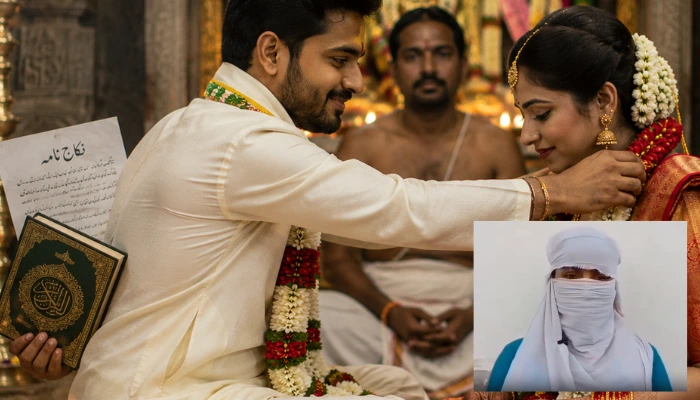
Case Summary
A Hindu woman from Delhi was deceived into marriage by a Muslim man from Aligarh, Uttar Pradesh. Ansar Ansari concealed his religious identity and presented himself as a Hindu named Rahul to enter into a relationship and marry her according to Hindu customs. Thereafter, when his identity and the fact that he was already married were revealed, before the victim, the accused gave her triple talaq. He and his brother assaulted and blackmailed her with her private pictures, and also forced her to undergo halala. The accused had introduced himself as "Rahul" and married her in a Hindu temple before she later discovered that his real name was Ansar Ansari and that he was already married. According to the victim, she is a resident of Delhi's Jahangirpuri area. After her father's death, her mother ran a tea stall in the locality. Ansar Ansari was a frequent visitor to the shop and became acquainted with the family. During this period, he identified himself as Rahul and represented himself as a Hindu. Over time, the two developed a close relationship, which eventually led to marriage. About a year ago, the couple married in a temple in Jahangirpuri according to Hindu rituals. Members of the victim's family attended the ceremony. However, no relatives from the accused's side were present. When questioned about their absence, the accused told the victim that his family was unhappy with the marriage and would accept it after some time. Following the marriage, the couple began living in a rented accommodation in Jahangirpuri. The victim stated that the marriage appeared normal during the initial months. Approximately six months later, she became suspicious when she noticed the accused speaking frequently with another woman. Upon inquiring, she discovered that he was already married. When she confronted him about concealing his marital status, the accused became violent and assaulted her. During the confrontation, he disclosed that his real name was not Rahul but Ansar Ansari. The victim stated that she was shocked to learn that the identity under which she had entered the relationship and marriage was false. The victim further stated that when she spoke of approaching the authorities, the accused threatened to circulate her private photographs and videos. He subsequently forced her to leave the house and warned that he would pronounce triple talaq. Fearing further harassment, she returned to her parental home. After spending about a week with her family, the victim decided to contact Ansar Ansari to continue the marriage. According to her complaint, the accused informed her that he had already divorced her. He further stated that if she wished to return to him, she would first have to undergo halala. The victim said that Ansar Ansari told her she would have to spend a night with his brother, Irshad, as part of the process. When she refused, both Ansar Ansari and Irshad began harassing her. She further stated that the accused continued threatening to release her private photographs and used them to blackmail her. Unable to bear the continued harassment, the victim travelled from Delhi to Aligarh and approached the Lodha Police Station seeking action against the accused. She stated that she was unwilling to undergo halala and demanded strict legal action against Ansar Ansari and his brother. The matter also drew the attention of local Bajrang Dal activists, who accompanied the victim to the police station and supported her demand for legal action. A formal complaint was submitted, following which the police initiated an inquiry. Police officials stated that while the complaint was received at Lodha Police Station, several key events described by the victim had occurred in Delhi, and the accused was a resident of the Qarsi Police Station area of Aligarh. The matter was therefore transferred to the appropriate jurisdiction for further investigation. Police stated that legal action would be taken based on the investigation's findings.
Why it is Hate Crime ?
This incident has been added to the tracker under- Crimes against women in relationships and other sexual crimes. Within this, the. first subcategory selected is- Man pretends to be Hindu, and the tertiary categories selected are- Name changed, Marries as per Hindu rituals. When a non-Hindu man pretends to be a Hindu to deceive a Hindu woman into a relationship, the act is seen as triggered by malafide intentions. In some cases, the woman eventually accepts the man’s original religious identity and converts after the man’s identity is revealed. These cases could be argued as cases of religious brainwashing and a result of the pressure a woman feels after getting into a relationship with a man. The woman, it can be argued, also changed her religious identity because of the stigma she believes she might face if she chooses to walk out of a deceptive relationship. However, for the purpose of documenting hate crimes, the cases in this subcategory are limited to those where there is explicit violence aimed at religious conversion against the wishes of the victim (force-feeding beef, blackmailing with intimate videos, rape on refusal to convert, etc), or if the woman herself complains of the man’s religious deception. In such cases, it is established that the deception of the non-Hindu man had a specific aim of religious conversion or targeting of the victim due to her Hindu religious identity, therefore, making it a religiously motivated hate crime. The other subcategory selected is- Forced conversion after marriage, and the tertiary category within this is- Forced to do Nikah. In such cases, a non-Hindu man marries a Hindu woman, and the force/pressure to convert to any Abrahamic faith, like Islam, begins after marriage. In such cases, typically, two patterns emerge. First, when the relationship is consensual, and the religious identity of the perpetrator is known to the Hindu woman in the relationship. The marriage could be under the Special Marriages Act, where neither parties are required to convert their religion for the marriage to be considered legitimate. While the victim in such cases enters matrimony assuming that religious identity is not a barrier, the non-Hindu man starts to pressure the woman to convert her religion after marriage. The second is when the woman gets into a marriage with the man, pretending to share her faith. Later, when the truth is revealed, the man starts pressuring the woman to convert her religion and give up her religious identity. In both situations, there is application of force by the perpetrator, including the denial of the woman’s religious rights. Some of the means by which the woman is forced/pressured to convert include force-feeding beef, being forced to read the Kalma, being forced to wear a hijab, forced to undergo Halala, etc. There are several instances where, after marriage, the woman voluntarily converts to Islam. Such cases are often argued to be a result of religious brainwashing, however, for the purpose of documenting religiously motivated hate crimes, in the absence of the victim complaining of forced conversion, such cases do not form a part of the database. The religious motive of the crime is evident from the fact that the Muslim perpetrator deliberately hid his real identity and pretended to be a Hindu in order to gain the trust of the Hindu victim. If religion had no role in the crime, there would have been no need for him to conceal his faith and present himself as a Hindu. The deception worked precisely because he knew that sharing the same religious identity would make the victim more comfortable, trusting, and willing to interact with him. This makes the victim's Hindu identity central to the offence. The perpetrator did not simply lie about his name or personal details. He specifically used a false Hindu identity as a tool to approach, manipulate, and exploit a Hindu victim. The fact that he felt the need to pose as a Hindu shows that he understood the importance of religion in the victim's life and deliberately exploited it for his own benefit. The deception also reflected a deeper disregard for Hindu beliefs and community trust. Rather than respecting the victim's religious identity and her right to make informed choices, the perpetrator treated her faith as an obstacle to be bypassed through dishonesty. Hindu identity was reduced to a disguise that could be adopted whenever it became useful. Such conduct demonstrates contempt for the religious boundaries, customs, and values that the victim was entitled to rely upon while deciding whom to trust. It is also significant that the perpetrator specifically targeted a Hindu victim through a fabricated Hindu identity. The entire deception depended upon exploiting the trust associated with being Hindu. This shows that the victim's Hindu identity was not incidental to the crime but one of the factors that made her a target. The perpetrator consciously chose a method that weaponised Hindu identity itself in order to gain access, influence, and control. For this reason, the offence carries clear religiously aggravating elements. The perpetrator's ability to target and exploit the victim depended on religious deception and the manipulation of trust associated with Hindu identity. This demonstrates that the victim's religion was not incidental to the crime but one of the key factors that enabled it. Another important aspect is that the victim was divorced through triple talaq. When she attempted to reconcile, she was told that she would have to undergo halala before she could return to the relationship. The imposition of religious practices and conditions associated with a faith she had not chosen further underscores the religious element of the victimisation. The victim also stated that she faced threats, intimidation, and blackmail through the use of her private photographs. Such threats served to silence her and reduce her ability to challenge the deception and abuse she had experienced. The combination of identity concealment, coercion, religious pressure, and blackmail created circumstances in which the victim became increasingly vulnerable and isolated. This case is a glaring example of how deep-seated intolerance can manifest in violent and coercive actions, with the ultimate goal of religious subjugation and domination. The deliberate nature of the deception and the subsequent attempt to impose Islamic rituals like halala highlight the extent of disdain the accused harboured for the victim and her faith, making this a clear case of religiously motivated hate.
Victim Details
Total Victim
1
Deceased
0
Gender
- Male 0
- Female 1
- Third Gender 0
- Unknown 0
Caste
- SC/ST 0
- OBC 0
- General 0
- Unknown 1
Age Group
- Minor 0
- Adult 0
- Senior Citizen 0
- Unknown 1


Case Status
Complaint filed


Perpetrators Details
Perpetrators
Muslim Extremists
Perpetrators Range
From 2 To 5
Perpetrators Gender
male
 Sources




