Hindu man hounded over allegations of blasphemy in Bangladesh; Muslim mob attacks his home, vandalises a Hindu temple amid chants of 'Allahu Akbar'
 Sunamganj, Sylhet District, Bangladesh
  22 June, 2026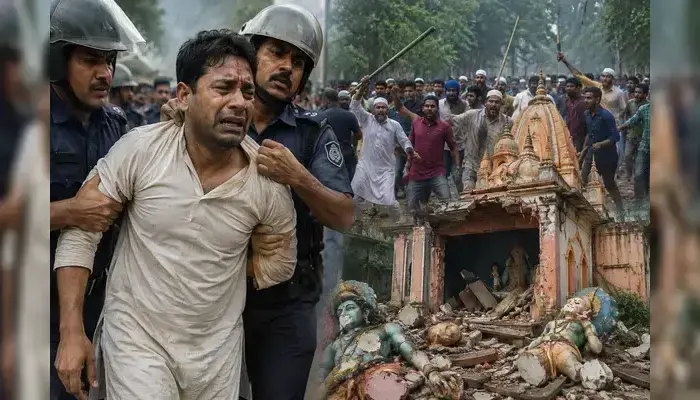
Case Summary
In Sylhet, Bangladesh, a 25-year-old Hindu man named Prince Roy Deepto was hounded by members of the Muslim community over an unverified allegation of blasphemy against Islam and the Prophet Muhammad. The victim was taken into police custody without any publicly disclosed verification of the allegation. Following his detention, a mob of Muslim men launched attacks on his home and businesses and vandalised a nearby Hindu temple. During the unrest, members of the crowd were heard raising Islamic religious slogans like "Allahu Akbar". According to media reports, the incident occurred in Tahirpur Upazila of Sunamganj district. On the morning of 23 June 2026, local Muslims accused a 25-year-old Hindu youth of posting comments on his personal Facebook account that they considered offensive to Islam and the Prophet Muhammad. The post spread rapidly across social media, triggering anger among members of the local Muslim community and leading to calls for strict action against him. Later on 23 June 2026, local Muslims organised protest marches and human chains in Badaghat Bazaar demanding the arrest and exemplary punishment of the Hindu youth. As the demonstrations intensified, police took the victim into custody from Muktar Mia's oil shop in Badaghat Bazaar during the afternoon and transported him to the police station. A large crowd gathered in the market area demanding punishment for the Hindu youth, while reports described extreme tension prevailing throughout the locality. Following the arrest, and after news of the incident spread further, a mob of agitated Muslim men attacked the victim's residence and businesses during the evening of 23 June 2026. The mob went further and also vandalised a local Hindu temple, causing damage to a place of worship sacred to the Hindu community. The attacks heightened fear among local Hindus and further escalated tensions in the area. Nazrul Islam Sikder, President of the Badaghat Bazar Traders Association, stated that the situation had become unusual following the allegations and that the Hindu youth had been taken into police custody on accusations of insulting Islam. He further remarked that Muslim groups were attempting to exploit the situation and make the circumstances more chaotic. Tahirpur Police Station Officer-in-Charge Aminul Islam confirmed that the Hindu youth had been detained over allegations of insulting Islam. He stated that the matter was being investigated and that legal action would be taken following the inquiry. He further stated that law enforcement agencies were treating the incident seriously and conducting an investigation into the matter. The police officer also urged the public not to spread rumours, engage in inflammatory propaganda, or take the law into their own hands. This escalation of violence against Hindus in Bangladesh has unfolded in three distinct phases: first, following the ouster of Sheikh Hasina’s government in August 2024; second, after the death of Sharif Osman Bin Hadi in December 2025; and third, in the immediate aftermath of the 13th National Parliamentary Election 2026. Following the ouster of Sheikh Hasina, multiple reports documented attacks on Hindu homes, temples, and religious institutions, alongside intimidation campaigns, arson, and mob assaults targeting minority neighbourhoods. The Hinduphobia tracker has recorded 336 such incidents against the Hindu minority, underscoring the scale and persistence of anti-Hindu violence during this period. A further escalation occurred following the death of Sharif Osman Bin Hadi, a Muslim political activist and student leader known for his anti-Hindu and anti-India rhetoric. Hadi had been involved in political unrest after the fall of the Hasina government and was killed in Dhaka on 18 December 2025 during clashes. In the aftermath of his death, Hindu communities were blamed and subsequently targeted in retaliatory violence. Hindu homes were selectively set ablaze in multiple localities, forcing families to flee and leaving many displaced. The attacks appeared patterned rather than sporadic, with Muslim mobs focusing on Hindu neighbourhoods, properties, and religious symbols. Among the victims was Dipu Chandra Das, who was lynched to death and his body was set ablaze by a Muslim mob over false blasphemy allegations. The Hinduphobia tracker documented 51 incidents of anti-Hindu violence in the period following Hadi’s death alone. Such incidents underscore the vulnerability of the Hindu minority amid rising communal hostility and the weaponisation of religious accusations. Reports further indicated that posters and written materials calling for the extermination of Hindus were displayed in public spaces, signalling an alarming normalisation of genocidal rhetoric. When combined with acts of arson, vandalism, assault, and targeted intimidation, these developments suggest a coordinated environment of hostility aimed at terrorising the Hindu community and reinforcing majoritarian dominance. The third phase of violence was unleashed after the 13th National Parliamentary Election 2026. Within days of the announcement of results, Hindu families in districts such as Noakhali, Rangpur, Nilphamari, Sylhet, Thakurgaon, and Dinajpur reported coordinated attacks involving arson, looting, assault, and vandalism of temples and homes. In several instances, Hindu homes were selectively targeted, looted, and families were threatened with displacement.
Why it is Hate Crime ?
In this case, the first primary category selected is: Attack not resulting in death. The subcategory selected is: Attacked over 'blasphemy'. Blasphemy essentially refers to the desecration of anything which is held sacred/holy to a group of people. However, for religious supremacist groups, the elements of ‘blasphemy’ are ever-changing, shifting and expanding – leading to infringement on the rights of other religious groups, freedom of speech and expression, threats and even physical violence. There are instances where blasphemy is also used as a dog whistle to target Hindus owing to intrinsic animosity towards Hinduism. There are several instances where stating truths as mentioned in the non-Hindu doctrine itself has led to unmitigated violence against Hindus. There have also been instances where non-Hindus have themselves created a ‘blasphemous’ situation, like placing a Quran in a temple, to use it as an excuse to attack Hindus. Essentially, Blasphemy charges are often made up and/or are used to shut down any form of criticism of non-Hindu faiths and as a tool to target Hindus. Any physical violence over Blasphemy charges against Hindus are foundationally based on animosity for Hindus and their faith owing to religious supremacist ideologies, therefore, such attacks would be documented as religious motivated hate crimes under this category. The other subcategory selected is: Attacked for Hindu identity. In several cases, Hindus are attacked merely for their Hindu identity without any perceived provocation. A classic example of this category of religiously motivated hate crime is a murder in 2016. 7 ISIS terrorists were convicted for shooting a school principal in Kanpur because they got ‘triggered’ seeing the Kalava on his wrist and tilak that he had put. In this, the Hindu victim had offered no provocation except for his Hindu religious identity. The motivation for the murder was purely religious, driven by religious supremacy. Such cases where Hindus are targeted merely for their religious identity would be documented as a hate crime under this category. The second primary category selected in this case is: Attack on Hindu religious representations. The subcategory selected is: Attack on Temples. In Hinduism, a temple is the abode of the Deity. The Deity in the Temple is consecrated, thereby, making it a real, breathing entity. Hindus believe that not just the Deity but the temple premises itself are sacred to Hindus since Hindus hold the faith that the entire Temple space is an amalgamation of the divine energy of the deity. Given the central significance of Temples in Hindu Dharma, any attack against a Hindu Temple or its peripheral premises is an attack on the faith itself and is born out of animosity towards the faith, of which, the Temple is a central tenet. Any manner of attack against a Temple and/or its premises would therefore be considered a religiously motivated hate crime. The third primary category selected is- Hate Speech against Hindus. The subcategory selected is- Violent Threats. Violent threats, explicit, implicit or implied, is the most dangerous form of hate speech since it goes beyond discriminatory and prejudicial language to express the intent of causing harm to an individual or a group of people based on their religious identity and faith. There could be several different kinds of threats that are issued to Hindus based on religious animosity. An explicit threat would mean the direct threat of violence towards an individual Hindu, a group of Hindus or Hindus at large. Physical violence, death threats, threats of destruction of property belonging to Hindus and threats of genocide would mean explicit threats against Hindus for their religious identity. Implicit threats may not be a direct threat but implied through the use of symbols of actions – for example – in the Nupur Sharma case, other than explicit threats, there were also implicit threats when Islamists took to the streets to burn and beat her effigies. It implies that they want to do the same to Nupur Sharma – thereby is considered an implicit threat. Violent threats can be delivered in person, through letters, phone calls, graffiti, or increasingly through social media and other online platforms. It would be important to understand that a threat – explicit or implicit, online or offline – to an individual who happens to be a Hindu does not qualify as a religiously motivated threat. Such a threat, while vile and dangerous, could be owing to non-religious reasons and/or personal animosity. To qualify as a religiously motivated threat, it would need to exhibit an indication that the individual is being targeted for religious reasons and/or owing to his/her religious identity as a Hindu. This case is a clear example of a religiously motivated hate crime. The targeting of the Hindu victim over an unverified allegation of blasphemy, followed by mass Muslim mobilisation, police detention, and subsequent communal violence, demonstrates how blasphemy allegations relating to Islam are routinely used as a pretext for hostility against Hindus in Bangladesh. The sequence of events shows that the allegation itself, without any established proof, was sufficient to trigger collective action and punitive consequences against the Hindu individual and the Hindu community. Without any verification of whether any blasphemous act had actually occurred, the Hindu youth was hounded by the Muslim community through protests, public pressure, and coordinated mobilisation. This escalation occurred purely on the basis of circulating claims, yet it rapidly created a situation where law enforcement intervened and detained the accused. The arrest took place in an environment shaped by intense communal pressure rather than by a completed evidentiary assessment, demonstrating how accusation alone becomes sufficient to initiate coercive state action against Hindus. This reflects a serious distortion of due process, where perception replaces proof and the Hindu accused is treated as guilty by default in cases involving alleged insult to Islam. Blasphemy-related allegations in Muslim-majority countries such as Bangladesh are frequently weaponised to persecute Hindus and other minorities. Such accusations often rely on hearsay, selective interpretation, disputed digital content, or unverified claims, yet they are capable of provoking public outrage, communal mobilisation, and police intervention before any impartial investigation takes place. In many cases, merely being accused becomes sufficient grounds for mob violence, social humiliation, ostracism, arrest, threats of violence, or long-term persecution. The reaction in this case, where allegations circulating on social media rapidly triggered public anger, Muslim mobilisation, protest rallies, and legal proceedings against a Hindu youth, highlighted the unequal environment in which Hindu minorities are frequently denied the presumption of innocence. Muslim extremist groups have historically exploited blasphemy accusations to intimidate religious minorities, particularly Hindus, silence dissent, and reinforce social control. Hindus in Bangladesh remain especially vulnerable because allegations involving Islam frequently trigger collective outrage and public vigilantism regardless of whether the accusations have been independently verified. Such allegations have repeatedly preceded Muslim mob attacks, destruction of Hindu homes and temples, forced displacement, arrests, and other forms of persecution across Bangladesh. Consequently, accusations of blasphemy against Hindus cannot be viewed in isolation from the broader environment of anti-Hindu hostility in which they occur. The events in this case therefore demonstrate a consistent pattern in which unverified allegations lead to immediate communal mobilisation, institutional response under pressure, and exposure of the Hindu victim to punitive action without verified evidence. The absence of any established proof prior to detention highlights how the presumption of innocence is undermined in cases involving alleged insult to Islam. The police action in this case further reflects the extent to which state authorities respond to and accommodate communal pressure from Muslims, as the Hindu youth was taken into custody following claims circulated by the Muslim mob without any publicly established verification of the allegations. This demonstrates how institutional decision-making becomes influenced by what is effectively an Islamic street veto, where collective anger and mobilisation shape the actions of law enforcement. Such responses indicate a pattern of state compliance with communal pressure, reinforcing the vulnerability of Hindus in Bangladesh, where even authorities act in alignment with mass Muslim sentiment rather than verified evidence. The Hindu individual is therefore placed in a position of extreme exposure where accusation alone is sufficient to trigger both state intervention and mass hostility, reinforcing the broader climate of insecurity faced by Hindus in Bangladesh. Furthermore, the attack on the Hindu youth's home and businesses following his detention further exposes the religiously motivated nature of the violence. Once the police had already taken the Hindu man into custody, there was no conceivable justification for members of the Muslim community to attack his residence or commercial establishments. The fact that Muslim mobs nevertheless proceeded to vandalise his home and businesses demonstrates that the violence was not only about securing justice for an alleged offence but about targeting a Hindu individual and his family. The victim's home and livelihood were attacked because he was a Hindu accused of offending Islamic sentiments, with the allegation serving as a pretext for communal aggression. Such attacks are designed not only to punish the immediate victim but also to intimidate his family and instil fear among the wider Hindu community. By targeting a Hindu family's residence and means of livelihood, the perpetrators sent a message of collective intimidation to local Hindus, making the attack a clear example of religiously motivated hostility rooted in hatred towards Hindu identity. Additionally, the vandalism of a Hindu temple represented an attack on one of the most sacred institutions of the Hindu faith. Hindu temples are revered places of worship where devotees offer prayers, perform religious rituals, celebrate festivals, and maintain their spiritual connection with their deities. They serve as centres of religious, cultural, and community life and hold profound significance for Hindu communities. Temples embody the collective faith, heritage, and religious identity of Hindus and are treated with deep reverence by devotees. Consequently, attacks on Hindu temples strike not only at a physical structure but at the religious sentiments and collective identity of the Hindu community itself. The attack on the Hindu temple demonstrates that the violence extended beyond the individual accused and was directed at the Hindu community as a whole. Although the allegations concerned a single Hindu youth, Muslim mobs targeted a sacred place of worship revered by the wider Hindu population. This amounted to collective punishment of an entire religious community for an alleged offence attributed to one of its members. The vandalism of the temple shows that the allegation of blasphemy was used as a pretext to attack Hindu religious institutions that had no connection whatsoever to the alleged act. Such incidents demonstrate how blasphemy allegations involving Islam are frequently exploited to justify attacks on Hindu places of worship and expressions of Hindu faith. The targeting of a sacred Hindu temple under these circumstances reflects deep-seated animosity towards Hinduism and its religious symbols. Accordingly, the incident constitutes a clear example of a religiously motivated hate crime directed against the Hindu community. Another point to highlight is that the Muslim mob was chanting “Allahu Akbar” while carrying out the attack. Traditionally, this slogan is a chant of glorification; however, Muslim extremists have weaponised it as a battle cry to intimidate Hindus and assert Islamic supremacy. In this case, the group raised it precisely as they launched their attack, mirroring patterns in other similar incidents including the 2020 Delhi anti Hindu riots where Muslim mobs targeted Hindu homes and temples, the 2022 Karauli violence in Rajasthan with Hindu shops set ablaze, the Jahangirpuri riots in Delhi assaulting Hindu processions, the September 2025 Bareilly clashes during the “I Love Mohammad” poster controversy, and the December 2025 lynching of Dipu Chandra Das in Mymensingh, Bangladesh, where the same slogan was used during a fatal attack over a blasphemy allegation. In each of these instances, the slogan accompanied acts of aggression directed against Hindus and their religious or economic institutions. The use of such slogans during acts of violence further underscores how religious expressions are deployed by Muslim extremist elements to legitimise aggression in the name of Allah. This pattern is evident in multiple incidents where Muslim mobs launch attacks against non-Muslims, particularly Hindus, using religious slogans both as a battle cry and as a means of framing violence as divinely sanctioned. The invocation of such slogans amid stone pelting, arson, and communal riots reflects a mindset in which perpetrators believe their actions align with religious duty, thereby dehumanising Hindu victims and encouraging further violence. This dynamic contributes to the normalisation of hostility against Hindus, who are targeted for their religious identity, their participation in cultural or religious practices, or perceived offences against Islamic sentiments. The repeated use of such slogans during coordinated acts of violence reveals an underlying pattern of religious intolerance in which aggression is sanctified under the guise of faith-driven retaliation. The same pattern is observed very clearly in this current case. Overall, since this case meets the parameters of a religiously driven hate crime, it is being added to the hate crime database of the Hinduphobia Tracker.
Victim Details
Total Victim
1
Deceased
0
Gender
- Male 1
- Female 0
- Third Gender 0
- Unknown 0
Caste
- SC/ST 0
- OBC 0
- General 0
- Unknown 1
Age Group
- Minor 0
- Adult 1
- Senior Citizen 0
- Unknown 0


Case Status
Unknown


Perpetrators Details
Perpetrators
Muslim Extremists
Perpetrators Range
Unknown
Perpetrators Gender
male
 Sources




