Anti-Hindu prejudice in media: Leftist news outlets and Muslim journalist falsely frame murder of Muslim man as case of 'cow vigilantism' by Hindu gau rakshaks
 India
India  12 June, 2026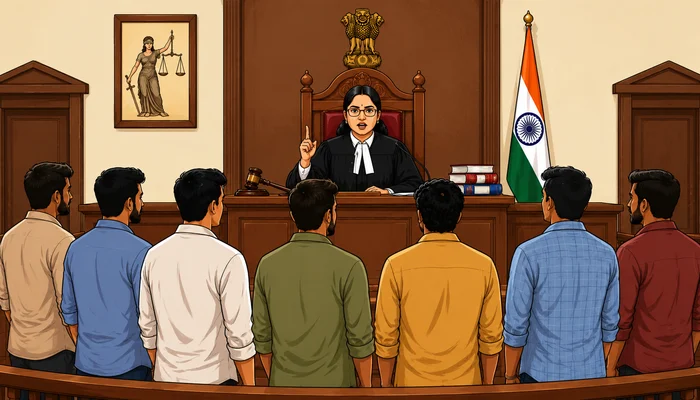
Case Summary
Anti-Hindu prejudice was propagated in the mainstream media by several left-leaning news outlets, which targeted Hindu gau rakshaks (cow protectors) through misleading and inaccurate reporting. These outlets falsely sought to portray the murder of a Muslim man as an incident of "cow vigilantism" carried out by Hindu gau rakshaks. This narrative was widely circulated despite being inconsistent with the findings recorded by the court in its verdict. Recently, an Additional District and Sessions Court in Madhya Pradesh convicted seven individuals in connection with a rioting and murder incident that took place in the Narmadapuram district of Madhya Pradesh in August 2022. The incident resulted in the death of a Muslim man named Nazeer Ahmed, while several others sustained serious injuries. In a verdict delivered on 12 June 2026, Additional Sessions Judge Tabassum Khan convicted seven accused, namely Deepak alias Baba Kewat, Ajay alias Ajju Rathore, Prakash Kaushal, Pawan Bathav, Amar alias Bhola Bathav, Kanhaiya Bathav and Ballu alias Anuj Raghuvanshi, under Sections 302, 307, 148 read with 149 of the Indian Penal Code. The judge sentenced all the convicts to life imprisonment. While the accused were convicted under provisions relating to murder, attempted murder and rioting, many leftist media outlets were quick to portray the case as one involving cow vigilantism merely because the incident concerned a truck transporting cattle. Several media outlets, including Live Law, referred to the convicts as gau rakshaks (cow vigilantes), even though the term appeared nowhere in the judgment. Some media reports, including those published by The New Indian Express and Lallantop, incorrectly stated that 14 gau rakshak individuals had been sentenced to life imprisonment by the court. In reality, seven persons were convicted and sentenced by the Sessions Court. A similar narrative was also presented by The Wire’s Arfa Khanum Sherwani, who referred to seven individuals sentenced to imprisonment as gau rakshaks. She discussed this in a 16-minute video where she cherry-picked 4-5 incidents involving Muslim victims to create a false narrative that Muslims are being persecuted in India by Hindus. The incidents cited were isolated cases, but the video was framed to suggest that anti-Muslim rhetoric is becoming normalised in India, a characterisation that is false. The incident under consideration by the court took place around midnight on 3 August 2022 on Nandarwada Road in Barakhad village, under the jurisdiction of Seoni Malwa Police Station in the Narmadapuram district of Madhya Pradesh. The complainant, Sheikh Lala, a truck driver, along with his companions Nazeer Ahmed and Sheikh Mushtaq, was travelling in a truck carrying cattle. The vehicle had departed from Nandarwada and was heading towards Amravati in Maharashtra. As the truck passed near Barakhad village around midnight on the day of the incident, its occupants were attacked by 10 to 12 villagers carrying sticks. The villagers assaulted Sheikh Lala, Nazeer Ahmed and Sheikh Mushtaq. The police arrived at the scene and transported the victims to the Community Health Centre, Seoni Malwa. Sheikh Lala and Sheikh Mushtaq sustained serious injuries, while Nazeer Ahmed succumbed to his injuries during treatment at the hospital. A First Information Report was registered by the police at Seoni Malwa Police Station against 10 to 12 persons under Sections 147, 148, 341, 307 and 302 of the Indian Penal Code. Seven of the accused were tried for the offences and were convicted of some of the offences mentioned in the First Information Report. The court framed seven issues for determining whether the offences mentioned in the First Information Report had been committed. Among these, a key issue listed at serial number three concerned whether the accused had deliberately stopped the victims' truck before launching the attack. This issue was significant in determining whether the accused had acted with a religious motive. “Whether, at the said date, time and place, the accused persons wrongfully restrained the complainant Sheikh Lala, Nazeer Ahmed and Sheikh Mushtaq, who were travelling in truck registration number MH-40-CD-8751, by stopping or obstructing their way?” read the issue framed by the court. After examining the evidence presented and the arguments advanced by both sides, the court concluded that the element of wrongful restraint could not be established against the accused. In other words, the court held that the prosecution failed to prove that the accused had deliberately stopped the victims' truck before attacking them. In the absence of proof that the truck had been intentionally intercepted, the media narratives portraying the incident as an act of cow vigilantism were not supported by the court's findings. In paragraph 96 of the judgment, the court stated that the allegation that the accused had wrongfully restrained the injured persons and the deceased by blocking their path had not been proved. The court noted that the eyewitnesses, Sheikh Lala and Syed Mushtaq, made no statement before the court indicating that anyone from the crowd had stopped their vehicle by placing another vehicle in front of it. The court further observed that their statements recorded by the police also contained no reference to the truck's path being blocked. No other evidence was placed before the court to establish that the accused had obstructed the truck's movement. A plain reading of the judgment was sufficient to refute the attempts by leftist media outlets to characterise the case as one of cow vigilantism. The court's findings made it clear that the case concerned offences of murder, attempted murder and rioting, and did not establish that the incident arose from an act of cow vigilantism.
Why it is Hate Crime ?
The primary category selected in this case is: Hate Speech against Hindus. The subcategory selected is: Anti-Hindu subversion and prejudice. The tertiary category selected is: Anti-Hindu Fake news or Downplaying. Hate speech is defined as any speech, gesture, conduct, writing, or display that is prejudicial against a specific individual and/or group of people, which is leading to or may lead to violence, prejudicial action or hate against that individual and/or group. Media plays a specific and overarching reach in perpetuating prejudicial attitudes towards a community owing to unfair, untrue coverage and/or misrepresentation/misinterpretation, selective coverage and/or omission of facts of/pertaining to issues affecting a specific religious group. This type of bias can dehumanise the victim group, making it easier for others to justify harmful actions against them, which aligns with the objectives of hate speech laws aimed at preventing such harm. It is often observed that the media takes a prejudicial stand against the Hindu community driven by their need to shield the aggressor community which happens to be a numeric minority, however, is the one perpetrating violence against Hindus. For example, the media is often quick to contextualise religiously motivated crimes against Hindus, omit or misrepresent facts that point towards religiously motivated hate crimes, justify and/or downplay religiously motivated hate crimes or simply present fake news to stereotype Hindus. Such media bias leads to the denial of persecution and is often used to dehumanise Hindus, leading to justification for violence against them. For example, the media covered several fake allegations of Hindus targeting Muslims and forcing them to chant Jai Shree Ram. Most of these cases were proved false and fabricated after police investigation. These fake news reports were subsequently never retracted or clarified. Such fake news led to the justification of violence and dehumanisation of Hindus based on the argument that since Hindus targeted Muslims and forced them to chant Jai Shree Ram, the dehumanisation of Hindus and violence against them was par for the course and merely a retaliation. Such media bias leads to prejudicial portrayal of Hindus and offers a justification for violence against them and therefore, is considered hate speech under this category. In this case, the manner in which several leftist media outlets portrayed this case reflected a clear pattern of anti-Hindu bias and prejudice. Even though the court convicted the accused for offences relating to murder, attempted murder and rioting, and did not characterise the incident as an act of cow vigilantism, the leftist media nevertheless framed it as an example of "cow vigilante violence" by Gau rakshaks. By doing so, they attached a specifically Hindu religious identity to a criminal act without any such finding being recorded by the court. This framing created the impression that Hindu cow protectors had been sentenced to life imprisonment for carrying out an organised act of cow vigilantism against a Muslim man, despite the judgment containing no such conclusion. Such reporting went beyond factual inaccuracies and contributed to the stigmatisation of Hindu religious practices and activists associated with cow protection. By disregarding the court's findings and substituting them with a politically loaded anti-Hindu narrative, these outlets reinforced negative stereotypes about Hindus and their religious beliefs, thereby fostering hostility towards the Hindu community. The prejudice becomes even more apparent when viewed in the context of the religious significance of the cow in Hinduism. For millions of Hindus, the cow is regarded as sacred and is associated with compassion, motherhood, sustenance and non-violence. The protection and welfare of cows have historically been viewed as a moral and religious duty, and many Hindu organisations and activists dedicate their time and resources to rescuing abandoned, injured and illegally trafficked cattle. For such individuals, cow protection is not merely a social activity but an expression of deeply held religious convictions. Consequently, portraying every incident involving cattle as an example of "cow vigilantism" unfairly criminalises a long-standing religious and cultural tradition. In this case, the mere presence of cattle in the vehicle was used by the left-leaning media outlets to construct a narrative that linked the crime to Hindu cow protection, despite the court finding no evidence that the accused had intentionally intercepted the vehicle on that basis. Such portrayals demonise both the concept of cow protection and the Hindu religious sentiments associated with it. The repeated tendency to associate criminal incidents involving cattle with Hindu religious activism has wider implications. When media organisations selectively highlight the supposed religious dimension of a case while ignoring judicial findings that contradict their narrative, they contribute to a climate in which Hindu beliefs and customs are viewed with suspicion. The effect is not limited to the individuals involved in a particular case; rather, it extends to the broader Hindu community, whose religious motivations and cultural practices are portrayed as inherently aggressive or intolerant. By presenting cow protection primarily through the lens of extremism or vigilantism, such narratives marginalise the genuine religious, ethical and humanitarian motivations that inspire Hindus to engage in cattle welfare and protection activities. This creates a distorted public perception that unfairly associates a core aspect of Hindu belief with criminality. A similar pattern is also visible in the way Muslim journalist Arfa Khanum Sherwani presented the case, wherein she referred to the accused as “Gau rakshaks” and framed the incident within a broader narrative of Hindu cow protection activism. By doing so, she attributed a specific religious identity and ideological motivation to the accused despite the absence of any such finding in the judicial record. This framing contributed to portraying Hindu cow protection efforts in a negative light and reinforced associations between Gau rakshaks and criminality. She also has, on multiple occasions, been seen as selectively presenting incidents involving Hindu-Muslim dynamics in a way that highlights the wrongdoing by Hindus while minimising or omitting contextual details that do not support such framing. In this case as well, her selective emphasis on a narrative of Hindu-perpetrated violence contributes to perceptions of bias against Hindu religious identity and cow protection traditions, and reflects a broader pattern of interpreting such incidents through a consistently critical lens toward Hindu practices. More broadly, this case reflects a pattern in which the left-leaning media have frequently sought to deride, trivialise or villainise cow protection under the guise of secular commentary. In doing so, they mock, dismiss or minimise the deep emotional, cultural and religious significance that cows hold for Hindus. The underlying message conveyed through such narratives is that Hindu concerns regarding cow slaughter or cattle welfare are unworthy of respect and should be treated as regressive or illegitimate. This approach stands in stark contrast to the sensitivity often shown towards the religious sentiments of other communities. By repeatedly framing Hindu religious customs in a negative light and by mischaracterising incidents in ways that reinforce adverse stereotypes, these outlets normalise prejudice against Hindus and their beliefs. The misrepresentation of this case, despite clear judicial findings to the contrary, therefore serves as a striking example of how anti-Hindu bias can manifest through selective and misleading media narratives. Since this case meets the parameters of a religiously motivated offence, it is being added to the hate crime database of the Hinduphobia Tracker. Disclaimer: The Hinduphobia Tracker records incident dates based on when the anti-Hindu act, crime, discriminatory conduct, or victim's ordeal occurred, rather than when it was reported by the media or brought to public attention. However, in the present case, the incident concerns the dissemination of a misleading media narrative and not a standalone physical crime with a clearly identifiable date of occurrence. Among the media outlets discussed, the earliest report advancing this narrative was published on 13 June 2026, while two other outlets published similar reports on 14 June 2026. Accordingly, 13 June 2026 has been selected as the indicative incident date, as it marks the earliest identified instance in which this narrative was propagated in the media. This date has been recorded for documentation purposes only.


Case Status
Unknown


Perpetrators Details
Perpetrators
Others
Perpetrators Range
From 2 To 5
Perpetrators Gender
unknown
 Sources




