Hindu politician targeted over spiritual beliefs and Hindu associations by American media, her Guru portrayed as 'Cult' leader
 Washington, United States
  20 June, 2026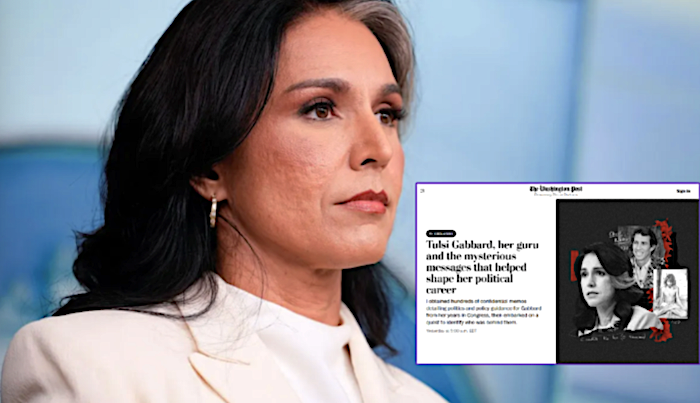
Case Summary
A Hindu American political leader and practising Hindu came under public scrutiny in the United States after a major newspaper published an article focusing extensively on her religious background and long-standing association with a Hindu spiritual organisation. The publication examined her spiritual teacher, her religious upbringing, and her connection to the Science of Identity Foundation, portraying these relationships as a matter of public concern. The article appeared shortly after she released declassified information concerning the origins of COVID 19 and before stepping down as Director of National Intelligence due to her husband's illness. On 21st June 2026, The Washington Post published an article by Jon Swaine titled "Tulsi Gabbard, her guru and the mysterious messages that helped shape her political career." The piece centred on former United States Congresswoman and former Director of National Intelligence Tulsi Gabbard and her relationship with Jagad Guru Siddhaswarupananda Paramahamsa, also known as Chris Butler, the founder of the Science of Identity Foundation in Hawaii. The article described the organisation as a "cult" and explored Gabbard's upbringing within the movement, her family's involvement, and her ongoing spiritual association with the group. The publication examined confidential political memoranda connected to Gabbard's congressional career and advanced the proposition that her political rise and decision-making may have been influenced by her spiritual mentor. It referred to Butler as a "Hindu guru" and repeatedly linked his religious teachings and spiritual guidance to Gabbard's public life and political positions. The article also noted that Gabbard took her oath of office on the Bhagavad Gita and publicly identified herself as the first Hindu American member of Congress. The report relied heavily on statements from Rebecca Salzburg, a former member of the Science of Identity Foundation and former volunteer in Gabbard's political campaigns. It highlighted her criticisms of the organisation and included allegations concerning Butler's influence over followers and their personal decisions. The article also referred to historical materials and communications involving Gabbard and individuals connected to the organisation in an effort to examine the extent of Butler's influence on her political career. Representatives of the Science of Identity Foundation rejected the characterisation of the organisation and disputed the article's portrayal of Gabbard's faith and spiritual background. Jeannie Bishop, president of the organisation, stated that the publication constituted an attack on Gabbard's faith and described it as an example of anti-Hindu religious bigotry. Sunil Khemaney, a senior disciple of Butler, also rejected the article's assertions, stating that there was no evidence that Gabbard's political work had been directed by Butler. The publication generated significant public reaction. Television personality Meghan McCain publicly criticised the article on 21st June 2026 and described it as an anti-Hindu and bigoted attack on Gabbard. Several supporters of Gabbard and members of the Science of Identity Foundation similarly condemned the article, asserting that it singled out a Hindu public figure's religious beliefs and spiritual associations for scrutiny in a manner that would not ordinarily be applied to individuals belonging to other faiths. No criminal proceedings or police action arose from the incident. The matter remained a public controversy concerning media coverage of a Hindu public figure's faith, her association with a Hindu spiritual organisation, and the characterisation of her religious beliefs and community in a national newspaper.
Why it is Hate Crime ?
This case has been added to the tracker under the primary category of - Hate speech against Hindus. Within this, he sub-category selected here is - Mocking/Denigrating Hindu leaders. Hate speech is defined as any speech, gesture, conduct, writing, or display that is prejudicial against a specific individual and/or group of people, which is leading to or may lead to violence, prejudicial action or hate against that individual and/or group. Religious leaders are often seen as representatives of the community, especially, the community’s religious faith and beliefs. Mocking or denigrating a religious leader specifically owing to his religious identity and/or the religious rituals he observes can be considered hate speech because the motivating factor of the speech is animosity and/or dislike for what he represents – the religious beliefs and faith of the community. It is important to note that mere insulting words against an individual do not constitute hate speech. It is entirely possible that insulting words are used for an individual, however, the specific speech is not the result of religious hate and/or animosity towards the professed faith of the religious leader, but the individual himself. For the speech to be considered hate speech, the speech itself or the motivating factor behind the speech has to be religious in nature. Such speech which denigrates Hindu religious leaders specifically owing to animosity towards the faith they profess and the community faith they represent will be treated as hate speech under this category. Another sub-category selected is - Anti-Hindu subversion and prejudice. Hate speech is defined as any speech, gesture, conduct, writing, or display that is prejudicial against a specific individual and/or group of people, which is leading to or may lead to violence, prejudicial action or hate against that individual and/or group. Media plays a specific and overarching reach in perpetuating prejudicial attitudes towards a community owing to unfair, untrue coverage and/or misrepresentation/misinterpretation, selective coverage and/or omission of facts of/pertaining to issues affecting a specific religious group. This type of bias can dehumanise the victim group, making it easier for others to justify harmful actions against them, which aligns with the objectives of hate speech laws aimed at preventing such harm. It is often observed that the media takes a prejudicial stand against the Hindu community driven by their need to shield the aggressor community which happens to be a numeric minority, however, is the one perpetrating violence against Hindus. For example, the media is often quick to contextualise religiously motivated crimes against Hindus, omit or misrepresent facts that point towards religiously motivated hate crimes, justify and/or downplay religiously motivated hate crimes or simply present fake news to stereotype Hindus. Such media bias leads to the denial of persecution and is often used to dehumanise Hindus, leading to justification for violence against them. For example, the media covered several fake allegations of Hindus targeting Muslims and forcing them to chant Jai Shree Ram. Most of these cases were proved false and fabricated after police investigation. These fake news reports were subsequently never retracted or clarified. Such fake news led to the justification of violence and dehumanisation of Hindus based on the argument that since Hindus targeted Muslims and forced them to chant Jai Shree Ram, the dehumanisation of Hindus and violence against them was par for the course and merely a retaliation. Such media bias leads to prejudicial portrayal of Hindus and offers a justification for violence against them and therefore, is considered hate speech under this category. The other selected sub-category here is - Anti-Hindu slurs, mocking faith. Anti-Hindu slurs and the deliberate mocking of the Hindu faith owing to religious animosity involve the usage of derogatory terms, stereotypes, or offensive references to religious practices, symbols, or figures. One of the common anti-Hindu slurs used against Hindus is “cow-worshipper” and “cow piss drinker”. The intention of using this term is to demean and mock Hindus as a group and their religious beliefs since Hindus consider the cow holy. Additionally, some symbols and the slurs attached to them have a historical context that exacerbates the insult, hate, stereotyping, dehumanisation and oppression against Hindus. Cow worship has been used for centuries to denigrate Hindus, insult their faith and oppress Hindus specifically as a religious group. There has been overwhelming documentation about how cow slaughter has been used to persecute Hindus with cow meat being thrown in temples and places of worship. There has also been overwhelming documentation where cow meat (beef) has been force-fed to Hindus to either forcefully convert them to Islam or denigrate their faith. Apart from cow worship, the Swastika – which holds deep religious significance for the Hindus – has also been misinterpreted and distorted to use as a slur against Hindus. Similarly, the worship of the Shivling has been used by supremacist ideologies and religions to denigrate Hindus owing to religious animosity. Such slurs and denigration stem out of inherent animosity and hate towards Hindus and their faith, therefore, it is categorised as hate speech targeted at Hindus specifically owing to their religious identity. Firstly, the targeting of Tulsi Gabbard's spiritual teacher and the repeated portrayal of him as a shadowy and sinister figure amounted to the denigration of a Hindu religious leader and the broader guru-disciple tradition that occupies a sacred place within Hinduism. In Hindu Dharma, the guru is not merely a personal adviser or religious functionary but a spiritual guide who occupies one of the most revered positions in religious life and is regarded as the medium through which spiritual knowledge and self-realisation are attained. By presenting the relationship between a Hindu public figure and her guru as inherently suspicious and politically dangerous, the article did not simply criticise an individual but cast aspersions on a central and deeply respected Hindu religious institution. Such treatment demonstrated a profound lack of understanding of Hindu religious traditions and contributed to the stigmatisation of a practice that millions of Hindus regard as sacred. The ridicule and suspicion directed towards the guru and his relationship with his disciple therefore carried a distinctly religious dimension because the criticism stemmed from, and was inseparable from, their Hindu spiritual identities. Secondly, the manner in which a major international media outlet framed Hindu beliefs and institutions carried consequences far beyond the individuals directly involved and reflected broader anti-Hindu prejudice and subversion. Media organisations possess significant influence in shaping public perceptions, and presenting Hindu religious associations as sinister, cult-like, or politically manipulative contributes to the normalisation of prejudicial narratives against Hinduism and its adherents. By selecting a Hindu politician's faith and spiritual affiliations as a subject of scrutiny and controversy, the publication reinforced long-standing stereotypes that depict Hindu traditions as exotic, irrational, or inherently suspect. Such narratives do not remain confined to one article or one individual; they contribute to an atmosphere in which Hindu beliefs and practices are viewed through a lens of suspicion and hostility. The portrayal of a practising Hindu's spiritual identity as a matter requiring exposure or investigation therefore had the effect of delegitimising Hindu religious expression in public life and fostered broader prejudice against the Hindu community. Thirdly, the repeated characterisation of the Science of Identity Foundation and its religious traditions as "cult-like" amounted to the mocking of Hindu faith and the use of language that carried strong derogatory implications. Labelling a Hindu spiritual organisation and its practices as a "cult" served to portray Hindu beliefs as abnormal, dangerous, and outside the bounds of legitimate religion. Such terminology has historically been used to stigmatise minority faiths and to discredit their beliefs by presenting them as deceptive or manipulative rather than as genuine expressions of spirituality. The application of this language to a Hindu organisation and its guru conveyed contempt for Hindu religious practices and fostered animosity towards the faith itself. The mockery was particularly significant because it did not arise from any unlawful activity but from the organisation's religious identity and the existence of a guru-disciple relationship rooted in Hindu tradition. By reducing sacred Hindu leaders, beliefs and institutions to the language of cultism and conspiracy, the article promoted prejudicial stereotypes and contributed to the denigration of Hinduism and its followers. Therefore, this case has been added to the Hinduphobia Tracker’s hate crime database.
Victim Details
Total Victim
2
Deceased
0
Gender
- Male 1
- Female 1
- Third Gender 0
- Unknown 0
Caste
- SC/ST 0
- OBC 0
- General 0
- Unknown 2
Age Group
- Minor 0
- Adult 2
- Senior Citizen 0
- Unknown 0


Case Status
Unknown


Perpetrators Details
Perpetrators
Others
Perpetrators Range
One Person
Perpetrators Gender
male
 Sources




