Hindu woman raped and murdered, Muslim perpetrator arrested after four years of investigation in Bangladesh amidst ongoing persecution of Hindu minority
 Brahmanbaria District, Bangladesh
  30 September, 2021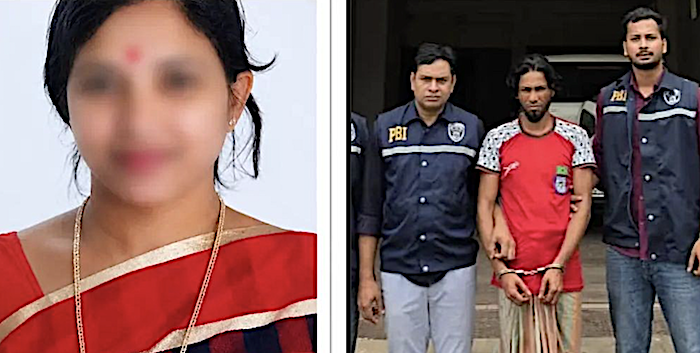
Case Summary
In Brahmanbaria district of Bangladesh, a Hindu woman was raped and murdered by a Muslim co-worker who feared that their extramarital relationship would become public. The victim, Shipra Rani Das, a member of the minority Hindu community and a working woman who earned her livelihood as a cooking assistant, disappeared while travelling for work and was later found dead in an agricultural field. The case remained unsolved for nearly four years before investigators arrested the principal perpetrator and uncovered the circumstances surrounding the crime. Shipra Rani Das worked as a cooking assistant alongside Kalu Baburchi and Tajul Islam Prakash Kajal to support herself and her family. On 1st October 2021, she left her home to go to work but did not return. Her disappearance caused concern among her family members, who began searching for her after she failed to come back. Three days later, on 4th October 2021, the half-decomposed body of Shipra Rani Das was recovered from the cropland of Faizul Haque in Jalar Char under Nabinagar police station in Brahmanbaria district. Following the recovery and identification of the body, her husband, Sabinay Das, lodged a case against unknown persons at Nabinagar Police Station under the Prevention of Violence against Women and Children Act and relevant sections of the Penal Code. Despite investigating the case for more than six months, Nabinagar Police Station failed to identify those responsible for the crime. Subsequently, on the instructions of Police Headquarters, the Police Bureau of Investigation (PBI), Brahmanbaria district branch, assumed responsibility for the investigation on 20th July 2022. As the investigation progressed, PBI officers gathered evidence and identified individuals connected to the murder. On 7th September 2023, one of the accomplices in the crime, Kalu Baburchi, also known as Prakash Kalu Saha, was arrested from Narayanganj. The investigation continued over the following years under different investigating officers. On 22nd June 2026, at approximately 12:30 pm, a specialised team from the PBI Brahmanbaria district branch arrested the principal perpetrator, Tajul Islam Kajal, from the Sonaimuri Railway Station area of Noakhali district. During questioning, investigators established that Tajul Islam Kajal had maintained an extramarital relationship with Shipra Rani Das. Fearing that the relationship would become known publicly, he planned to rape and kill her. Investigators found that after sexually assaulting Shipra Rani Das, he strangled her to death and disposed of her body in Jalar Char in an attempt to conceal the crime. Following his arrest, Tajul Islam Kajal was produced before the competent court. The Police Bureau of Investigation stated that further investigation into the case remained ongoing and that efforts continued to ensure justice for the victim and her family. The murder of Shipra Rani Das occurred against the backdrop of increasing insecurity faced by the Hindu minority in Bangladesh, particularly by Hindu women, who have frequently been subjected to violence, sexual assault, intimidation, and other forms of targeted abuse. Incidents involving attacks on Hindu women have repeatedly generated fear within minority communities, with many families expressing concerns about the safety and vulnerability of Hindu women living in predominantly Muslim areas. This escalation of violence against Hindus in Bangladesh has unfolded in three distinct phases: first, following the ouster of Sheikh Hasina's government in August 2024; second, after the death of Sharif Osman Bin Hadi in December 2025; and third, in the immediate aftermath of the 13th National Parliamentary Election 2026. Following the ouster of Sheikh Hasina, multiple reports documented attacks on Hindu homes, temples, and religious institutions, alongside intimidation campaigns, arson, and mob assaults targeting minority neighbourhoods. The Hinduphobia Tracker has recorded 336 such incidents against the Hindu minority, underscoring the scale and persistence of anti-Hindu violence during this period. A further escalation occurred following the death of Sharif Osman Bin Hadi, a Muslim political activist and student leader known for his anti-Hindu and anti-India rhetoric. Hadi had been involved in political unrest after the fall of the Hasina government and was killed in Dhaka on 18th Decrember 2025 during clashes. In the aftermath of his death, Hindu communities were blamed and subsequently targeted in retaliatory violence. Hindu homes were selectively set ablaze in multiple localities, forcing families to flee and leaving many displaced. The attacks appeared patterned rather than sporadic, with Muslim mobs focusing on Hindu neighbourhoods, properties, and religious symbols. Among the victims was Dipu Chandra Das, who was lynched to death and his body was set ablaze by a Muslim mob over false blasphemy allegations. The Hinduphobia Tracker documented 51 incidents of anti-Hindu violence in the period following Hadi's death alone. Such incidents underscored the vulnerability of the Hindu minority amid rising communal hostility and the weaponisation of religious accusations. Reports further indicated that posters and written materials calling for the extermination of Hindus were displayed in public spaces, signalling an alarming normalisation of genocidal rhetoric. When combined with acts of arson, vandalism, assault, and targeted intimidation, these developments suggested a coordinated environment of hostility aimed at terrorising the Hindu community and reinforcing majoritarian dominance. The third phase of violence was unleashed after the 13th National Parliamentary Election 2026. Within days of the announcement of results, Hindu families in districts such as Noakhali, Rangpur, Nilphamari, Sylhet, Thakurgaon, and Dinajpur reported coordinated attacks involving arson, looting, assault, and vandalism of temples and homes. In several instances, Hindu homes were selectively targeted, looted, and families were threatened with displacement.
Why it is Hate Crime ?
This case has been placed in the Undecided database of the Hinduphobia Tracker because, while the victim was a Hindu woman who was subjected to rape and murder by a Muslim man with whom she was in a consensual relationship, the presently available evidence does not establish that the immediate crime was motivated by hostility towards her Hindu identity. The facts indicate that the perpetrator killed the victim out of fear that their extramarital relationship would become public. Although the victim's religious identity and the broader circumstances in which the crime occurred naturally raise concerns about possible anti-Hindu motivations, the currently available evidence does not demonstrate that the murder was committed because she was Hindu. The victim was a Hindu woman who was subjected to sexual violence before being murdered. This aspect of the case warrants documentation because Hindu women in Bangladesh constitute one of the most vulnerable sections of an already persecuted minority community and have repeatedly faced abduction, sexual violence, coercion, and suspicious deaths. The fact that the victim was a Hindu woman who entered into a relationship with a Muslim man and subsequently suffered sexual violence and death therefore merits careful scrutiny, particularly in light of the broader insecurity experienced by Hindu women in Bangladesh. However, the presently available evidence does not establish that the immediate crime was motivated by hostility towards her Hindu identity. The victim's death occurred within the context of a consensual relationship that ultimately ended in rape and murder. Similar incidents involving Hindu women have raised concerns regarding exploitation and violence directed at minority women, making the circumstances of this case deserving of documentation and continued examination. However, the available evidence indicates that the immediate motive for the murder was the perpetrator's desire to conceal the extramarital affair rather than demonstrated animosity towards the victim's faith. For this reason, the incident remains categorised as Undecided. The victim was also a Hindu woman murdered in Bangladesh, a Muslim-majority country where the Hindu minority has faced sustained persecution, targeted violence, attacks on religious institutions, and repeated incidents of sexual violence. Crimes involving Hindu victims in such an environment warrant careful documentation because the broader context raises the possibility that anti-Hindu prejudice may have contributed to the victimisation. Nevertheless, the existence of a hostile environment alone cannot substitute for evidence of a religious motive in the immediate crime. This incident occurred against the backdrop of continuing anti-Hindu persecution in Bangladesh, particularly following the political upheaval after August 2024, the violence that followed the death of Sharif Osman Bin Hadi in December 2025, and the attacks that emerged after the 13th National Parliamentary Election 2026. Numerous incidents documented by the Hinduphobia Tracker have demonstrated that Hindus continue to face discrimination, intimidation, sexual violence, attacks on religious institutions, and targeted killings because of their identity. Consequently, any violent crime involving a Hindu victim deserves careful examination for a possible hate motive. However, the presently available facts do not establish that the victim was targeted because she was Hindu, nor do they demonstrate that religious hostility played a direct role in the rape or murder. The available information indicates that the immediate motive was linked to concealing an extramarital relationship. In the absence of evidence connecting the crime to anti-Hindu animus, it would be premature to classify the incident as a religiously motivated hate crime. For these reasons, the case remains in the Undecided database of the Hinduphobia Tracker and will continue to be monitored. Should additional evidence emerge establishing that the victim's Hindu identity played a role in the violence she suffered or that religious hostility contributed to the crime, the classification of this case will be reviewed and updated accordingly.
Victim Details
Total Victim
1
Deceased
1
Gender
- Male 0
- Female 1
- Third Gender 0
- Unknown 0
Caste
- SC/ST 0
- OBC 0
- General 0
- Unknown 1
Age Group
- Minor 0
- Adult 1
- Senior Citizen 0
- Unknown 0


Case Status
Arrested


Perpetrators Details
Perpetrators
Muslim Extremists
Perpetrators Range
One Person
Perpetrators Gender
male
 Sources




