Hindu youth forced to convert to Islam in Sindh, Pakistan, had disappeared under mysterious circumstances from his home before returning with changed identity
 Umerkot District, Sindh, Pakistan
  31 March, 2025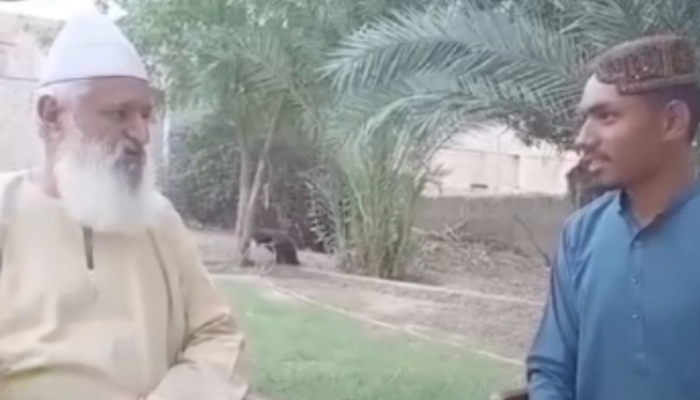
Case Summary
In the Umarkot district of Sindh, Pakistan, a 20-year-old Hindu youth, Suraj Kumar, was converted to Islam after disappearing from his home under unexplained circumstances. According to reports, Suraj remained missing for nearly 48 hours, during which his family searched extensively for him but was unable to ascertain his whereabouts. The family later learned that Suraj had surfaced with a new Islamic identity, "Muhammad Ali." Official accounts stated that he embraced Islam in Gulzar Khalil while he was missing. The sudden conversion, coupled with his unexplained disappearance, raised concerns among members of the local Hindu community regarding the circumstances under which the conversion took place. The conversion was reportedly overseen by Mufti Peer Muhammad Ibrahim Khan, who issued a formal conversion certificate documenting the event. The certificate, dated 1 April 2025, stated that Suraj Kumar had converted to Islam and adopted the name Muhammad Ali. According to the Urdu-language certificate, Suraj Kumar, son of Ramesh Kumar and a resident of Somroo, had renounced Hinduism and embraced Islam. The document further stated that the conversion was undertaken of his own free will and officially certified his new religious identity as Muhammad Ali. The incident attracted attention because it occurred after the Hindu youth had gone missing from his home and remained untraceable for nearly two days before reappearing as a Muslim convert. The circumstances surrounding his disappearance, subsequent conversion, and adoption of a new religious identity further deepened fears among Pakistan's Hindu community, which continues to face a documented pattern of persecution, coercive conversions, and religiously motivated targeting.
Why it is Hate Crime ?
This case is being categorised under the primary category of- Predatory Proselytisation. Under this, the subcategory selected is- Proselytisation by grooming, brainwashing, manipulation or subtle indoctrination. Religious brainwashing essentially means the often subtle and forcible indoctrination to induce someone to give up their religious beliefs to accept contrasting regimented ideas. Religious grooming or brainwashing also involves propaganda and manipulation. It involves the systematic effort, driven by religious malice and indoctrination, to persuade “non-believers’ to accept allegiance, command, or doctrine to and of a contrasting faith. Cases of such grooming or brainwashing are far more nuanced than direct threats, coercion, inducement and violence. In such cases, it is often seen that there is repeated, subtle and continual manipulation of the victim to induce disaffection towards their own faith and acceptance of the contrasting faith of the perpetrator. While subtle indoctrination is widely acknowledged as predatory, an element which is often understated in such conversions or the attempts of such conversion is the role of loyalty and trust which might develop between the perpetrator and the victim. Fiduciary relationships are often abused to affect such religious conversion. For example, an educator transmitting religious doctrine of a competing faith to a Hindu student. The Hindu student is likely to accept what the teacher is transmitting owing to existence of the fiduciary relationship. The exploitation of the fiduciary relationship to religiously indoctrinate victims would also be included in this category. Since the underlying animosity towards the victim’s faith forms the basis of predatory proselytization, such cases are considered religiously motivated hate crimes. n this case, the Hindu victim was subjected to religious conversion under circumstances that raise serious concerns about coercion and vulnerability. The facts indicate that the Hindu youth disappeared from his home and remained missing for nearly 48 hours before resurfacing with a new Islamic identity and a certificate documenting his conversion to Islam. During this period, he was separated from his family and support system, leaving them unaware of his whereabouts and unable to ascertain what had transpired. A significant aspect of the incident is the active role played by a religious authority in formalising the conversion. The conversion was overseen by a Maulvi, who issued a certificate recording the victim's renunciation of Hinduism, acceptance of Islam, and adoption of a new Islamic name. The replacement of the victim's Hindu identity with a new religious identity was not merely symbolic but formed a central outcome of the incident. The circumstances of the case suggest that the victim's Hindu identity was the focal point of the conversion process. The objective was not simply to influence the victim's personal beliefs but to secure his abandonment of Hinduism and acceptance of Islam. Such incidents directly impact an individual's religious autonomy by seeking to replace one faith identity with another. Given the victim's unexplained disappearance, the subsequent conversion process, the involvement of a religious authority, and the formal adoption of a new Islamic identity, this case bears the hallmarks of coercive religious conversion. The underlying offence was directed at a Hindu individual and culminated in the abandonment of his professed faith. In this specific case, it is important to also explain the dynamics of religious conversions in Pakistan. It is true that there are several religious conversions around the world that are completely voluntary and undertaken of one's own free will, driven by a change in faith. However, the broader environment facing Hindus in Pakistan further strengthens concerns in cases involving conversion and religious coercion. Religious conversions in Pakistan have an especially predatory nature. Pakistan, being an Islamic nation, harbours specific animosity towards non-Muslims, especially Hindus. Human rights organisations, minority rights groups, and numerous documented cases have shown that abductions, forced conversions, forced marriages, blasphemy accusations, and intimidation are not isolated incidents but form part of a recurring pattern affecting the Hindu minority. Over the years, Hindu families have repeatedly reported that girls were abducted, converted to Islam, married to their abductors, and then prevented from returning to their families through social, religious, and institutional pressure. The situation is made even more severe by Pakistan's blasphemy laws and the atmosphere surrounding them. Blasphemy accusations often carry devastating consequences, including mob violence, social persecution, and extrajudicial killings. For minority Hindus, the mere threat of such an accusation can become a powerful tool of intimidation. Minority rights advocates have repeatedly warned that this climate of fear makes it difficult for Hindu victims and their families to openly resist coercion, challenge conversions, or seek justice without risking further harm. Viewed cumulatively, these incidents point towards a sustained pattern in which Islamists target vulnerable members of the Hindu minority through coercion, intimidation, conversion pressure, and the misuse of religious and legal mechanisms. The repeated nature of these incidents across different regions of Pakistan ascertains a well-established strategy of marginalising Hindu communities and weakening their ability to preserve their religious identity. Against this backdrop, claims that conversions occur entirely of the victim's own free will cannot be assessed in a vacuum. They must be examined in light of the documented reality of anti-Hindu persecution, conversion-related coercion, blasphemy-linked intimidation, and the wider pressures faced by Hindus living as a vulnerable minority in Pakistan. In most cases, even if the Hindus say they converted out of their own free will, it is most likely to escape persecution if they don't convert to Islam in Pakistan.
Victim Details
Total Victim
1
Deceased
0
Gender
- Male 1
- Female 0
- Third Gender 0
- Unknown 0
Caste
- SC/ST 0
- OBC 0
- General 0
- Unknown 1
Age Group
- Minor 0
- Adult 1
- Senior Citizen 0
- Unknown 0


Case Status
Unknown


Perpetrators Details
Perpetrators
Muslim Extremists
Perpetrators Range
One Person
Perpetrators Gender
male
 Sources




