Hindu religious symbols desecrated through obscene content by Muslim youth; boast of converting Hindu girls in name of "Jihad"
 Kota, Rajasthan, India
  14 June, 2026
Case Summary
In Kota, Rajasthan, Hindu religious sentiments were outraged after pornographic videos depicting girls alongside Hindu religious symbols were found on the mobile phone of a Muslim youth. Furthermore, the accused also talked about impregnating and converting Hindu girls to Islam under the name of "jihad." According to the complaint filed by a Bajrang Dal activist on 15 June 2026, the Muslim youth had been under observation for several months after concerns were raised about his activities through the Bajrang Dal helpline. During the monitoring process, Bajrang Dal workers examined material linked to him and discovered obscene videos and audio recordings involving girls, along with the use of religious symbols. Following the complaint, the Udyog Nagar Police registered a case against the accused under various legal provisions, including those relating to hurting religious sentiments, and initiated an investigation into the matter. The complainant stated that the accused was born into a Hindu family, was educated up to Class 10, worked at a local shop, and was married with a four-year-old child. During the course of the inquiry, attention was drawn to several social media and messaging groups bearing names such as “Pathan Saheb”, “Auction of Sanatanis”, “Dominance of Muslim Sandos”, “Telegram Interfaith”, and “Inter Love Zone”. The complaint stated that these groups operated through platforms including Telegram, Snapchat, and Discord and were involved in efforts to target Hindu girls and women. It was further stated that individuals connected to these networks were indoctrinated and used to lure Hindu women, after which explicit content featuring religious symbols was created and circulated across online channels. Additionally the accused made the statement that one of the "jihad" is impregnating and converting Hindu girls to Islam. The complaint further stated that the networks behind these activities were operating from Pakistan and were engaged in spreading anti-Hindu propaganda through fake social media identities. According to the information submitted to the police, the objective of the campaign was to insult Hindu religious symbols, promote hostility against Hinduism, and facilitate the targeting and conversion of Hindu women on a wider scale. Concerns were also raised regarding the targeting of organisations associated with Hindu causes and the potential implications for national security and social harmony. The complainant urged authorities to conduct a high-level investigation into the wider network behind the online groups and the circulation of the objectionable content. Police registered the FIR and commenced an investigation into the matter.
Case Images
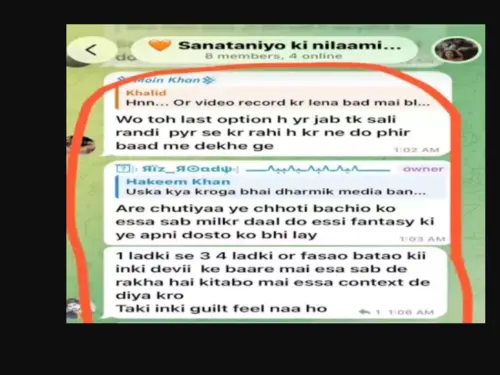
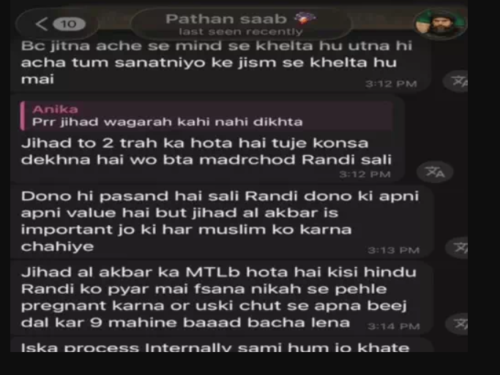
Why it is Hate Crime ?
This case has been added to the tracker under the primary category of - Hate speech against Hindus. Within it, the sub-category selected is - Anti-Hindu slurs, mocking faith. Anti-Hindu slurs and the deliberate mocking of the Hindu faith owing to religious animosity involve the usage of derogatory terms, stereotypes, or offensive references to religious practices, symbols, or figures. One of the common anti-Hindu slurs used against Hindus is “cow-worshipper” and “cow piss drinker”. The intention of using this term is to demean and mock Hindus as a group and their religious beliefs since Hindus consider the cow holy. Additionally, some symbols and the slurs attached to them have a historical context that exacerbates the insult, hate, stereotyping, dehumanisation and oppression against Hindus. Cow worship has been used for centuries to denigrate Hindus, insult their faith and oppress Hindus specifically as a religious group. There has been overwhelming documentation about how cow slaughter has been used to persecute Hindus with cow meat being thrown in temples and places of worship. There has also been overwhelming documentation where cow meat (beef) has been force-fed to Hindus to either forcefully convert them to Islam or denigrate their faith. Apart from cow worship, the Swastika – which holds deep religious significance for the Hindus – has also been misinterpreted and distorted to use as a slur against Hindus. Similarly, the worship of the Shivling has been used by supremacist ideologies and religions to denigrate Hindus owing to religious animosity. Such slurs and denigration stem out of inherent animosity and hate towards Hindus and their faith, therefore, it is categorised as hate speech targeted at Hindus specifically owing to their religious identity. The other sub-category selected here is - Anti Hindu subversion and prejudice. Hate speech is defined as any speech, gesture, conduct, writing, or display that is prejudicial against a specific individual and/or group of people, which is leading to or may lead to violence, prejudicial action or hate against that individual and/or group. Media plays a specific and overarching reach in perpetuating prejudicial attitudes towards a community owing to unfair, untrue coverage and/or misrepresentation/misinterpretation, selective coverage and/or omission of facts of/pertaining to issues affecting a specific religious group. This type of bias can dehumanise the victim group, making it easier for others to justify harmful actions against them, which aligns with the objectives of hate speech laws aimed at preventing such harm. It is often observed that the media takes a prejudicial stand against the Hindu community driven by their need to shield the aggressor community which happens to be a numeric minority, however, is the one perpetrating violence against Hindus. For example, the media is often quick to contextualise religiously motivated crimes against Hindus, omit or misrepresent facts that point towards religiously motivated hate crimes, justify and/or downplay religiously motivated hate crimes or simply present fake news to stereotype Hindus. Such media bias leads to the denial of persecution and is often used to dehumanise Hindus, leading to justification for violence against them. For example, the media covered several fake allegations of Hindus targeting Muslims and forcing them to chant Jai Shree Ram. Most of these cases were proved false and fabricated after police investigation. These fake news reports were subsequently never retracted or clarified. Such fake news led to the justification of violence and dehumanisation of Hindus based on the argument that since Hindus targeted Muslims and forced them to chant Jai Shree Ram, the dehumanisation of Hindus and violence against them was par for the course and merely a retaliation. Such media bias leads to prejudicial portrayal of Hindus and offers a justification for violence against them and therefore, is considered hate speech under this category. The second primary category selected here - Attack on Hindu religious representation. Within it, the sub-category selected here is - Iconoclastic representation of Hindu Gods/Goddesses. An icon is a symbol of someone or something that is revered, or a religious representation of a spiritual ideal. Iconography is of vital significance in the Hindu milieu. It helps connect people’s spiritual beliefs with the real world. Iconography within the Hindu faith takes several shapes and forms. Murtis are of most significance to Hindus, to which daily rituals, prayers and offerings are done. Besides the murtis, there are several other symbols which have deep significance in the Hindu faith – the Om and Swastika for example. Any iconoclastic representation of these symbols, images and murtis is an affront to the religious beliefs and faith of the Hindu community itself since the symbols and icons are deeply religious in nature. In this sub-category of crime, we would record hate crimes and iconoclastic representations, in words, art, or any other form of representations of symbols that hold religious significance for the Hindu community. Since these symbols, icons and murtis are central to the Hindu faith, any iconoclastic representation of these symbols is born out of animosity towards the faith itself, manifesting itself through these symbols and therefore, these representations would be considered religiously motivated hated crimes. This case has been included in the tracker because the objectionable material recovered from the accused's mobile phone consisted of pornographic videos in which Hindu religious symbols were featured alongside sexually explicit content. The inclusion of sacred religious symbols in pornography is not a neutral or incidental act. Hindu religious symbols hold profound spiritual, cultural, and devotional significance for millions of Hindus and are treated with reverence in everyday religious life. Their deliberate placement within obscene content strips them of their sanctity and reduces them to objects of sexualisation, mockery, and degradation. Such conduct goes beyond the mere possession or circulation of pornographic material and enters the realm of religious desecration, as it involves the use of symbols associated with a faith community in a manner that is inherently insulting and offensive. By depicting or associating sacred Hindu imagery with pornography, the content effectively attacks the dignity of the religion itself and was as an attempt to humiliate, provoke, and outrage members of the Hindu community. The content made by the accused was connected to online groups and channels that specifically referenced Hindus, Sanatan Dharma, and interfaith targeting. These networks were involved in creating and distributing explicit material featuring Hindu women and Hindu religious symbols. The anti-Hindu nature of the incident is further reinforced by the context in which the material was created, stored, and circulated. The content was linked to online networks and channels that specifically referenced Sanatan Dharma, Hindus, and interfaith targeting campaigns and these platforms were used to circulate explicit material featuring hostility against Hindu religious symbols and Hindu women. The accused also made statements describing the impregnation and conversion of Hindu girls to Islam as a form of "jihad." Such statements are significant because it underscored that Hindu women were not being viewed as individuals but as targets for Muslims. The invocation of jihad while discussing the conversion of Hindu women demonstrated an ideological dimension that extends beyond personal conduct. When explicit content involving Hindu religious symbols is coupled with rhetoric advocating the targeting, impregnation, and conversion of Hindu girls, it strengthens the inference that the actions were motivated by hostility towards Hindu religious identity and were intended The complaint additionally described the existence of organised online groups that promoted anti-Hindu narratives and sought to target Hindu women through coordinated digital networks. The significance of this aspect lies not only in the circulation of obscene material but also in the apparent pattern of behaviour underlying it. The objective of creating and sharing explicit content featuring Hindu religious symbols suggests an attempt to weaponise sexuality and obscenity as tools for religious humiliation. Throughout history, attacks on a community's sacred symbols have often been used as a means of asserting dominance, expressing contempt, and inflicting psychological harm on members of that community. In this case, the use of Hindu symbols in pornographic material had the effect of degrading objects and imagery that Hindus regard as sacred. Such acts contribute to an atmosphere of hostility towards Hindus by normalising disrespect for their religious beliefs and portraying their sacred symbols in a vulgar and humiliating context. For these reasons, this case warrants inclusion in the tracker as a hate incident targeting Hindus.


Case Status
Complaint filed


Perpetrators Details
Perpetrators
Muslim Extremists
Perpetrators Range
One Person
Perpetrators Gender
male
 Sources




