Hindu woman tricked into temple marriage by married Muslim man posing as Hindu, forced to convert and undergo nikah after his identity was revealed
 Lucknow, Uttar Pradesh, India
  18 June, 2026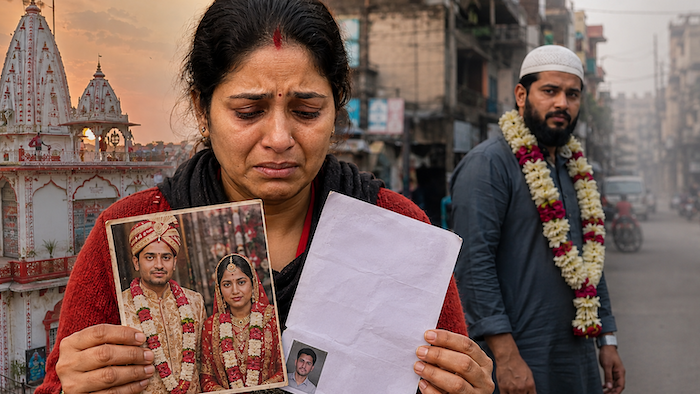
Case Summary
A Hindu woman from Lucknow was deceived into a relationship and marriage by a Muslim man, Atiq Khan, who concealed both his religious identity and the fact that he was already married with a child. Presenting himself as "Prateek Arya," he developed a relationship with the Hindu woman and eventually married her in an Arya Samaj temple according to Hindu rituals. The victim stated that she met Atiq Khan in 2012, when he introduced himself as Prateek Arya and represented himself as a Hindu man. Trusting the identity he presented, she entered into a relationship with him. Over time, the relationship deepened and culminated in a marriage solemnised according to Hindu customs in an Arya Samaj temple. At no point before the marriage did Atiq disclose that he was a Muslim or that he was already married and had a child. Soon after the marriage, the Hindu woman discovered that the man she had married as Prateek Arya was in fact Atiq Khan. Following the revelation of his religious identity, Atiq Khan and his parents began pressuring her to convert to Islam and undergo nikah. She stated that they made it clear that continuing the marriage was contingent upon her accepting Islam and participating in Islamic marriage rituals. By this stage, having already entered into the marriage and become emotionally invested in the relationship, she felt compelled to comply with these demands. The victim stated that she subsequently began observing roza and following Islamic religious practices. However, further revelations about Atiq Khan's life soon emerged. In 2013, she discovered that he was maintaining another marital relationship and that his first wife and child were living in Delhi. She also learned that money and jewellery taken from her during the course of the marriage had been transferred to his first wife. As more information about Atiq Khan's true identity, marital status, and relationships came to light, the foundation on which the Hindu woman had entered the marriage collapsed. The deception extended beyond religion and encompassed multiple aspects of his personal life that had been deliberately concealed from her. The matter escalated when the Hindu woman travelled from Lucknow to Delhi in search of Atiq Khan after uncovering the deception. A confrontation took place in the Sagarpur area of southwest Delhi, where she publicly confronted him. Videos of the incident later circulated widely on social media. In the videos, the victim recounted her ordeal and stated that Atiq Khan had gone on to marry a third woman after abandoning both his previous wives. She further stated that Atiq Khan and members of his family had forced the women into prostitution for financial gain. During the confrontation, the first and second wives were seen physically confronting the accused in public. The case drew attention because the relationship and marriage were established through the concealment of religious identity and marital status, after which the victim faced pressure to convert to Islam and undergo nikah. The disclosures made by the victim and the subsequent confrontation brought renewed scrutiny to the circumstances under which the marriage had taken place and the deception that preceded it.
Why it is Hate Crime ?
This case has been added to the tracker under the primary category of - Crimes against women in relationships and other sexual crimes. Within this, the sub-category selected is - Man pretends to be Hindu. Under this, the tertiary category selected is - Name Changed. When a non-Hindu man pretends to be a Hindu to deceive a Hindu woman into a relationship, the act is seen as triggered by malafide intentions. In some cases, the woman eventually accepts the man’s original religious identity and converts after the man’s identity is revealed. These cases could be argued as cases of religious brainwashing and a result of the pressure a woman feels after getting into a relationship with a man. The woman, it can be argued, also changed her religious identity because of the stigma she believes she might face if she chooses to walk out of a deceptive relationship. However, for the purpose of documenting hate crimes, the cases in this subcategory are limited to those where there is explicit violence aimed at religious conversion against the wishes of the victim (force-feeding beef, blackmailing with intimate videos, rape on refusal to convert, etc), or if the woman herself complains of the man’s religious deception. In such cases, it is established that the deception of the non-Hindu man had a specific aim of religious conversion or targeting of the victim due to her Hindu religious identity, therefore, making it a religiously motivated hate crime. The other sub-category selected is - Forced conversion after marriage, with the tertiary category being - Forced to do Nikah. In such cases, a non-Hindu man marries a Hindu woman, and the force/pressure to convert to any Abrahamic faith, like Islam, begins after marriage. In such cases, typically, two patterns emerge. First, when the relationship is consensual, and the religious identity of the perpetrator is known to the Hindu woman in the relationship. The marriage could be under the Special Marriages Act, where neither parties are required to convert their religion for the marriage to be considered legitimate. While the victim in such cases enters matrimony assuming that religious identity is not a barrier, the non-Hindu man starts to pressure the woman to convert her religion after marriage. The second is when the woman gets into a marriage with the man, pretending to share her faith. Later, when the truth is revealed, the man starts pressuring the woman to convert her religion and give up her religious identity. In both situations, there is application of force by the perpetrator, including the denial of the woman’s religious rights. Some of the means by which the woman is forced/pressured to convert include force-feeding beef, being forced to read the Kalma, being forced to wear a hijab, forced to undergo Halala, etc. There are several instances where, after marriage, the woman voluntarily converts to Islam. Such cases are often argued to be a result of religious brainwashing, however, for the purpose of documenting religiously motivated hate crimes, in the absence of the victim complaining of forced conversion, such cases do not form a part of the database. The other subcategory is- Brainwashed and/or groomed. The tertiary category is- Victim says she was brainwashed/groomed. In our database, we have not added incidents where women have converted to another religion of their free will and no allegations of forced/involuntary conversion have been made. However, there are certain cases of conversion where the consent itself is a result of the brainwashing or grooming of a minor by the non-Hindu perpetrator trying to victimise a woman for her Hindu religious identity. The phenomenon of grooming points to non-Hindu perpetrators identifying their Hindu victims’ vulnerabilities and exploiting them over months and sometimes years, to extract the supposed ‘consent’ in order to convert their religion. In most cases of grooming, the victims are minors or the grooming started when the victim was a minor. In other cases of grooming, the non-Hindu perpetrator brainwashes and grooms a minor victim to extract their trust and then proceeds to rape them repeatedly with the intent of converting them to their faith. It is pertinent to understand here that when the victim is a minor, the ‘consent’ to convert or enter into a romantic relationship with an adult itself is redundant – addressed by POCSO. While every case of conversion of a minor and incidents of establishing a physical relationship with a minor by an adult is a crime, for the purpose of this database, a case would be considered a hate crime only if there is a distinct religious angle to the grooming. For example, in the UK, if a Hindu minor is targeted by Pakistani grooming gangs, it would be considered a hate crime because the victims are specifically targeted owing to their non-Muslim religious identity with the perpetrators being Muslim. In other cases, if a Hindu minor is brainwashed into entering a physical relationship with the non-Hindu adult perpetrator and the family alleges grooming/brainwashing of the minor to convert her religion, it would form a part of this database. If the victim is a Hindu adult, the case would form a part of this database only if the victim herself says that she was brainwashed/groomed to convert her religion. However, if the victim is deceased (murdered or otherwise), the case would form a part of this database if her family/friends provided testimony that the victim was brainwashed/groomed to convert her religion. Since these crimes have a distinct religious angle where the victim is being targeted owing to her Hindu religious identity, these cases are considered a hate crime. This case exhibits clear religiously motivated targeting because the Muslim perpetrator deliberately concealed his religious identity and presented himself as a Hindu in order to gain the trust of a Hindu woman and secure a marital relationship with her. The deception was not incidental to the relationship but formed the foundation upon which it was established. By hiding his identity as Atiq Khan and presenting himself as “Prateek Arya”, the perpetrator created a false impression of religious compatibility and shared cultural background. Such conduct demonstrates a calculated effort to exploit the trust and familiarity associated with Hindu identity in order to gain access to a Hindu woman who may have made different decisions had she been aware of his true identity from the outset. The use of a fabricated Hindu persona was therefore not merely a personal deception but a religiously significant act aimed at circumventing the victim's ability to make informed choices based on accurate knowledge of the other person's faith and background. The deliberate adoption of the Hindu name “Prateek Arya” further strengthens the religious dimension of the targeting. Names are among the most visible markers of religious and cultural identity, and the decision to abandon a Muslim identity and assume a Hindu one demonstrates a conscious recognition that the victim's trust could be more easily secured through the appearance of belonging to the same faith community. The deception relied upon exploiting the social confidence, familiarity, and acceptance associated with a perceived Hindu identity. Rather than approaching the victim honestly, the perpetrator used a fabricated Hindu identity as a tool to build trust, establish a relationship, and ultimately secure marriage. The fact that this deception occurred while he already had another wife further highlights the calculated nature of the targeting and demonstrates that the false Hindu identity was instrumental in enabling the relationship to progress. The religious significance of the marriage ceremony is also substantial. By participating in marriage rites as a Hindu in a temple despite concealing his true religious identity, the perpetrator used Hindu religious customs and sacred institutions as instruments of deception. Hindu marriage rituals hold deep religious and cultural significance and are traditionally undertaken with the expectation of honesty and mutual consent. When an individual enters such a ceremony while concealing a fundamental aspect of their identity, the sanctity of those religious rites is undermined and exploited for personal gain. Marrying the victim in the temple in this manner demonstrates a disregard for the religious significance attached to them and reflects an intentional effort to utilise Hindu traditions to secure a relationship that was built upon religious misrepresentation from the outset. The pressure exerted upon the Hindu woman to convert after the marriage carries an even stronger religious dimension because it directly targeted her faith and religious identity. The issue was no longer merely concealment of identity but an active effort to replace the victim's existing religious beliefs with another faith. Such conduct represents an attempt to erase an individual's religious identity and compel them to abandon the beliefs, customs, traditions, and community to which they belong. The victim's Hindu identity became the subject of pressure and transformation, demonstrating that her faith was not incidental but central to the actions directed against her. Efforts to compel a Hindu woman to renounce her religion after first securing a relationship through deception indicate a pattern in which the victim's religious identity was deliberately targeted for alteration and removal. The coercion to undergo a Nikah further reinforces the religiously motivated nature of the conduct. A Nikah is not merely a social or administrative process but an Islamic religious institution that carries specific religious significance. Pressuring a Hindu woman into participating in such a ceremony after concealing one's identity and after efforts to secure conversion reflects an attempt to draw the victim into an entirely different religious framework against the backdrop of deception. The sequence of events demonstrates that the objective extended beyond maintaining a personal relationship and moved towards replacing the victim's Hindu identity with a new religious identity and marital structure rooted in another faith tradition. Such actions disregard the victim's religious autonomy and her right to make informed decisions regarding matters of faith and marriage. Overall, the concealment of a Muslim identity, the adoption of the Hindu name “Prateek Arya”, the use of Hindu marriage rituals while operating under a false identity, the pressure to convert after marriage, and the coercion to participate in a nikah establish clear religiously aggravating elements. The victim's Hindu identity was not merely a characteristic she happened to possess; it was specifically exploited, manipulated, and subjected to sustained efforts at religious transformation. The pattern of conduct demonstrates that religion was central to the targeting process and that the Hindu woman's faith became the focus of deception, coercion, and attempts at erasure, making this a clear case of religiously motivated targeting. Disclaimer: The exact date of when the Hindu woman and the Muslim perpetrator first came into contact was not specified in the available sources. However, the incident became publicly known through reports published on 19th June 2026. Accordingly, the Hinduphobia Tracker has recorded the respective date as the incident date for documentation purposes only.
Victim Details
Total Victim
1
Deceased
0
Gender
- Male 0
- Female 1
- Third Gender 0
- Unknown 0
Caste
- SC/ST 0
- OBC 0
- General 0
- Unknown 1
Age Group
- Minor 0
- Adult 1
- Senior Citizen 0
- Unknown 0


Case Status
Unknown


Perpetrators Details
Perpetrators
Muslim Extremists
Perpetrators Range
One Person
Perpetrators Gender
male
 Sources




