Anti-Hindu bias: NDTV journalist downplays glorification of Islamist "Sar Tan Se Juda" clarion call popularised to target Hindus
 India
India  18 June, 2026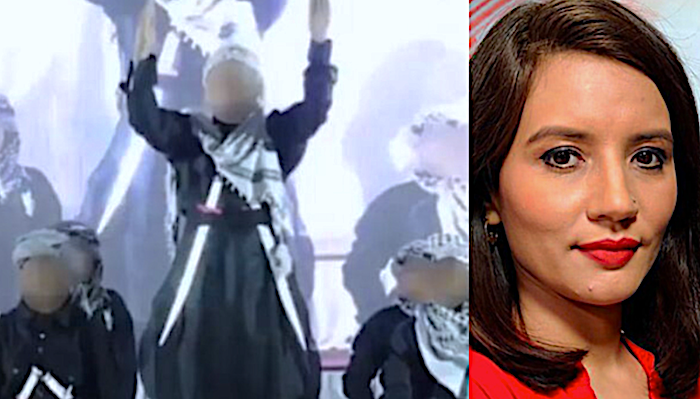
Case Summary
A prominent journalist downplayed the glorification of the Islamist clarion call "Sar Tan Se Juda", a slogan that has been repeatedly used to target and intimidate Hindus, by portraying it merely as a song from a Turkish television series. The comments came after a school function in Maharashtra, where children performed to the slogan while carrying dummy swords, had already become the subject of police action and widespread public concern. Rather than addressing the slogan's extremist connotations or the appropriateness of exposing schoolchildren to such content, the journalist's remarks sought to trivialise the incident by shifting the focus to the song's origin. The controversy stemmed from an annual function organised by Kids World English School in Partur, Jalna district, Maharashtra, an incident that had already been documented separately by the Hinduphobia Tracker. Videos from the programme showed schoolchildren performing with dummy swords to the song "Gustakh-e-Nabi Ki Ek Saza, Sar Tan Se Juda." The performance drew widespread criticism because the slogan "Sar Tan Se Juda" has, in recent years, become synonymous with Islamist calls for beheading and violence against those accused of insulting Islam. It has repeatedly been invoked in threats, intimidation campaigns, and acts of violence directed against non-Muslims, particularly Hindus. The incident prompted complaints from members of the public, who questioned the appropriateness of presenting content associated with extremist religious slogans during a school function. On 17 June 2026, police registered a First Information Report against individuals connected with organising the programme under various provisions of the Bharatiya Nyaya Sanhita relating to promoting enmity between groups, spreading misinformation affecting national integration, circulating false information likely to cause public alarm, and acts affecting the sovereignty, unity, and integrity of India. The registration of the FIR reflected the seriousness with which the authorities viewed the incident and intensified public scrutiny of the programme. Amid these developments, Gargi Rawat Ansari, who has worked as a television journalist, news anchor, and Consulting Editor at NDTV, commented on the controversy in a social media post on 19 June 2026. In her post, she highlighted statements made in defence of the programme and described the song as originating from the Turkish television series Ertugrul, thereby framing the controversy primarily around the song's source rather than its content or the violent symbolism attached to the slogan. The post drew criticism for overlooking the central issue raised by the incident. The concern was never the geographical origin of the song but the fact that schoolchildren had been made to perform to a slogan that has become an internationally recognised Islamist rallying cry associated with calls for beheading those accused of blasphemy. Critics argued that reducing the issue to the song's appearance in a television serial ignored the slogan's established association with religious extremism and its repeated use to justify or glorify violence, including against Hindus. The criticism assumed greater significance because the comments were made after criminal proceedings had already been initiated in connection with the event. The incident subsequently expanded beyond the school programme itself to include questions regarding the role of influential journalists and media personalities in shaping public understanding of incidents involving religious extremism. Critics argued that by focusing on the song's Turkish origin while ignoring its extremist associations and the concerns that had led to police action, the commentary had the effect of downplaying the glorification of an Islamist clarion call that has repeatedly been used to threaten, intimidate, and incite violence against Hindus. The present case, therefore, concerns the public trivialisation of a documented anti-Hindu incident. Rather than acknowledging the gravity of schoolchildren performing to a slogan closely associated with Islamist violence and the targeting of Hindus, the commentary reframed the issue in a manner that diminished its seriousness and diverted attention away from the concerns that had prompted criminal proceedings.
Why it is Hate Crime ?
This case has been added to the tracker under the primary category - Hate Speech against Hindus. Within this, the subcategory selected is - Anti-Hindu subversion and prejudice, with the tertiary category being - Anti-Hindu fake news or downplaying. Hate speech is defined as any speech, gesture, conduct, writing, or display that is prejudicial against a specific individual and/or group of people, which is leading to or may lead to violence, prejudicial action or hate against that individual and/or group. Media plays a specific and overarching reach in perpetuating prejudicial attitudes towards a community owing to unfair, untrue coverage and/or misrepresentation/misinterpretation, selective coverage and/or omission of facts of/pertaining to issues affecting a specific religious group. This type of bias can dehumanise the victim group, making it easier for others to justify harmful actions against them, which aligns with the objectives of hate speech laws aimed at preventing such harm. It is often observed that the media takes a prejudicial stand against the Hindu community driven by their need to shield the aggressor community which happens to be a numeric minority, however, is the one perpetrating violence against Hindus. For example, the media is often quick to contextualise religiously motivated crimes against Hindus, omit or misrepresent facts that point towards religiously motivated hate crimes, justify and/or downplay religiously motivated hate crimes or simply present fake news to stereotype Hindus. Such media bias leads to the denial of persecution and is often used to dehumanise Hindus, leading to justification for violence against them. For example, the media covered several fake allegations of Hindus targeting Muslims and forcing them to chant Jai Shree Ram. Most of these cases were proved false and fabricated after police investigation. These fake news reports were subsequently never retracted or clarified. Such fake news led to the justification of violence and dehumanisation of Hindus based on the argument that since Hindus targeted Muslims and forced them to chant Jai Shree Ram, the dehumanisation of Hindus and violence against them was par for the course and merely a retaliation. Such media bias leads to prejudicial portrayal of Hindus and offers a justification for violence against them and therefore, is considered hate speech under this category. This incident is classified as a hate crime and added to the Hinduphobia Tracker because it involved the public trivialisation of the glorification of an Islamist slogan that has, in recent years, become synonymous with threats and acts of violence against Hindus. The journalist's intervention did not occur in a neutral context. It came after widespread public concern had already been raised regarding a school event in which children performed to a song associated with the slogan “Sar Tan Se Juda”, a phrase that has acquired a well-established association with Islamist intimidation, threats of beheading, and violence directed against those perceived to have insulted Islamic religious figures. Rather than engaging with concerns about the slogan's history, its use by extremist elements, and its impact on communities threatened under its banner, the journalist reduced the controversy to a discussion of the song's presence in a Turkish television series. By shifting attention away from the slogan's documented associations and focusing instead on its appearance in popular entertainment, the seriousness of the issue was substantially diluted. The religious significance of this conduct lies in the fact that “Sar Tan Se Juda” is not merely a song lyric or cultural expression. Over time, it has become one of the most recognisable slogans associated with demands for violence against perceived blasphemers and has featured prominently in incidents that generated fear among Hindus and other non-Muslim communities. The slogan became closely linked with an atmosphere of radicalisation that surrounded killings such as those of Kanhaiya Lal and Umesh Kolhe, where accusations of blasphemy preceded acts of lethal violence. By reducing the issue to the fact that the song originated from a Turkish television series, the commentary overlooked the slogan's well-documented association with Islamist violence and diminished the gravity of its public glorification. The remark made by the journalist also reflects a broader pattern of anti-Hindu bias, where concerns about hatred or violence directed at Hindus are often dismissed or treated as less serious than they actually are. When a slogan that has repeatedly been used to threaten and justify violence against Hindus is described simply as a song from a television series, it ignores what that slogan has come to represent for the Hindu community. For many Hindus, "Sar Tan Se Juda" is not just a phrase. It is a slogan that has been raised before threats, intimidation, and even murders carried out in the name of blasphemy. Downplaying its significance overlooks the fear and trauma associated with it and sends the message that anti-Hindu hostility does not deserve the same level of concern. Such selective dismissal of Hindu concerns stems from a deeper animosity towards, and disregard for, the Hindu faith and the lived experiences of those who have been targeted because of it and, therefore, warrrants inclusion in the tracker.


Case Status
Unknown


Perpetrators Details
Perpetrators
Others
Perpetrators Range
One Person
Perpetrators Gender
female
 Sources




