Dalit Hindu man stabbed over minor road dispute; victims say Muslim ob targeted them for being Hindus, Muslim Policeman encouraged assault
 East Delhi, Delhi, India
  11 June, 2026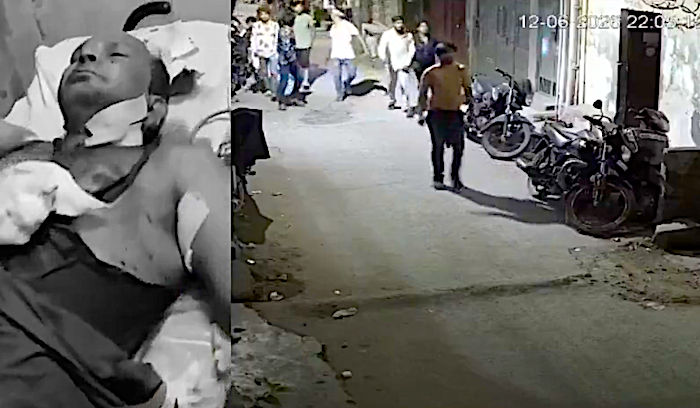
Case Summary
In the Bhikam Singh Colony area under Farsh Bazar Police Station in Delhi, a Hindu youth was subjected to caste-based abuse, and his family was subsequently attacked by a Muslim mob over a trivial road dispute. The family of the victim said they were targeted because of their Hindu identity, with the accused questioning how a Dalit could speak to them in a raised voice. They also accused a Muslim policeman of abetting the assault. On 12th June 2026, the Hindu youth Vansh was driving through a lane in Bhikam Singh Colony with a friend when he saw some Muslim youths, including Imran, Shahrukh, and others, standing on the road. Since the Muslim youths were obstructing his path, Vansh asked them to move aside so that the vehicle could pass. The Muslim youths became aggressive in response to this request. They pulled Vansh and his companion out of the vehicle, assaulted them, and subjected them to caste-based abuse. As the assault intensified, Vansh contacted his uncle Kuldeep and asked him to come to the scene. Kuldeep arrived to help his nephew and intervened in the dispute. Following the intervention, Vansh and his uncle Kuldeep returned home. According to the family, a short while later, a mob of around 30 to 35 people, including burqa-clad women, arrived outside their residence. The family stated that the mob was armed with knives, iron rods, and sticks and was accompanied by police personnel. According to the family's account, on seeing the armed mob approach, they immediately went inside the house and locked the doors, hoping to protect themselves. The mob then gathered outside the house and called upon Kuldeep to come out. The family believed they would be safe because police personnel were present with the crowd. Trusting that the officers would prevent any violence, Kuldeep stepped outside to speak to them. However, according to the family, the moment he came out, members of the Muslim mob attacked him with knives. The accused stabbed Kuldeep multiple times, inflicting serious injuries to his chest and neck. Vansh was also assaulted. The victims were rushed to Dr Hedgewar Hospital for treatment. According to the victims and their family members, the Muslim mob made remarks referencing their caste and questioned how a Dalit Hindu could speak to them in such a manner. The family stated that the victims were targeted because they were Hindus and belonged to the Dalit community. Kuldeep's wife further said that the attack took place in the presence of Muslim Police Constable Nafis, who was at the scene during the violence. According to Kuldeep's wife, she repeatedly pleaded with a police officer to intervene and save her husband, but the constable did not intervene; instead, he filmed the incident as it unfolded. They maintained that repeated opportunities existed to prevent or minimise the violence, but no intervention occurred while the victims were being assaulted. According to Kuldeep's wife, the officer brushed away her request by saying, "Don't we also have children and families? Why should we take the risk?" The family further stated that they dialled the police emergency number 100 seeking immediate assistance, but no help arrived while the attack was taking place. The victims maintained that the accused targeted them because they were Hindus from the Dalit community. They said that the assailants told them that, being Dalits, they had no right to speak in a raised voice. The victims also confirmed that despite approaching the police on the day of the incident, no FIR was initially registered against the accused. According to the family, their complaint was ignored because they were Hindus. The victims further maintained that discrimination influenced the handling of the incident and pointed to the conduct of the police officer present at the scene as evidence of this concern. Following public attention and complaints by the victims' family, a police case was registered, and an investigation was initiated. Senior police officials stated that the matter was under investigation and that action would be taken based on the findings. They rejected the allegation of police bias, stated that the accused would be arrested soon, and added that if the involvement or negligence of any police officer was established during the investigation, appropriate action would be taken against the officer concerned.
Why it is Hate Crime ?
This case has been added to the tracker under the primary category - Attack resulting in death. Within this, the subcategory selected for this case is - Attacked for Hindu identity. In several cases, Hindus are attacked merely for their Hindu identity without any perceived provocation. A classic example of this category of religiously motivated hate crime is a murder in 2016. 7 ISIS terrorists were convicted for shooting a school principal in Kanpur because they got ‘triggered’ seeing the Kalava on his wrist and tilak that he had put. In this, the Hindu victim had offered no provocation except for his Hindu religious identity. The motivation for the murder was purely religious, driven by religious supremacy. Such cases where Hindus are targeted merely for their religious identity would be documented as a hate crime under this category. The other selected subcategory is - Attacked for opposing radicals or trying to save a victim. In several cases, Hindus are attacked for opposing religiously motivated crimes being committed against a fellow Hindu or simply for voicing an opinion opposing radical elements, who either have in the past or continue to persecute Hindus. In such cases, the initial attack against the victim, against which the Hindu was trying to defend the victim, would also need to be classified as a religiously motivated hate crime. Since the initial crime itself was religiously motivated and the subsequent crime of attempting to save the victim or speaking against the radical elements ends up inviting a violent attack, it would also be classified as a religiously motivated hate crime under this category. Another primary category selected for this case is - Hate speech against Hindus. The selected subcategory is - Anti-Hindu slurs, mocking faith. Anti-Hindu slurs and the deliberate mocking of the Hindu faith owing to religious animosity involve the usage of derogatory terms, stereotypes, or offensive references to religious practices, symbols, or figures. One of the common anti-Hindu slurs used against Hindus is “cow-worshipper” and “cow piss drinker”. The intention of using this term is to demean and mock Hindus as a group and their religious beliefs since Hindus consider the cow holy. Additionally, some symbols and the slurs attached to them have a historical context that exacerbates the insult, hate, stereotyping, dehumanisation and oppression against Hindus. Cow worship has been used for centuries to denigrate Hindus, insult their faith and oppress Hindus specifically as a religious group. There has been overwhelming documentation about how cow slaughter has been used to persecute Hindus with cow meat being thrown in temples and places of worship. There has also been overwhelming documentation where cow meat (beef) has been force-fed to Hindus to either forcefully convert them to Islam or denigrate their faith. Apart from cow worship, the Swastika – which holds deep religious significance for the Hindus – has also been misinterpreted and distorted to use as a slur against Hindus. Similarly, the worship of the Shivling has been used by supremacist ideologies and religions to denigrate Hindus owing to religious animosity. Such slurs and denigration stem out of inherent animosity and hate towards Hindus and their faith, therefore, it is categorised as hate speech targeted at Hindus specifically owing to their religious identity. The targeting of the victims in this case carried clear religiously aggravating elements because their Hindu identity became central to the hostility, intimidation, and violence they faced. What began as a minor interaction did not remain an ordinary disagreement. Instead, the confrontation escalated into a violent attack directed at Hindu victims, culminating in serious physical injuries. The victims were not targeted for any criminal act or unlawful conduct but became the focus of aggression because of who they were. The use of violence against Hindu individuals in circumstances where the response was grossly disproportionate to the initial interaction demonstrates that their religious identity became a source of vulnerability and hostility. The fact that the confrontation ultimately resulted in a coordinated assault against members of a Hindu family reinforces the conclusion that the victims' Hindu identity was not incidental to the violence but formed an important part of the targeting process. The attack also falls within the category of violence directed at those who oppose radical elements or attempt to protect victims from ongoing aggression. The initial interaction was minor in nature, yet it was the Muslim perpetrators who escalated the situation into a violent confrontation. Rather than allowing the matter to end, they returned with additional associates and launched a further assault. Most significant is the fact that Kuldeep became a victim only because he intervened to protect his nephew and family member from the ongoing aggression. His involvement was not offensive or provocative; it was an attempt to rescue and defend a Hindu relative who was already under attack. The subsequent stabbing of Kuldeep demonstrates hostility towards those who resist or challenge such aggression. The violence therefore extended beyond the original victim and encompassed anyone who sought to shield Hindu family members from harm. The concerns raised regarding the conduct of Muslim Police Constable Nafis further deepen the gravity of the incident. According to the victims and their family, despite being present during the assault, he remained passive and failed to intervene while Hindu victims were being attacked. The family stated that he filmed the incident instead of stopping it, creating a perception that the victims were denied the protection they expected from law enforcement while facing violence from Muslim perpetrators because they shared the same religion as him. This perceived indifference strengthened the victims' belief that they had been left vulnerable while attempting to defend themselves and their family members. The religiously motivated nature of the attack is further reinforced by the use of caste-based slurs directed at the victims. It can be argued that such abuses were aimed at the victims' micro identity as members of the Dalit community rather than their Hindu identity itself. However, as far as hostility emanating from adherents of Abrahamic faiths towards Hindus is concerned, distinctions of caste, region, or language often become secondary, while the victim's broader Hindu identity remains central. In this case, the casteist insults were not used in isolation but formed part of a larger pattern of intimidation, violence, and humiliation directed at Hindu victims. The derogatory references to their Dalit background were employed to demean, subordinate, and degrade them while reinforcing their perceived vulnerability. The slurs were therefore not merely personal insults but identity-based attacks aimed at a section of the Hindu community. When viewed alongside the subsequent assault and threats, the caste-based abuse demonstrates that the perpetrators targeted the victims not only as individuals but as Hindu Dalits whose identity was treated with contempt. Therefore, the combination of anti-Hindu hostility, caste-targeted humiliation, and physical violence establishes clear religiously aggravating elements that warrant the inclusion of this case in the Hinduphobia Tracker. Disclaimer: The Hinduphobia Tracker also acknowledges that multiple Muslim perpetrators were involved in the assault, stabbing, intimidation, and threats directed against the Hindu Dalit victims and their family. However, as only Imran and Shahrukh were explicitly identified in the available reports, the perpetrator count has been recorded as 2. Available accounts indicate that several additional unnamed associates and family members also participated in the mob attack, but their identities were not disclosed in the sources reviewed. Accordingly, while the tracker records two identified perpetrators, it notes that the violence was carried out by a larger group comprising additional unidentified individuals.
Victim Details
Total Victim
2
Deceased
0
Gender
- Male 2
- Female 0
- Third Gender 0
- Unknown 0
Caste
- SC/ST 2
- OBC 0
- General 0
- Unknown 0
Age Group
- Minor 0
- Adult 1
- Senior Citizen 0
- Unknown 1


Case Status
Complaint filed


Perpetrators Details
Perpetrators
Muslim Extremists
Perpetrators Range
From 2 To 5
Perpetrators Gender
male
 Sources




