Hindu man in Aligarh brutally stabbed by Muslim girlfriend’s husband and brothers after being in interfaith relationship
 Aligarh, Uttar Pradesh, India
  14 June, 2026
Case Summary
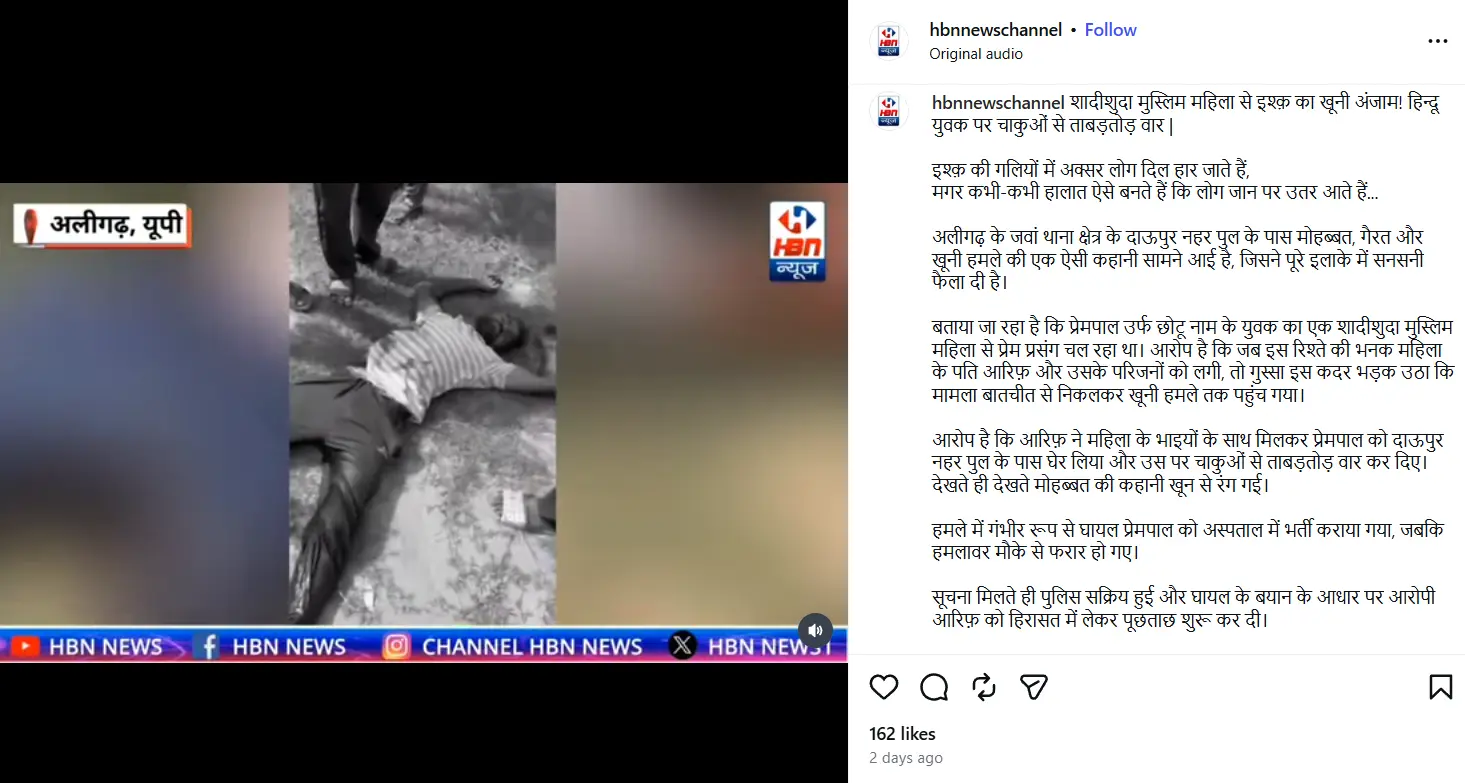
In Dawoodpur village, Aligarh, Uttar Pradesh, a Hindu man was attacked by a Muslim woman’s husband and her brothers after he was found to be in a relationship with the woman. This attack occurred on 15 June 2026. The Hindu youth named Prempal alias Chhotu was in a romantic relationship with a married Muslim woman. When the woman’s husband, Arif, and her family members came to know about the relationship, their anger escalated to such an extent that the matter turned from a verbal dispute into a violent attack. It is further stated that Arif, along with the woman’s brothers and accomplices, surrounded Prempal near the Dawoodpur canal bridge and repeatedly stabbed him with knives. Within moments, the situation escalated into a scene of bloodshed. Prempal, who sustained serious injuries in the attack, was rushed to the hospital for treatment, while the attackers fled the scene. Upon receiving information, the police acted swiftly and, based on the statement of the injured victim, arrested the accused, Arif, for questioning. At the time of writing this report, the incident was being widely discussed in the area. The police were investigating the matter and examining every aspect in detail. The Aligarh Police posted on X regarding the incident, stating: "On 15 June 2026, information was received from Dawoodpur village that a person had been injured. The local police immediately reached the spot and inspected the scene. The injured person was taken to the local Community Health Centre for treatment and is healthy and safe. Based on the statements given by the injured person during the preliminary inquiry, one person has been taken into police custody and is being questioned in detail regarding the motive behind the incident. Further legal action will be taken after the investigation. A statement in this regard has been issued by the Circle Officer, City III."
Case Images
Why it is Hate Crime ?
The first primary category selected in this case is- Men attacked for being associated with non-Hindu women. Within this, the subcategory selected is - Attacked/killed for being associated or suspicion of being associated with Muslim woman. There have been several cases documented of Hindu men/boys being attacked specifically by Muslim groups/mobs for merely being associated or suspicion of being associated or being seen with a Muslim woman in public. In most of such cases, the Hindu man is not in a relationship with the Muslim woman, however, the mob proceeds to threaten and/or assault the Hindu man for merely being associated with the Muslim woman in any capacity. The rise of such crimes stems from a particularly sinister campaign run by several Muslim ideologues and activists. The campaign claims that Hindu men are attempting to ‘lure’ Muslim women into relationships to ensure that Muslim women leave their faith and follow Hinduism. The propaganda has been spearheaded with the help of WhatsApp groups and the extensive use of social media, sans evidence of the same. In many cases, pamphlets were fabricated to lend credence to this campaign. The root of this campaign lies in the fact that several cases of sectarian crimes against Hindu women in relationships with Muslim men have been documented. In such cases, Hindu women have often been forced/pressured to convert to Islam, assaulted, threatened and even murdered owing specifically to their religious identity and their refusal to give up that religious identity to adopt Islam. To delegitimize the suffering of Hindu women when such sectarian crimes are committed against them, the theory of ‘Bhagwa Love Trap’ was floated by sections of the Muslim community. As this theory gained traction, Muslim mobs started targeting Hindu men who were seen with Muslim women. In several such cases, the Hindu man was assaulted merely for offering to drop a Muslim woman in his vehicle or being friends. The differentiating factor between such cases and legitimate cases of Hindu women being targeted while in a relationship with Muslim men is that there is no sectarian violence, and force/pressure to convert. The nature of sectarian violence against Hindu women is not about two adults in a consensual relationship, working together, studying together, or even marrying each other where religious considerations are declared. In this category of crimes, it is pertinent to remember that in none of the cases, there is an element of the Hindu man masking his identity or forced religious conversion. Such cases are driven by specific religious motivations and against the religious identity of the victim and are therefore qualified as hate crimes. The other subcategory selected is- Attacked by non-Hindu partner and/or her family. When Hindu men are in a relationship with non-Hindu women, there are cases where the man is forced to convert his religion and upon his refusal to do so, the partner or/and her family attacks the victim. Such relationships may be consensual with the religious identity of the non-Hindu woman known to the victim. Somewhere along the relationship, the non-Hindu woman or her family starts forcing/pressurizing the Hindu man to convert. In some of these cases, the association could be non-consensual as well or, the religious identity of the non-Hindu woman could be previously unknown to the Hindu victim. In such cases, the Hindu man is first forced/pressurized to change his religion by the non-Hindu woman or her family. The force/pressure could involve threats. The trigger for directing violence against the Hindu man is in these cases his refusal to comply and change his religion under threat and/or force. In other cases that have been documented, it is also seen that the Hindu partner is assaulted by the non-Hindu woman or her family simply for his relationship with the non-Hindu woman and by virtue of him following the Hindu faith and not the religion of the non-Hindu woman. In such cases, the relationship is consensual in most cases and the religion of both partners is known to the other. Often, in such cases, there is no direct force/pressure to convert either, however, the attack is a result of the Hindu man being in a relationship with the non-Hindu partner and not following her religion/following Hinduism specifically. Such cases are driven by specific religious motivations and against the religious identity of the victim and are therefore qualified as hate crimes. The second primary category selected is- Attack not resulting in death. The subcategory selected is- Attacked for Hindu identity. In several cases, Hindus are attacked merely for their Hindu identity without any perceived provocation. A classic example of this category of religiously motivated hate crime is a murder in 2016. 7 ISIS terrorists were convicted for shooting a school principal in Kanpur because they got ‘triggered’ seeing the Kalava on his wrist and tilak that he had put. In this, the Hindu victim had offered no provocation except for his Hindu religious identity. The motivation for the murder was purely religious, driven by religious supremacy. Such cases where Hindus are targeted merely for their religious identity would be documented as a hate crime under this category. In this case, a Hindu man was brutally attacked after being in a relationship with a Muslim woman, who was already married to Arif. Since the accused did not explicitly state that the crime was committed because of the Muslim woman being in an "interfaith relationship" or because the victim was a Hindu, some may argue that the murder was not religiously motivated and therefore should not be included in this tracker. Some may also argue that the murder stemmed purely from infidelity or adultery rather than religious hostility. However, if the motive had solely been infidelity, then the Muslim woman, who was married to Arif and therefore equally involved in the relationship, would also likely have faced similar violence from her husband. Instead, she was not harmed, while the Hindu man in the relationship was selectively targeted and brutally stabbed. This selective targeting indicates that religious identity played a significant role in the crime and was one of the major reasons why the Hindu victim bore the brunt of the violence. Therefore, there are several factors that establish why this case warrants inclusion in the hate crime database. The first factor is the direct connection between the attack and the relationship. According to the available details of the incident, Arif became aware of the relationship between his married Muslim wife and Prempal alias Chhotu, a Hindu man, following which tensions escalated. This led to a coordinated attack in which Prempal was surrounded and assaulted with knives by Arif along with the woman’s family members and associates. This indicates that the relationship itself acted as the immediate trigger for the violence. Since the relationship involved a Hindu man and a Muslim woman, religion becomes a contextual element in the hostility that led to the attack, even though no explicit religious motive was stated. The second important factor is the coordinated nature of the assault involving multiple accused persons. Arif, along with the brothers of the Muslim woman and other associates, participated in surrounding and attacking Prempal alias Chhotu. This indicates that the incident was not a spontaneous act of anger, but a planned and coordinated attack involving multiple individuals, rather than an isolated confrontation. In several cases where a Hindu man is involved in a consensual relationship with a Muslim woman, the Muslim woman’s family members or associates resort to violence because they disapprove of the relationship. Such cases are often described as 'honour killings', where the relationship is viewed as bringing dishonour to the family. These incidents are seen across communities and social groups; however, in interfaith cases involving a Hindu man and a Muslim woman, religion frequently becomes one of the primary points of hostility. In many such cases, the motive is openly articulated by the perpetrators or their families. In other cases, the exact motive is not explicitly stated in reports or police statements. However, even where explicit statements are absent, the surrounding circumstances help us to establish that the victim's religious identity did play a role in the crime. For the purpose of this tracker, cases are included where religion forms one of the determining factors behind the violence, particularly when the victim is Hindu and the hostility emerges from an interfaith relationship involving a Muslim woman. In Islamic doctrine, a Muslim woman marrying or being in a relationship with a non-Muslim man without conversion is considered impermissible. Consequently, relationships between Hindu men and Muslim women often face severe hostility within the Muslim community. In such circumstances, the Hindu identity of the man becomes one of the principal reasons for opposition to the relationship. Therefore, even if the perpetrators do not explicitly state religious motives, religion can still reasonably be understood as one of the determining factors behind the crime. Such incidents, where Hindu men are attacked or murdered over relationships with Muslim women, stem from hostility towards the Hindu man because of his religious identity and his involvement in an interfaith relationship. In several such cases, the Hindu man is selectively targeted while the Muslim woman involved is not subjected to similar violence, which raises questions about the nature of the hostility involved. In a number of similar situations, Hindu men are targeted for transgressing perceived social or relational boundaries through relationships with Muslim women, despite the relationships being consensual, between adults, and entered into with mutual awareness of each other’s religious identity. The selective targeting of the Hindu man in such relationships showcases deep-seated hostility towards the victim’s Hindu identity, making such incidents clear cases of communal hate crimes motivated by anti-Hindu bigotry and hatred. Given that this case meets the parameters of a hate crime, it is being added to the hate crime database of the Hinduphobia Tracker. Disclaimer: In this case, although multiple perpetrators were involved in the attack, only Arif is specifically identified in media reports. The exact number and identities of the remaining perpetrators have not been specified. Therefore, for documentation purposes, a conservative estimate of one perpetrator, referring only to Arif, has been recorded.
Victim Details
Total Victim
1
Deceased
0
Gender
- Male 1
- Female 0
- Third Gender 0
- Unknown 0
Caste
- SC/ST 0
- OBC 0
- General 0
- Unknown 1
Age Group
- Minor 0
- Adult 1
- Senior Citizen 0
- Unknown 0


Case Status
Case sub-judice


Perpetrators Details
Perpetrators
Muslim Extremists
Perpetrators Range
One Person
Perpetrators Gender
male
 Sources




