Hindu girl lured by Muslim man posing as Hindu, girl reports sustained harassment and threats
 Sagar, Madhya Pradesh, India
  16 June, 2026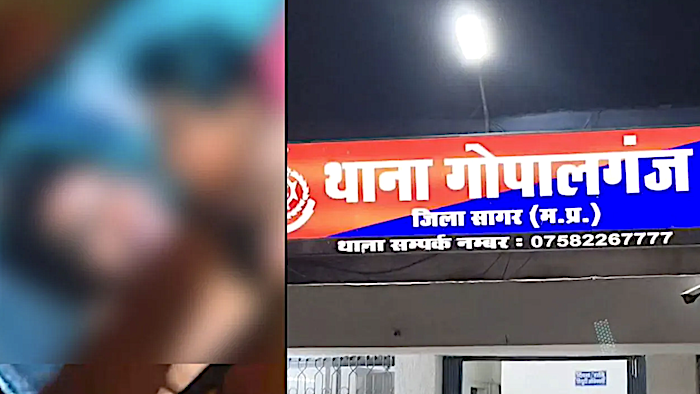
Case Summary
A Hindu woman from Sagar, Madhya Pradesh, was drawn into a relationship by a Muslim man, Faraz Khan, who concealed his religious identity and presented himself as Hindu. The victim stated that after the relationship was established, she was subjected to sustained harassment, intimidation, and blackmail. She accused Faraz Khan of repeatedly pressuring and threatening her over an extended period. The incident came to light at Atal Park in Sagar, within the jurisdiction of the Gopalganj police station. Hindu organisation workers received information that a Hindu girl was present in the park with a young man whose activities seemed suspicious. Acting on this information, the workers reached the location, stopped the man, and questioned him regarding his identity and his association with the Hindu girl. The situation quickly attracted public attention, and the man was subsequently handed over to the police for further examination. During questioning, the Muslim man was identified as Faraz Khan, a resident of Rahli. Information that emerged during the inquiry indicated that the Hindu girl had been in contact with him for an extended period and had been experiencing difficulties connected to that relationship. The matter gained further significance when it was revealed that the accused had trapped the girl by hiding his religious identity. As the investigation progressed, it came to the fore that the victim was being subjected to threats and blackmail over a prolonged period. The examination of Faraz Khan's mobile phone also became a significant aspect of the investigation after objectionable videos were recovered from the device. Following the intervention at Atal Park, Faraz Khan was taken into police custody for questioning. The Gopalganj police began investigating all aspects of the case, including the concerning concealment of identity, blackmail, and the material recovered from the mobile phone. Authorities stated that further legal action would depend upon the findings of the investigation and the evidence collected during the inquiry. At the time of reporting, the case remained under investigation, with police continuing to verify statements, examine digital evidence, and gather information from all parties involved.
Why it is Hate Crime ?
This case has been added to the tracker under the primary category - Crimes against women in relationships and other sexual crimes. Within this, the subcategory selected is - Man pretends to be Hindu. When a non-Hindu man pretends to be a Hindu to deceive a Hindu woman into a relationship, the act is seen as triggered by malafide intentions. In some cases, the woman eventually accepts the man’s original religious identity and converts after the man’s identity is revealed. These cases could be argued as cases of religious brainwashing and a result of the pressure a woman feels after getting into a relationship with a man. The woman, it can be argued, also changed her religious identity because of the stigma she believes she might face if she chooses to walk out of a deceptive relationship. However, for the purpose of documenting hate crimes, the cases in this subcategory are limited to those where there is explicit violence aimed at religious conversion against the wishes of the victim (force-feeding beef, blackmailing with intimate videos, rape on refusal to convert, etc), or if the woman herself complains of the man’s religious deception. In such cases, it is established that the deception of the non-Hindu man had a specific aim of religious conversion or targeting of the victim due to her Hindu religious identity, therefore, making it a religiously motivated hate crime. The religious motive of the crime is evident from the fact that the Muslim perpetrator deliberately hid his real identity and pretended to be a Hindu in order to gain the trust of the Hindu victim. If religion had no role in the crime, there would have been no need for him to conceal his faith and present himself as a Hindu. The deception worked precisely because he knew that sharing the same religious identity would make the victim more comfortable, trusting, and willing to interact with him. This makes the victim's Hindu identity central to the offence. The perpetrator did not simply lie about his name or personal details. He specifically used a false Hindu identity as a tool to approach, manipulate, and exploit a Hindu victim. The fact that he felt the need to pose as a Hindu shows that he understood the importance of religion in the victim's life and deliberately exploited it for his own benefit. The deception also reflected a deeper disregard for Hindu beliefs and community trust. Rather than respecting the victim's religious identity and her right to make informed choices, the perpetrator treated her faith as an obstacle to be bypassed through dishonesty. Hindu identity was reduced to a disguise that could be adopted whenever it became useful. Such conduct demonstrates contempt for the religious boundaries, customs, and values that the victim was entitled to rely upon while deciding whom to trust. It is also significant that the perpetrator specifically targeted a Hindu victim through a fabricated Hindu identity. The entire deception depended upon exploiting the trust associated with being Hindu. This shows that the victim's Hindu identity was not incidental to the crime but one of the factors that made her a target. The perpetrator consciously chose a method that weaponised Hindu identity itself in order to gain access, influence, and control. For this reason, the offence carries clear religiously aggravating elements. The perpetrator's ability to target and exploit the victim depended on religious deception and the manipulation of trust associated with Hindu identity. This demonstrates that the victim's religion was not incidental to the crime but one of the key factors that enabled it. In cases like these, the tactic of adopting a false Hindu identity to manipulate and "ensnare" a Hindu individual is not just an act of personal betrayal but can also be interpreted as an expression of disdain or disregard for Hinduism and its customs that reflects a deeper animosity towards Hindus and their beliefs, and this is why this case has been added here. It is also significant that the victim stated that she had faced ongoing problems arising from her interactions with the perpetrator and that allegations of blackmail subsequently emerged during the course of the investigation. The concealment of identity, when viewed alongside these developments, indicates that the deception was not an isolated act but part of a broader pattern through which influence and control over the victim were maintained. The recovery of objectionable material during the investigation further intensified concerns regarding the manner in which the victim may have been manipulated after trust had been established through concealment. Taken together, the concealment of a Muslim identity, the exploitation of trust associated with a Hindu victim, and the use of deception as a means of establishing and maintaining access to that victim demonstrate clear religiously aggravating elements. The victim's Hindu identity was not merely a characteristic she happened to possess; it was a factor that was knowingly exploited through calculated concealment and misrepresentation. For this reason, the case reflects a pattern of religiously motivated targeting in which a Hindu woman's trust was secured through deception rooted in the concealment of religious identity, making her faith central to the manner in which she was approached and ultimately victimised. Disclaimer: The exact date of when the Hindu woman and the Muslim perpetrator first came into contact was not specified in the available sources. However, the incident became publicly known through reports published on 17th June 2026. Accordingly, the Hinduphobia Tracker has recorded the respective date as the incident date for documentation purposes only.
Victim Details
Total Victim
1
Deceased
0
Gender
- Male 0
- Female 1
- Third Gender 0
- Unknown 0
Caste
- SC/ST 0
- OBC 0
- General 0
- Unknown 1
Age Group
- Minor 0
- Adult 0
- Senior Citizen 0
- Unknown 1


Case Status
Complaint filed


Perpetrators Details
Perpetrators
Muslim Extremists
Perpetrators Range
One Person
Perpetrators Gender
male
 Sources




