Hindu temple land illegally occupied by encroachers, temple idol thrown away, installation of new idols blocked in Sheopur, Madhya Pradesh
 Sheopur, Madhya Pradesh, India
  14 June, 2026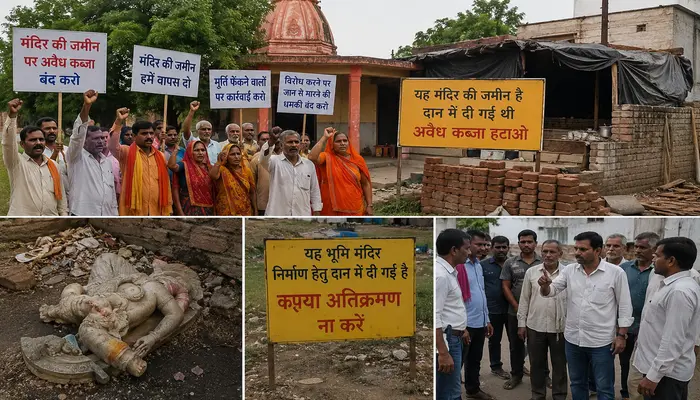
Case Summary
In Sheopur, Madhya Pradesh, a Hindu temple's land was illegally occupied by a few unidentified encroachers. Following the occupation, the encroachers also threw away the old idol of a Hindu deity installed at the site and were preventing the installation of new idols. This triggered protests from local Hindu residents, who stated that land donated for the temple had been unlawfully seized. The locals stated that influential individuals had encroached upon the temple premises and that Hindus opposing the occupation were being threatened with death. According to local Hindu residents, the land in question was situated near an Anganwadi at Ward No. 14, Fakkad Chowraha, and had originally been donated for the construction of a Hindu temple. They stated that repeated complaints to the administration regarding the encroachment had yielded no action. On 15 June 2026, they again approached the Municipal Corporation and the Kotwali Police Station, demanding an impartial investigation and the removal of the encroachment. Ward councillor Jugal Kishore Mehra stated that a Mata temple had existed at the site since 2006 and that while efforts were underway to relocate a Shiva temple, two unidentified individuals threatened them and demanded ₹2 lakh. He further stated that miscreants had thrown away the old temple idol and obstructed the installation of a new one. Local residents echoed similar statements. Kalavati stated that powerful encroachers had occupied the temple land, discarded the old idol, and were preventing the installation of new idols of Lord Shiva and Goddess Parvati. Another resident, Omprakash Vaishnav, stated that a platform dedicated to Lord Shiva had stood at the site for nearly two decades but that a powerful individual had built a house on the land and was now attempting to occupy the remaining temple property for further construction. Elderly resident Modu Lal also maintained that the land had originally been donated for the temple but was subsequently taken over by influential persons. Following the complaints, Municipal Corporation Chief Municipal Officer Radhe Raman Yadav assured residents that the matter would be investigated and that the temple land would not be allowed to remain under illegal occupation, describing it as an issue of faith. The officer in charge of the Kotwali Police Station also confirmed that a complaint had been received and stated that a joint investigation with the municipal team would be conducted, with strict action promised against those found responsible.
Why it is Hate Crime ?
The first primary category selected is: Attack on Hindu religious representations. The subcategory selected is: Encroachment or illicit takeover of temple land/land near temple. In Hinduism, a temple is the abode of the Deity. The Deity in the Temple is consecrated, thereby, making it a real, breathing entity. Hindus believe that not just the Deity but the temple premises itself are sacred to Hindus since Hindus hold the faith that the entire Temple space is an amalgamation of the divine energy of the deity. Not only the Temple but the Temple premises in its entirety are considered sacred by Hindus. In several cases, the premises of the Temple and/or religious centre are illicitly taken over by institutions belonging to other faiths – like the Waqf board or the Church. Other times, the temple property, land or the property of religious centres are illicitly encroached by non-Hindu groups. Any illicit take over or encroachment is a crime an initio, however, when non-Hindu groups illicitly take over or encroach the sacred land of Hindus, it is an affront to the Hindu community and is therefore classified as a religiously motivated hate crime under this category. The other subcategory selected is: Desecration of Hindu religious symbol. Icons and symbols or a religious representation of a spiritual ideal are widely revered in Hinduism. Iconography is of vital significance in the Hindu milieu. It helps connect people’s spiritual beliefs with the real world. Iconography within the Hindu faith takes several shapes and forms. Murtis are of most significance to Hindus, to which daily rituals, prayers and offerings are done. Besides the murtis, there are several other symbols which have deep significance in the Hindu faith – the Om and Swastika for example. Since these Hindu religious symbols hold paramount importance in Hinduism, any desecration of symbols, icons, murtis, religious representations and manifestations, is driven by animosity towards the faith itself which manifests itself through these murtis, icons and symbols. Therefore, any desecration of these Hindu religious symbols and representations is considered religiously motivated hate crimes under this category. This case serves as a clear example of a religiously motivated hate crime. The perpetrators did not merely execute a real estate seizure; they targeted the core spiritual identity of the local Hindu community by encroaching upon a Hindu temple's land, throwing away a sacred idol of a Hindu deity, and thereby actively desecrating it. By preventing new idols from being installed, the encroachers sought to entirely disrupt and suppress Hindu worship at the site. Furthermore, the targeted nature of this offence is underscored by the fact that perpetrators issued death threats specifically to the Hindu local residents who stood up to oppose this illegal encroachment and the disrespect of their deities, confirming that the hostility was explicitly directed at their religious identity. For Hindus, a temple is far more than a structure or a brick-and-mortar building; it is considered the literal house of the divine, a sacred space where the material world meets the spiritual realm. Known as a Mandir or Devalaya, the temple serves as an anchor for the community's collective faith, a sanctuary for quiet contemplation, and the central hub for daily rituals, festivals, and spiritual devotion. The loss or targeting of such a space directly strikes at the community's freedom to practice their faith, threatening the continuity of traditions passed down through generations. Within Hindu tradition, the sanctity of a temple extends completely to the land upon which it is built. The temple land itself is viewed as consecrated property, chosen through specific spiritual criteria and dedicated entirely to the deity through formal rituals. Once land is donated and designated for a temple, it ceases to be mere commercial real estate; it is considered divine property held in trust for the deity. The ground is seen as infused with spiritual energy, meant solely for the performance of sacred rites and religious gatherings in devotion. Consequently, the act of illegally encroaching upon Hindu temple land directly violates and undermines the sanctity of this consecrated ground, delivering a profound shock to Hindu religious sentiments. Forcing commercial or unauthorised structures onto property dedicated to the divine is a profound act of disrespect to the Hindu faith and its adherents. This physical takeover actively prevents and disrupts the performance of traditional rituals, prayers, and festivals, denying local devotees the ability to peacefully follow their religious practices within the temple premises and turning a place of peace into a site of conflict. The act of throwing away the idol of a Hindu deity represents a direct desecration of a deeply revered religious symbol. In Hinduism, an idol (Murti) is not viewed as a mere statue or representation; following the sacred consecration ritual of Prana Pratishtha, the idol is revered as a living manifestation of the deity's presence. Care, reverence, and daily offerings are extended to the Murti as an act of direct devotion. Discarding or damaging such an idol is therefore felt by devotees as a deeply hateful assault on their faith, amounting to a clear desecration of a sacred symbol intended to cause maximum emotional and spiritual distress. Similarly, the actions of the perpetrators in actively preventing Hindus from installing new idols further compound the nature of this offence. Blocking the installation of Murtis of Lord Shiva and Goddess Parvati directly impedes the community's right to restore their place of worship and resume their spiritual practices. This deliberate obstruction ensures that the temple remains stripped of its religious functionality, serving as a persistent denial of worship that deeply hurts the spiritual well-being of the community and demonstrates an intent to sustain the targeting of their religious life. The vulnerability of the Hindu community is further highlighted by the severe backlash faced by local Hindu residents, who were met with death threats simply for opposing the encroachment and desecration. These individuals were targeted with violence and mortal intimidation for attempting to protect their place of worship and preserve their sacred heritage. This pattern demonstrates the acute risks faced by local Hindu communities when trying to safeguard their religious sites, showing that efforts to defend their faith can make them targets of extreme threats and hostility. In conclusion, because this case involves the targeted desecration of religious symbols, the unlawful seizure of consecrated temple land, deliberate obstruction of worship, and targeted threats of violence against the Hindu community, it meets the defined parameters of a hate crime and is added to the hate crime database of the tracker. Disclaimer: The Hinduphobia tracker records incident dates based on when the crime occurs, rather than when it is reported by media. In the present case, the date on which the encroachment began has not been specified in available reports. The only clearly mentioned date is 15 June 2026, the date when the Hindu locals approached the Municipal Corporation and the Kotwali Police Station, demanding an impartial investigation and the removal of the encroachment. Henceforth, 15 June 2026 is being selected as the indicative incident date for documentation purposes only. In this case, although the total number of perpetrators has not been specified in the available details, at one instance, Ward Councillor Jugal Kishore Mishor stated that two unidentified individuals had threatened him in connection with the temple encroachment dispute. Henceforth, a conservative perpetrator count of two individuals has been recorded. This figure is recorded strictly for documentation purposes only.


Case Status
Complaint filed


Perpetrators Details
Perpetrators
Unknown
Perpetrators Range
From 2 To 5
Perpetrators Gender
unknown
 Sources




