Hindu sentiments outraged after Muslim politician describes Hindu community as "toxic" during political event
 Moradabad, Uttar Pradesh, India
  13 June, 2026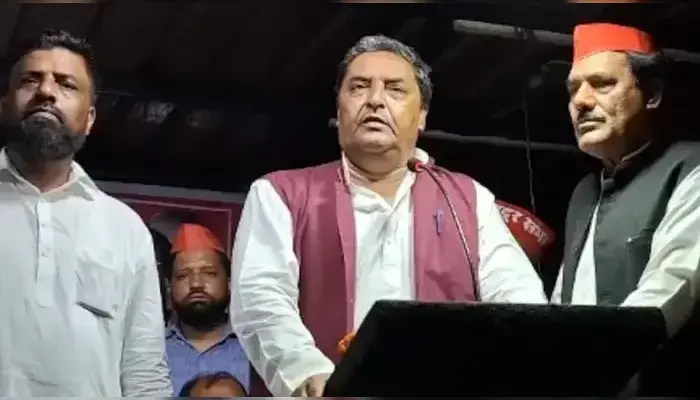
Case Summary
In Moradabad, Uttar Pradesh, Hindu sentiments were outraged after Samajwadi Party Rajya Sabha MP Javed Ali Khan referred to the majority Hindu community as "jahreela" (poisonous/toxic) during a public political gathering. He used the term while claiming that the BJP had spread "poison" among the majority Hindu community, leading to growing religious divisions and a breakdown of social trust. On 14 June 2026, while addressing party workers and supporters during a PDA convention, Samajwadi Party Rajya Sabha MP Javed Ali Khan spoke about the political influence of the Bharatiya Janata Party (BJP) and its supposed impact on social relations in the country. Referring to areas such as Moradabad and Sambhal, where he said the Samajwadi Party had enjoyed longstanding support since the tenure of Mulayam Singh Yadav, he stated that little explanation of the party's position was required there. However, while discussing regions where the minority population was smaller, and the Hindu population formed a larger proportion of residents, he claimed that the majority community had been influenced by what he described as the BJP's divisive politics. During his speech, he said, "Jahreela ho gaya hai bahusankhyak samaj" (“The majority community (Hindu) has become poisonous/toxic”), attributing this development to the “poison” spread by the BJP. He further claimed that the political environment created by the BJP had weakened trust between people on the basis of religion and had led to a significant breakdown in inter-community relations across Uttar Pradesh and the wider country. He added that the Samajwadi Party would work to strengthen its organisational presence and outreach efforts in areas where minority populations were comparatively smaller and where, according to him, greater political engagement would be required to persuade voters.
Why it is Hate Crime ?
This case has been added to the tracker under the primary category of - Hate speech against Hindus. Within it, the sub-category selected is - Anti-Hindu slurs, mocking faith. Anti-Hindu slurs and the deliberate mocking of the Hindu faith owing to religious animosity involve the usage of derogatory terms, stereotypes, or offensive references to religious practices, symbols, or figures. One of the common anti-Hindu slurs used against Hindus is “cow-worshipper” and “cow piss drinker”. The intention of using this term is to demean and mock Hindus as a group and their religious beliefs since Hindus consider the cow holy. Additionally, some symbols and the slurs attached to them have a historical context that exacerbates the insult, hate, stereotyping, dehumanisation and oppression against Hindus. Cow worship has been used for centuries to denigrate Hindus, insult their faith and oppress Hindus specifically as a religious group. There has been overwhelming documentation about how cow slaughter has been used to persecute Hindus with cow meat being thrown in temples and places of worship. There has also been overwhelming documentation where cow meat (beef) has been force-fed to Hindus to either forcefully convert them to Islam or denigrate their faith. Apart from cow worship, the Swastika – which holds deep religious significance for the Hindus – has also been misinterpreted and distorted to use as a slur against Hindus. Similarly, the worship of the Shivling has been used by supremacist ideologies and religions to denigrate Hindus owing to religious animosity. Such slurs and denigration stem out of inherent animosity and hate towards Hindus and their faith, therefore, it is categorised as hate speech targeted at Hindus specifically owing to their religious identity. The other sub-category selected here is - Anti Hindu subversion and prejudice. Hate speech is defined as any speech, gesture, conduct, writing, or display that is prejudicial against a specific individual and/or group of people, which is leading to or may lead to violence, prejudicial action or hate against that individual and/or group. Media plays a specific and overarching reach in perpetuating prejudicial attitudes towards a community owing to unfair, untrue coverage and/or misrepresentation/misinterpretation, selective coverage and/or omission of facts of/pertaining to issues affecting a specific religious group. This type of bias can dehumanise the victim group, making it easier for others to justify harmful actions against them, which aligns with the objectives of hate speech laws aimed at preventing such harm. It is often observed that the media takes a prejudicial stand against the Hindu community driven by their need to shield the aggressor community which happens to be a numeric minority, however, is the one perpetrating violence against Hindus. For example, the media is often quick to contextualise religiously motivated crimes against Hindus, omit or misrepresent facts that point towards religiously motivated hate crimes, justify and/or downplay religiously motivated hate crimes or simply present fake news to stereotype Hindus. Such media bias leads to the denial of persecution and is often used to dehumanise Hindus, leading to justification for violence against them. For example, the media covered several fake allegations of Hindus targeting Muslims and forcing them to chant Jai Shree Ram. Most of these cases were proved false and fabricated after police investigation. These fake news reports were subsequently never retracted or clarified. Such fake news led to the justification of violence and dehumanisation of Hindus based on the argument that since Hindus targeted Muslims and forced them to chant Jai Shree Ram, the dehumanisation of Hindus and violence against them was par for the course and merely a retaliation. Such media bias leads to prejudicial portrayal of Hindus and offers a justification for violence against them and therefore, is considered hate speech under this category. This case has been included in the tracker because a Muslim political leader, Javed Ali Khan, made a sweeping and derogatory remark about the country's majority community, which in the Indian context overwhelmingly refers to Hindus. By claiming that the "bahusankhyak samaj" (Hindu community) had become "jahreela" (poisonous/toxic), Javed Ali Khan attributed a negative and undesirable characteristic to the entire Hindu religious community comprising hundreds of millions of people. Such generalisations reduce a diverse population to a pejorative stereotype and foster prejudice against members of the Hindu community because of their religious identity. By calling Hindus "toxic", he effectively portrayed a vast religious group as socially harmful and morally tainted, thereby stigmatising its members as a collective. Importantly, the statement was not directed at specific individuals accused of wrongdoing, nor was it limited to criticism of a political party or its supporters. Instead, the remark was framed in terms of the Hindu community itself having become "toxic". Even though the statement was made in the context of criticising the BJP, the language used extended beyond political criticism and reflected negatively upon the broader Hindu-majority population. Political disagreement and criticism of a party are legitimate aspects of democratic discourse; however, characterising an entire religious majority in derogatory terms crosses from political critique into commentary that targets a community on the basis of its identity. He made those remarks as a criticism of the growing political awareness and assertiveness among the Hindu community. In recent years, many Hindus have become more vocal about issues that affect their religious, cultural, and civil rights, and have increasingly demanded equal treatment under the law and public policy. They have also began expressing opposition to minority-centric or Muslim-appeasement policies pursued by political parties such as the Samajwadi Party. Against this backdrop, Javed Ali Khan's characterisation of the majority community as "poisonous/toxic" underscores his disapproval of this growing Hindu consciousness and mobilisation. By describing the resulting social and political awakening of the Hindu community as "toxic", the remarks effectively delegitimised the community's efforts to advocate for its interests and portrayed Hindu self-assertion in public life as something undesirable or harmful. The remarks were directed not only at the BJP as a political rival but at the broader social changes that BJP brought, including the rise of Hindu political consciousness. While political criticism between rival parties is a normal feature of democracy, Javed Ali Khan's statement underscored dissatisfaction with the fact that large sections of the Hindu community have become more aware of issues affecting their religious and cultural interests and have increasingly sought political representation for those concerns. The BJP has often positioned itself as a party that advocates for Hindu causes and has brought several issues of concern to Hindus into mainstream political discourse. Against this backdrop, describing the majority community as "poisonous/toxic" is not merely of a criticism of a political party but a criticism of the growing Hindu awakening. The statement also carried the potential to foster resentment against Hindus by framing them as the principal source of deteriorating social relations. Public figures wield considerable influence, and their words can shape public perceptions. When a political leader characterises an entire religious community in negative terms, it legitimises hostility and prejudice towards members of that community. Such rhetoric contributes to social polarisation by encouraging audiences to view individuals through the lens of their religious identity rather than as citizens with diverse perspectives and experiences. For these reasons, the incident has been classified as a case involving derogatory and prejudicial speech directed at Hindus. The remarks targeted the majority Hindu community as a collective group, assigned it a negative characteristic, and framed its social and political outlook in a manner that was capable of fostering hostility, contempt, or prejudice towards Hindus on the basis of their religious identity.


Case Status
Unknown


Perpetrators Details
Perpetrators
Muslim Extremists
Perpetrators Range
One Person
Perpetrators Gender
male
 Sources




