Hindu spiritual leader working against religious conversion issued “Sar Tan Se Juda” threats, warned with Kanhaiya Lal fate in Ujjain, Madhya Pradesh
 Ujjain, Madhya Pradesh, India
  15 June, 2026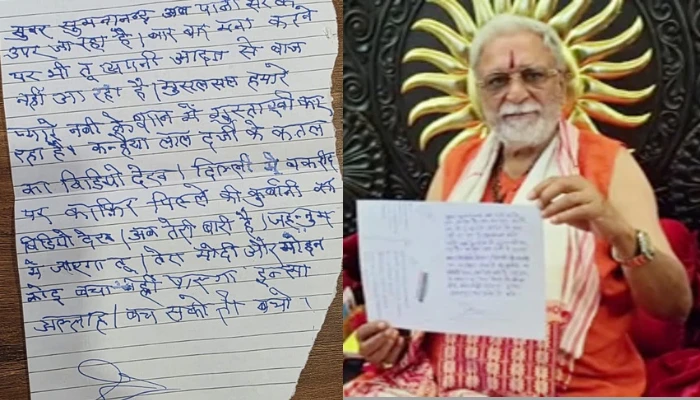
Case Summary
In Ujjain, Hindu spiritual leader Mahamandaleshwar Suminananda Maharaj received violent sar tan se juda death threats from unknown miscreants. This was the third time that the spiritual leader faced such genocidal threats. The threatening letter used offensive and inflammatory language and threatened him with a fate similar to Kanhaiya Lal, a Hindu tailor from Udaipur who was slaughtered by 2 rabid Islamists. Given the seriousness of the matter, Maharaj sent a complaint to the Ujjain Superintendent of Police via WhatsApp, seeking protection. Maharaj Suminananda is a prominent Hindu spiritual leader and motivational speaker based at the Maun Tirth Ashram in Ujjain, Madhya Pradesh. He is affiliated with the Shri Panchayati Niranjani Akhara and is highly regarded for integrating ancient Vedic wisdom from the Ramayana with modern life coaching. He is widely recognised for his work against religious conversions and Ghar wapsi, reconnecting people to Sanatan Dharma. The letter addressed to Maharaj stated: “Now the situation is getting out of hand. Despite repeated warnings, you are refusing to give up your habit. You are continuously insulting our beloved Prophet. Watch the video of Kanhaiya Lal’s murder… now it’s your turn. You will go to hell. Neither Modi nor Mohan will be able to save you. Insha’Allah, save yourself if you can.” The letter referred to previous murders and threatened Maharaj with similar consequences. Notably, on 28 June 2022, Kanhaiya Lal Teli, a Hindu tailor, was murdered by two Muslim men in Udaipur, Rajasthan. He was stabbed 26 times on his body from his neck to his shoulder. The attackers filmed the act and circulated the video online. The motive behind the killing was Lal’s sharing of a social media post in support of ex-BJP spokesperson Nupur Sharma, whose remarks had sparked the 2022 Muhammad remarks controversy. According to reports, the assailants entered Lal’s tailor shop pretending to be customers, murdered him, filmed the act, and uploaded it online Suminananda Maharaj confirmed that he had been receiving threats continuously for the past three to four years. This time, the letter contained a more serious and open threat of murder than before. Immediately after receiving the threat, he sent a copy of the letter to the Superintendent of Police via WhatsApp. The Superintendent of Police’s office confirmed receipt of the letter. Maharaj had been attacked twice before. One incident occurred in the Baroda area, where his car was stopped, and threats were issued to open fire and attack the ashram. He stated that the second incident took place at his ashram, where suspicious individuals arrived. After being informed, the police arrived late and later took the suspects with them. Complaints were made to the concerned police stations, the Superintendent of Police, and the government, but permanent security had not been arranged. Maharaj explained that threats were linked to his work of propagating Sanatan Dharma and facilitating Ghar Wapsi. He said that reconnecting individuals who wished to join Sanatan Dharma was his responsibility as a monk, and that this work had angered some people who continued to issue threats. Maharaj further stated that whenever he went on pilgrimage, he provided the local administration and police with written information about his route and return time to ensure his security. He was provided security during the Prayagraj Mahakumbh, but permanent security had not been arranged in Ujjain. He demanded that the government and administration take the constant threats seriously and provide adequate security. Jeevajiganj Police Station in‑charge Prateek Sharma confirmed that the information was received through WhatsApp and stated that the matter was under investigation.
Why it is Hate Crime ?
In this case, the first primary category selected is: Hate speech against Hindus. The subcategory selected is: Violent threats. Violent threats, explicit, implicit or implied, are the most dangerous form of hate speech since they go beyond discriminatory and prejudicial language to express the intent of causing harm to an individual or a group of people based on their religious identity and faith. There could be several different kinds of threats that are issued to Hindus based on religious animosity. An explicit threat would mean the direct threat of violence towards an individual Hindu, a group of Hindus or Hindus at large. Physical violence, death threats, threats of destruction of property belonging to Hindus and threats of genocide would mean explicit threats against Hindus for their religious identity. Implicit threats may not be a direct threat but implied through the use of symbols of actions – for example, in the Nupur Sharma case, other than explicit threats, there were also implicit threats when Islamists took to the streets to burn and beat her effigies. It implies that they want to do the same to Nupur Sharma, which is considered an implicit threat. Violent threats can be delivered in person, through letters, phone calls, graffiti, or increasingly through social media and other online platforms. It would be important to understand that a threat – explicit or implicit, online or offline – to an individual who happens to be a Hindu does not qualify as a religiously motivated threat. Such a threat, while vile and dangerous, could be owing to non-religious reasons and/or personal animosity. To qualify as a religiously motivated threat, it would need to exhibit an indication that the individual is being targeted for religious reasons and/or owing to his/her religious identity as a Hindu. Another primary category selected is "Attack not resulting in death". The sub-category selected in this is: Attacked for opposing radicals or trying to save victim. In several cases, Hindus are attacked for opposing religiously motivated crimes being committed against a fellow Hindu or simply for voicing an opinion opposing radical elements, who either have in the past or continue to persecute Hindus. In such cases, the initial attack against the victim, against which the Hindu was trying to defend the victim, would also need to be classified as a religiously motivated hate crime. Since the initial crime itself was religiously motivated and the subsequent crime of attempting to save the victim or speaking against the radical elements ends up inviting a violent attack, it would also be classified as a religiously motivated hate crime under this category. The other subcategory selected is- Attacked for supporting/being part of perceived Hindu party/org or working for Hindu community. In several cases, Hindus are attacked specifically or tangentially for their association with parties or organisations perceived to be pro-Hindu and/or for working in favour of the Hindu community. One of the classic cases was the attack against a Bharatiya Janata Party Yuva Morcha (BJYM) worker, Praveen Nettaru. Nettaru was attacked and hacked to death for his association with Hindu organisations and his work for the Hindu community. He was murdered by PFI, a terror organisation that aimed to commit a genocide of Hindus, target Hindu leaders specifically and turn India into an Islamic Nation. In such cases, it is possible that the immediate trigger for the violence is non-religious, either according to the perpetrator or the police. However, there are surrounding circumstances from which the conclusion can be reached that the victim was attacked for his association with a Hindu organisation. In a similar case, Rinku Sharma was attacked by radicals. He was a member of Bajrang Dal and regularly worked for the Hindu community. While the police cited a different non-religious trigger for the attack, it is true that he was associated with a Hindu organisation, and the family of Rinku Sharma specifically attributed his gruesome murder to his working for Bajrang Dal and raising Jai Shree Ram slogans. Such cases are intrinsically driven by religious hate and would therefore be documented as a hate crime under this category. This case has been added to the Hinduphobia Tracker because the victim was targeted specifically due to his role as a prominent Hindu spiritual leader and his efforts to promote Sanatan Dharma and facilitate Ghar Wapsi. The hostility directed against him was not the result of a personal dispute, private disagreement, or any ordinary conflict. Rather, it stemmed from his visible religious activities and his work in helping individuals reconnect with their ancestral Hindu faith. His Hindu identity, religious leadership, and advocacy of Sanatan Dharma formed the basis of the threats directed against him. The fact that the threats were linked to his work against religious conversion and his efforts to reconnect individuals with Hinduism is particularly significant. These are inherently religious activities. The opposition to them demonstrates hostility not only towards the victim personally but also towards his exercise of religious freedom and his right to propagate and practise his faith. His position as a Hindu spiritual guide was not incidental to the threats. It was the very reason he was targeted. Further, the perpetrators sought to intimidate the victim by invoking one of the most recognisable symbols of Islamist violence against Hindus in recent years. The threatening letter specifically referred to the murder of Kanhaiya Lal and warned the victim that "now it is your turn." This reference carried a clear and unmistakable message. Kanhaiya Lal was murdered by Islamist extremists who believed he had supported remarks considered offensive to Prophet Muhammad. By invoking that murder and warning the victim of a similar fate, the perpetrators were not merely expressing disagreement. They were threatening him with religiously motivated violence. The threat becomes even more serious because it drew upon the rhetoric of "Sar Tan Se Juda", an Islamist slogan that calls for the beheading of individuals accused of blasphemy. Over the years, this slogan has been repeatedly associated with threats, intimidation, mob mobilisation, and murders of non-Muslims, particularly Hindus. Its purpose is not simply to express offence but to create fear and silence those who are perceived as opposing Islamist religious interests. When such rhetoric is directed at a Hindu religious leader, it serves as a warning that continuing his religious work could invite violent consequences. The repeated nature of the threats is also significant. The victim stated that he had been receiving threats for several years and had previously faced intimidation because of his religious activities. This indicates sustained hostility towards his work rather than a one-time act of anger. The objective appears to have been to discourage him from continuing to promote Sanatan Dharma and Ghar Wapsi by creating a constant atmosphere of fear and insecurity. The impact of such threats extends beyond the individual victim. When a prominent Hindu leader is threatened with the same fate as Kanhaiya Lal, the message is directed not only at him but also at the wider Hindu community. It communicates that Hindu religious leaders and activists who openly work for Hindu causes may face violence for doing so. Such intimidation seeks to create a chilling effect, discourage Hindu religious outreach, and suppress Hindu religious expression through fear. Taken together, the incident reflects a deliberate attempt to intimidate and silence a Hindu spiritual leader because of his religious identity and his work in promoting Sanatan Dharma. The threats relied on references to previous religiously motivated killings, invoked extremist rhetoric associated with violence against Hindus, and sought to deter the victim from continuing his religious activities. Such explicit death threats, particularly those invoking "Sar Tan Se Juda" rhetoric and referencing the murder of Kanhaiya Lal, do not arise in a vacuum. They stem from animosity towards Hindus and hostility towards the open practice and propagation of the Hindu faith. The objective was not merely to frighten one individual but to create fear among those engaged in similar Hindu religious work and discourage the public expression of Hindu beliefs. Since the victim was targeted because of his role as a Hindu spiritual leader and because of the religious activities he carried out, the incident demonstrates clear anti-Hindu hostility and religious prejudice. For these reasons, the case qualifies as a religiously motivated hate crime and has been included in the Hinduphobia Tracker.
Victim Details
Total Victim
1
Deceased
0
Gender
- Male 1
- Female 0
- Third Gender 0
- Unknown 0
Caste
- SC/ST 0
- OBC 0
- General 1
- Unknown 0
Age Group
- Minor 0
- Adult 1
- Senior Citizen 0
- Unknown 0


Case Status
Complaint filed


Perpetrators Details
Perpetrators
Muslim Extremists
Perpetrators Range
Unknown
Perpetrators Gender
unknown
 Sources




