Minor students made to perform on genocidal song 'Sar Tan Se Juda" and brandish swords, school event glorifies Pakistani terrorist, displays his pictures alongside Indian flag visuals
 Jalna, Maharashtra, India
  15 June, 2024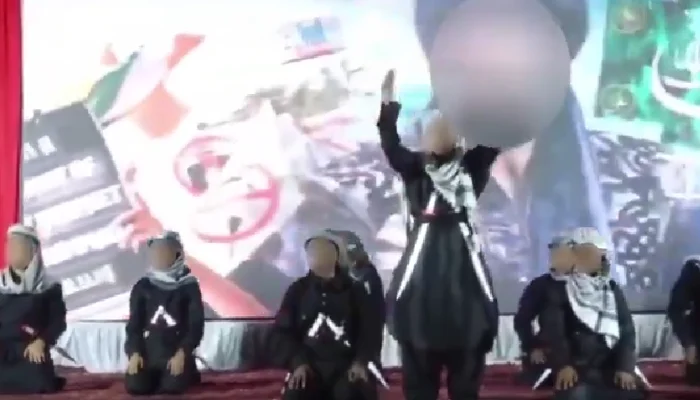
Case Summary
In a school in Jalna, Maharashtra, minor schoolchildren, including Hindus, were made to perform a dance on "Gustakh-e-Nabi Ki Ek Saza, Sar Tan Se Juda, Sar Tan Se Juda". Throughout the performance, the children were seen brandishing dummy swords. The Indian national flag and visuals of Pakistani terrorist Mumtaz Qadri repeatedly appeared on the screen in the background alongside the dance sequence. “Gustakh-e-Rasool ki Ek hi saza, sar tan se Juda, sar tan se Juda”, which translates to “There is only one punishment for being disrespectful to Rasool (Prophet Muhammad), their head separated from their torso, their head separated from the torso”, is an Islamist clarion call, that has become a staple feature of violent protests that have so far claimed the lives of at least 6 Hindus, including Kanhaiya Lal in Udaipur and Umesh Kolhe in Amravati, after Muslim fundamentalists, egged on by the dog-whistling of Alt News co-founder Mohammed Zubair against former BJP spokesperson Nupur Sharma, resorted to violence for what they perceived as ‘blasphemy’ against Prophet Muhammad. The incident took place during the annual gathering of Kids World English School in Partur, located in Jalna district. During the performance, the minor Hindu students were made to brandish fake swords while dancing to the song, while the Indian national flag repeatedly flashed on the screen as part of the visual presentation. An image of Pakistani Islamic terrorist Mumtaz Qadri was also displayed in the background, raising concerns over the nature of the content presented at a school event involving children. According to reports, the performance sparked controversy after a video of the event went viral on social media. The visuals drew widespread criticism and prompted questions regarding the appropriateness of making minor students perform to an Islamic extremist beheading song while repeatedly displaying the Indian national flag and imagery associated with terrorism during the same performance. During the performance, an image of Mumtaz Qadri was projected on the screen. Qadri was a Pakistani Islamic terrorist who assassinated the Governor of Punjab province after he supported Asia Bibi, a Christian woman who had been accused under Pakistan's blasphemy laws, which criminalise insulting or disrespecting Islam and its religious figures. The school, which is affiliated with the Central Board of Secondary Education (CBSE), faced criticism for making minor students participate in a performance featuring an Islamic extremist slogan and imagery associated with a convicted Muslim terrorist. Following the controversy, complaints were submitted to the National Commission for Protection of Child Rights, the Director General of Police, Maharashtra, and the Superintendent of Police, Jalna, seeking action against the institution. The school management claimed that the viral video was from an event held two years earlier, in 2024. It further claimed that the background visuals had been outsourced to an external contractor and that management was unaware of the image displayed during the performance. Following the incident, the Partur police initiated an inquiry and began questioning the institution's director, Tariq Siddiqui. On June 17, 2026, the police registered an FIR against the institution's director, Mohammad Vajiyoddin Tarekh Siddiqui; teacher Sheikh Sajid Abdul Gani; and event anchor Ujma Tabassum. On June 23, 2026, reports emerged that all three accused were arrested.
Why it is Hate Crime ?
The first primary category selected in this case is: Hate Speech against Hindus. The subcategory selected is: Violent Threats. Violent threats, explicit, implicit or implied, is the most dangerous form of hate speech since it goes beyond discriminatory and prejudicial language to express the intent of causing harm to an individual or a group of people based on their religious identity and faith. There could be several different kinds of threats that are issued to Hindus based on religious animosity. An explicit threat would mean the direct threat of violence towards an individual Hindu, a group of Hindus or Hindus at large. Physical violence, death threats, threats of destruction of property belonging to Hindus and threats of genocide would mean explicit threats against Hindus for their religious identity. Implicit threats may not be a direct threat but implied through the use of symbols of actions – for example – in the Nupur Sharma case, other than explicit threats, there were also implicit threats when Islamists took to the streets to burn and beat her effigies. It implies that they want to do the same to Nupur Sharma – thereby is considered an implicit threat. Violent threats can be delivered in person, through letters, phone calls, graffiti, or increasingly through social media and other online platforms. It would be important to understand that a threat – explicit or implicit, online or offline – to an individual who happens to be a Hindu does not qualify as a religiously motivated threat. Such a threat, while vile and dangerous, could be owing to non-religious reasons and/or personal animosity. To qualify as a religiously motivated threat, it would need to exhibit an indication that the individual is being targeted for religious reasons and/or owing to his/her religious identity as a Hindu. The second primary category selected is: Predatory Proselytisation. The subcategory selected is: Proselytisation by grooming, brainwashing, manipulation or subtle indoctrination. Religious brainwashing essentially means the often subtle and forcible indoctrination to induce someone to give up their religious beliefs to accept contrasting regimented ideas. Religious grooming or brainwashing also involves propaganda and manipulation. It involves the systematic effort, driven by religious malice and indoctrination, to persuade “non-believers’ to accept allegiance, command, or doctrine to and of a contrasting faith. Cases of such grooming or brainwashing are far more nuanced than direct threats, coercion, inducement and violence. In such cases, it is often seen that there is repeated, subtle and continual manipulation of the victim to induce disaffection towards their own faith and acceptance of the contrasting faith of the perpetrator. While subtle indoctrination is widely acknowledged as predatory, an element which is often understated in such conversions or the attempts of such conversion is the role of loyalty and trust which might develop between the perpetrator and the victim. Fiduciary relationships are often abused to affect such religious conversion. For example, an educator transmitting religious doctrine of a competing faith to a Hindu student. The Hindu student is likely to accept what the teacher is transmitting owing to existence of the fiduciary relationship. The exploitation of the fiduciary relationship to religiously indoctrinate victims would also be included in this category. Since the underlying animosity towards the victim’s faith forms the basis of predatory proselytization, such cases are considered religiously motivated hate crimes. This case constitutes a clear example of a religiously motivated hate incident, as minor Hindu students were made to perform a dance centred around the "Sar Tan Se Juda" slogan while brandishing swords and with the Indian national flag repeatedly appearing on the screen throughout the performance, alongside imagery glorifying Pakistani Islamic terrorist Mumtaz Qadri, within the premises of a school. The performance exposed Hindu children to a slogan that has become synonymous with religiously motivated beheadings and violence against non-Muslims, particularly Hindus, along with the glorification of an Islamic terrorist who murdered a public official for defending a non-Muslim woman falsely accused under Pakistan's blasphemy laws. An important aspect of this case is that the incident occurred in a secular school located in Maharashtra, a state where Hindus constitute the overwhelming majority of the population. In such a setting, it is evident that a significant proportion of the children participating in the performance were Hindu students. In such a setting, making Hindu students perform to the "Sar Tan Se Juda" slogan, a Muslim extremist call associated with religiously motivated violence, amounts to a clear case of religiously motivated hostility. Subjecting minor Hindu students to such messaging normalises Islamic extremist rhetoric within an educational environment and risks exposing impressionable children to radicalisation and ideological indoctrination instead of the values of pluralism and peaceful coexistence. The performance is particularly significant because it required minor Hindu students themselves to enact and watch a programme built around an Islamic extremist slogan associated with calls for beheading. The children were made to participate in a choreographed performance featuring fake swords, repeated displays of the Indian national flag in the background, and the image of a Pakistani terrorist. The repeated appearance of the Indian flag alongside the Muslim extremist slogan and terrorist imagery sent an implicit message that such anti-Hindu acts were worthy of admiration. This normalisation of violent Islamic symbolism made Hindu students become victims of Islamic radicalisation, thereby demonstrating hostility towards Hinduism and the Hindu community. The glorification of the slogan “Sar Tan Se Juda” is particularly significant because it constitutes an explicitly religious call for the beheading of Hindus and other non-Muslims. “Gustakh-e-Rasool ki ek hi saza, sar tan se juda, sar tan se juda”, which translates to “There is only one punishment for disrespecting the Prophet Muhammad, beheading”, is an Islamist clarion call, that has become a staple feature of violent protests that have so far claimed the lives of at least 6 Hindus, including Kanhaiya Lal in Udaipur and Umesh Kolhe in Amravati, after Muslim fundamentalists, egged on by the dog-whistling of Alt News co-founder Mohammed Zubair against former BJP spokesperson Nupur Sharma, resorted to violence for what they perceived as ‘blasphemy’ against Prophet Muhammad. From Kanpur in India’s northern plains to the southern metropolis of Bengaluru, from Kolkata in the east to Hyderabad in the south, protests in the name of blasphemy have erupted in almost every corner of the country as Islamists took to the streets running amok and shouting “Sar Tan Se Juda” chants over the perceived belief of blasphemy against their Prophet. Though a radical Muslim outfit in Pakistan coined this slogan, it has gained popularity among Islamists in regions beyond its geographical origins. Over the years, we have seen large crowds of Islamists chanting the “Sar Tan Se Juda” slogan, which is nothing but a direct incitement to violence against Hindus, leading to murders committed in the name of blasphemy. The radicalised outcry is not merely a statement of disapproval; it is a call for the execution of an individual through beheading, based on their religious identity. When this slogan is raised, it sends a clear and terrifying message not just to the individual targeted but also to anyone else who might share similar views or dare to express them. This tactic of intimidation aims to silence dissent and suppress freedom of expression, particularly in religious discourse. It aims to instil fear in the broader community. Islamists use this tactic to settle personal scores with non-Muslims, particularly Hindus, by levelling fabricated charges of blasphemy against them, which causes outrage and paints a target on them. The underlying hatred and animosity toward non-Muslims, especially Hindus, drive these false blasphemy accusations as a means to subjugate and victimise them. The inclusion of this slogan in a school performance is particularly alarming because it involved minor children participating in a programme built around rhetoric that has become synonymous with Islamist extremism and violence against non-Muslims, especially Hindus. The slogan was incorporated into a choreographed performance in which children wielded imitation swords while the Indian national flag repeatedly appeared in the backdrop. In effect, a slogan associated with calls for the beheading of kafirs or Hindus was transformed into a public performance and celebration. Such a presentation risks normalising extremist narratives among impressionable children, desensitising them to the violent implications of the slogan, and legitimising hostility and violence against non-Muslims, particularly Hindus, when carried out in the name of religion. This incident also bears the hallmarks of ideological conditioning. Radicalisation rarely begins with direct participation in violence. It often begins with the normalisation of extremist slogans, the glorification of individuals who commit violence in the name of religion, and the repeated presentation of such acts as admirable or justified. By making children perform to a song associated with "Sar Tan Se Juda", the programme exposed them to an ideology rooted in religious vigilantism and hate for Hindus and other non-Muslims. Repeated exposure to such messages can gradually shape how children view religion, society, and those of other faiths. In this sense, the event risked functioning as a vehicle for the subtle indoctrination and radicalisation of impressionable young Hindu minds. The display of Pakistani Islamic terrorist Mumtaz Qadri's image further reinforced the extremist nature of the programme. Qadri assassinated the Governor of Punjab province in Pakistan after the latter supported Asia Bibi, a Christian woman falsely accused under Pakistan's blasphemy laws. Displaying his image alongside a performance based on "Sar Tan Se Juda" effectively glorified an individual celebrated by Muslim extremists for carrying out a religiously motivated killing. The combination of these elements conveyed a message that validated and celebrated violence committed in defence of religious dogma. Such acts, performed by children within a school setting, were not random but symbolised the projection of Islamic supremacy through imagery and slogans associated with violence and intimidation. The simultaneous use of repeated visuals of the Indian national flag added another layer of symbolism to the performance. India and Pakistan share a long history of political and religious conflict, with Pakistan having been founded on the basis of the Two-Nation Theory, which asserted that Hindus and Muslims constituted separate nations. The theory was rooted in the belief among Muslims that they formed a distinct nation united by a shared Islamic identity and global Muslim brotherhood (ummah), and that such an identity could not coexist within India, which they viewed as a Hindu collectivity. Within this historical context, the juxtaposition of Indian national symbols with a slogan associated with religiously motivated beheading and the glorification of a Pakistani terrorist cannot be viewed as an isolated artistic choice. Rather, it carries the potential to communicate hostility towards the Hindu-majority national collective represented by India and to normalise Islamic supremacy with intimidation and violence. Presented in a school setting, such symbolism reinforces religious polarisation and exposes impressionable children to extremist rhetoric instead of the values of pluralism and peaceful coexistence. The vulnerability of Hindu children in this context is particularly significant because they are minors and, by virtue of their age, lack the maturity and capacity to fully comprehend the religious, ideological, and long-term consequences of exposure to such messaging. Minors are especially susceptible to manipulation, coercion, and subtle ideological influence, making them easy targets for indoctrination and predatory proselytisation. Requiring Hindu children to perform to an Islamist extremist slogan associated with religiously motivated beheading, and repeatedly exposing them to such rhetoric in a celebratory setting, gradually erodes their ability to critically assess these ideas and increases the likelihood of accepting or internalising them. Such sustained ideological conditioning risks weakening their attachment to their own faith by normalising Islamist narratives and presenting them as socially acceptable or worthy of admiration. In turn, this can subtly encourage the abandonment of their existing religious identity and increase their susceptibility to adopting an alternative religious identity before they possess the maturity to make a free and informed choice. Once such a religious shift occurs through sustained ideological influence rather than genuine conviction, it further exposes children to more rigid forms of radical Islamic indoctrination and, ultimately, to radicalisation. Rather than being educated in an atmosphere of mutual respect and religious pluralism, Hindu children risk being moulded into passive supporters or active participants in Muslim extremist movements before they possess the capacity to make independent and informed decisions about matters of faith and belief. This overall amounts to a religiously motivated hate incident rooted in hostility towards the Hindu community and its faith. Therefore, it is being added to the tracker's hate crime database. Disclaimer: The Hinduphobia Tracker records incident dates based on when the crime occurred, not when it was reported by the media. However, in the present case, the media reports did not specify the exact date of the incident. The reports were published on 16 June 2026, while the school authorities stated that the viral video was from an event held two years earlier. Based on these two pieces of information, an indicative incident date of 16 June 2024 has been selected. This date is recorded for documentation purposes only. Disclaimer regarding perpetrator classification: The religious identity of the individuals who conceptualised, approved, or organised the performance is not presently available in the public domain. However, following the incident, Partur Police initiated an inquiry and began questioning the institution's director, Tariq Siddiqui. Since he is the only identifiable individual whose role in the event has come under official scrutiny so far, the perpetrator count has been kept at one. This count does not imply that no other individuals were involved in organising or approving the programme. Rather, it reflects the limited information currently available. Should further details emerge regarding the identity or involvement of additional persons, the perpetrator count and classification will be reviewed and updated accordingly.


Case Status
Arrested


Perpetrators Details
Perpetrators
Muslim Extremists
Perpetrators Range
From 2 To 5
Perpetrators Gender
both
 Sources




