Hindu minor girl lured into love affair, abducted and forced to convert to Islam by Muslim Man in Lucknow, Uttar Pradesh
 Lucknow, Uttar Pradesh, India
  6 June, 2026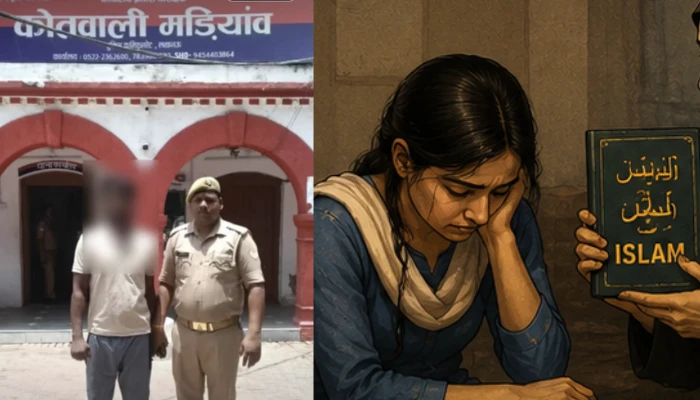
Case Summary
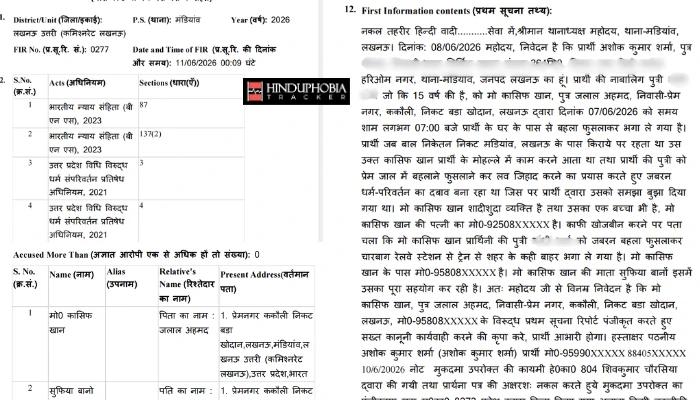
A Hindu minor girl in Lucknow, Uttar Pradesh, was lured through a romantic relationship, abducted, and subjected to sustained pressure to convert to Islam by a Muslim man and his mother. The Hinduphobia Tracker team contacted Madiyaon Police Station in Lucknow, which confirmed that the girl is Hindu. The FIR copy obtained in the case also reaffirms her Hindu identity. The matter came to light when the victim's father, Ashok Kumar Sharma, filed a written complaint at Madiyaon Police Station on 11 June 2026. He stated that his daughter, aged fifteen, had been abducted on 7 June 2026 at around 7:00 PM by Mohammad Kasif Khan, son of Jalal Ahmad, resident of Premnagar Kakauli, Lucknow. According to the complaint, Kasif Khan had previously worked in the complainant’s neighbourhood and had attempted to entrap the minor in a love trap. He pressured her for religious conversion and sought to marry her through Nikah (Islamic marriage). The complainant had earlier warned him to desist, but despite this, Kasif Khan continued his efforts. On 7 June 2026, he abducted the girl from near her home and took her away by train from Charbagh Railway Station. The FIR recorded that Kasif Khan was already married and had a child. His wife’s mobile number was provided in the complaint. The complainant further stated that Kasif Khan’s mother, Sufiya Bano, actively assisted him in the abduction and conversion attempt. Police registered the case under sections 87 and 137(2) of the Bharatiya Nyaya Sanhita, 2023 and sections 3 and 4 of the Uttar Pradesh Prohibition of Unlawful Conversion of Religion Act, 2021. The investigation was assigned to Sub-Inspector Deepak Kumar Pandey. Police recovered the minor before arresting the accused. On 14 June 2026, a police team comprising Inspector-in-Charge Shivanand Mishra, Sub-Inspector Pandey, and Constable Rohit Kumar received a tip from an informer that Kasif Khan was present behind Ramlila Maidan in the Naubasta Chowki area. The team moved immediately and arrested him on the spot.
Case Images
Why it is Hate Crime ?
This case has been added to the tracker under the primary category: Predatory Proselytisation. Within this, the subcategory selected is- Proselytisation by grooming, brainwashing, manipulation or subtle indoctrination. Under this, the tertiary categories selected are: Conversion of a minor, Family claims grooming. Religious brainwashing essentially means the often subtle and forcible indoctrination to induce someone to give up their religious beliefs to accept contrasting, regimented ideas. Religious grooming or brainwashing also involves propaganda and manipulation. It involves the systematic effort, driven by religious malice and indoctrination, to persuade “non-believers’ to accept allegiance, command, or doctrine to and of a contrasting faith. Cases of such grooming or brainwashing are far more nuanced than direct threats, coercion, inducement and violence. In such cases, it is often seen that there is repeated, subtle and continual manipulation of the victim to induce disaffection towards their own faith and acceptance of the contrasting faith of the perpetrator. While subtle indoctrination is widely acknowledged as predatory, an element which is often understated in such conversions or the attempts of such conversion is the role of loyalty and trust which might develop between the perpetrator and the victim. Fiduciary relationships are often abused to affect such religious conversion. For example, an educator transmitting religious doctrine of a competing faith to a Hindu student. The Hindu student is likely to accept what the teacher is transmitting owing to the existence of the fiduciary relationship. The exploitation of the fiduciary relationship to religiously indoctrinate victims would also be included in this category. Since the underlying animosity towards the victim’s faith forms the basis of predatory proselytisation, such cases are considered religiously motivated hate crimes. The other subcategory selected is: Harassment, threats, coercion for conversion. Harassment covers a wide range of behaviours of an offensive nature. It is commonly understood as behaviour that demeans, humiliates, and intimidates a person, including threats and coercion. Harassment and threats, in this case, find their root on discriminatory grounds, which has the effect of nullifying a person’s rights or infringing upon his freedom to exercise his right specifically owing to the victim’s religious identity. Verbal and physical threats and psychological or physical harassment are often used against Hindu victims because they choose to practice their professed religion. Religious harassment also includes forced and involuntary conversions by harassment, threats or coercion. Coercion includes intimidatory tactics like force-feeding a Hindu victim beef to convert to another religion, forceful circumcision, etc. In several cases documented, non-Hindu perpetrators or those who harbour specific animosity towards Hinduism, harass victims simply based on their religious identity. Such cases often also include harassment to ensure the Hindu victim abandons his/her professed religion and adopts the religion of the perpetrator. Such cases, where Hindu victims are harassed to convert to the perpetrator’s religion, are rooted in animosity towards the victim’s religious identity and are therefore documented as religiously motivated hate crimes. The other primary category selected in the case is " Crime against women in relationships and other sexual crimes". The sub-category selected is: "Brainwashed and/or Groomed. The tertiary categories selected are: Conversion of a minor, Family claims grooming. In our database, we have not added incidents where women have converted to another religion of their free will, and no allegations of forced/involuntary conversion have been made. However, there are certain cases of conversion where the consent itself is a result of the brainwashing or grooming of a minor by the non-Hindu perpetrator trying to victimise a woman for her Hindu religious identity. The phenomenon of grooming points to non-Hindu perpetrators identifying their Hindu victims’ vulnerabilities and exploiting them over months and sometimes years, to extract the supposed ‘consent’ to convert their religion. In most cases of grooming, the victims are minors, or the grooming started when the victim was a minor. In other cases of grooming, the non-Hindu perpetrator brainwashes and grooms a minor victim to extract their trust and then proceeds to rape them repeatedly with the intent of converting them to their faith. It is pertinent to understand here that when the victim is a minor, the ‘consent’ to convert or enter into a romantic relationship with an adult itself is redundant – addressed by POCSO. While every case of conversion of a minor and incidents of establishing a physical relationship with a minor by an adult are crimes, for this database, a case would be considered a hate crime only if there is a distinct religious angle to the grooming. For example, in the UK, if a Hindu minor is targeted by Pakistani grooming gangs, it would be considered a hate crime because the victims are specifically targeted owing to their non-Muslim religious identity, with the perpetrators being Muslim. In other cases, if a Hindu minor is brainwashed into entering a physical relationship with the non-Hindu adult perpetrator and the family alleges grooming/brainwashing of the minor to convert her religion, it would form a part of this database. If the victim is a Hindu adult, the case would form a part of this database only if the victim herself says that she was brainwashed/groomed to convert her religion. However, if the victim is deceased (murdered or otherwise), the case would form a part of this database if her family/friends provided testimony that the victim was brainwashed/groomed to convert her religion. Since these crimes have a distinct religious angle where the victim is being targeted owing to her Hindu religious identity, these cases are considered hate crimes. The other subcategory selected is: Forced conversion before marriage. The tertiary category selected is: Forced to do Nikah. In such cases, a non-Hindu man is in a relationship with a Hindu woman when the pressure to convert her religion begins to manifest. In such cases, typically, two patterns emerge. First, when the relationship is consensual, and the religious identity of the perpetrator is known to the Hindu woman in the relationship, however, at some point during the relationship, the non-Hindu man starts to force the victim to convert her religion and give up her Hindu religious identity. The second is when the woman gets into a marriage with the man, pretending to share her faith. Later, when the truth is revealed, the man starts pressuring the woman to convert to his religion and give up her religious identity. In both situations, the methods used to force the victim to convert her religion often revolve around force-feeding beef, forcing her to wear hijab, forcing her to read the Kalma or even pressurising the victim to do ‘Nikah’, which is marriage under Islamic law, with a prerequisite being conversion to Islam. Cases where a Hindu woman consensually converts to Islam in a relationship will be left out of the hate crime database, even though it could be argued in several cases that the conversion was a result of religious brainwashing. This case was included in the Hinduphobia Tracker because the victim was specifically subjected to efforts aimed at severing her connection with her Hindu faith and assimilating her into another religion, Islam. The religious motive was evident from the pressure exerted upon the minor girl to convert to Islam and undergo Nikah. The attempt to alter her religious identity formed a central component of the conduct and distinguished the incident from a conventional case of abduction to a hate crime driven by hatred for the victim due to her religious identity. The circumstances also revealed a calculated exploitation of a minor's vulnerability. Emotional influence was used to gain the confidence of a Hindu child before control was exercised over her life and personal choices. It is important to state that the victim being a minor means the element of consent and a genuine change of conscience is missing ab initio. Minors, due to their young age, lack of maturity, and vulnerability, are immature to make lifetime decisions like converting to another religion or getting into a relationship or marriage with an adult. In this case, the objective was not merely to establish a relationship but to place the victim in a position where resistance to demands concerning her faith became increasingly difficult. The fact that the Muslim perpetrator exploited this vulnerability of the minor Hindu girl to convert her to Islam by luring her into a relationship and pressuring her to do Nikah showcases the deep-seated religious hostility imposed on the victim due to her Hindu identity, making it a clear case of a hate crime. Such conduct reflected a deliberate effort to manipulate a minor for a religious end. The fact that the perpetrator abducted the minor child away from the safety of her home, her family, and her community further demonstrates the predatory and premeditated nature of the crime. At such a vulnerable age, a child requires the secure environment provided by her immediate family and the wider Hindu community to protect against exploitation. By deliberately removing her from this protective support system, the perpetrator sought to isolate her and weaken her capacity to resist his demands. This calculated separation served as a direct mechanism to facilitate her forced conversion and pressure her into Nikah. Consequently, executing the abduction away from her near and dear ones underscores the depth of religious hostility driving the offence. Furthermore, the insistence on conversion demonstrated that the victim's Hindu identity was viewed as an obstacle to the perpetrator's desired outcome. Had the intention been limited to a personal relationship, there would have been no reason to pressure the victim to abandon her faith. The repeated effort to secure a change in religion indicated an intention to replace her existing religious identity with one acceptable to the perpetrator. This imparted a clear religious dimension to the offence and brought it within the ambit of a hate crime directed against a Hindu victim. The demand for Nikah further reinforced this conclusion. In Islam, Nikah can only be possible between two Muslims; a non-Muslim woman, according to Islamic law, would have to convert to marry a Muslim man. The forced marriage, in this context, was not presented as an independent objective but as a mechanism through which conversion could be formalised and institutionalised. The victim was expected to relinquish her Hindu identity before the desired marital arrangement could be achieved. Consequently, the pressure for marriage and the pressure for conversion formed part of the same process. Such acts showcase the depth of hostility that the perpetrator had towards the victim's Hindu identity. The case was aggravated by the fact that the accused was already married and had a child. Despite having an existing family, he targeted a minor Hindu girl and sought to draw her into a situation that would have fundamentally altered her religion and future. This demonstrated a greater degree of premeditation and undermined any suggestion that the conduct arose from a genuine intention to enter into a lawful and legitimate relationship. Equally significant was that the accused's mother actively assisted in the overall endeavour. Her involvement indicated that the effort to remove the victim from her existing environment and facilitate the intended outcome was not confined to the actions of a single individual. The participation of a family member strengthened the coercive nature of the circumstances and highlighted the organised character of the religiously driven crime. Taken together, the incident reflected a pattern in which a Hindu minor was groomed, removed from the protection of her family, and subjected to pressure designed to alter her religious identity and bind her to an Islamic marriage. The intention was to secure both control over the victim and the abandonment of her Hindu faith. For these reasons, the case constituted a religiously motivated hate crime and was included in the Hinduphobia Tracker. Disclaimer: The Hinduphobia Tracker records incident dates based on when the victim’s ordeal began, rather than the date on which the case is reported in the media. However, in the present case, media reports did not specify the exact date on which the victim was first approached or drawn into the relationship by the perpetrator. The available records only confirmed, as per the First Information Report, that the victim was abducted on 7 June 2026. This remained the earliest clearly established date within the documented facts of the case. Therefore, 7 June 2026 was selected as the indicative incident date solely for documentation purposes.
Victim Details
Total Victim
1
Deceased
0
Gender
- Male 0
- Female 1
- Third Gender 0
- Unknown 0
Caste
- SC/ST 0
- OBC 0
- General 1
- Unknown 0
Age Group
- Minor 1
- Adult 0
- Senior Citizen 0
- Unknown 0


Case Status
Arrested


Perpetrators Details
Perpetrators
Muslim Extremists
Perpetrators Range
From 2 To 5
Perpetrators Gender
both
 Sources




