Minor Hindu girl from Darbhanga lured under pretext of marriage, abducted and taken towards Nepal for forced religious conversion by Muslim man
 Darbhanga, Bihar, India
  11 June, 2026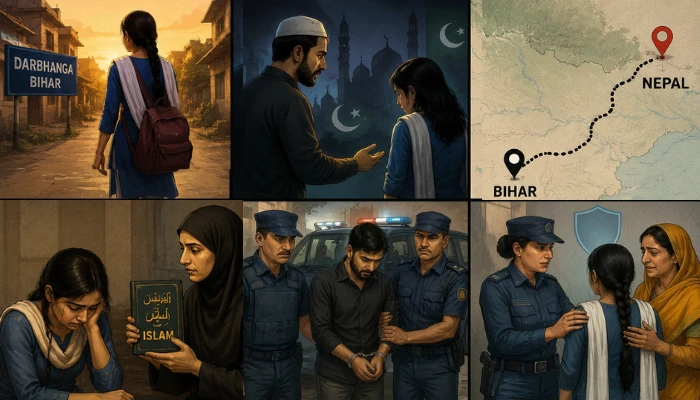
Case Summary
In Hanumannagar, within the jurisdiction of the Moro police station in the Darbhanga district of Bihar, a 14-year-old Hindu girl was lured into a relationship by a Muslim man with a false promise of marriage. She was abducted and transported towards the Nepal border. The accused, Talik Raza, the son of Shahzad Ali of Therma Gaighat, Muzaffarpur, abducted the victim with the intention of converting her to Islam and forcibly marrying her. The Hinduphobia Tracker contacted the police in this case, and they confirmed that the victim was a Hindu girl. The incident took place on the morning of 12 June 2026, when the 14-year-old Hindu girl was abducted by Talik Raza. Following the abduction, Talik Raza began transporting the victim towards the Nepal border with the plan to have her converted to Islam and married across the border, outside the reach of Indian law and her family. During interrogation after her recovery, the minor victim stated that the accused used psychological manipulation to prevent her from returning to her parents, threatening her with arrest by her family and telling her that if she went back she would be caught and punished. She also revealed that the accused had lured and pressured her to convert and undergo a nikah (Islamic marriage) with him. The case came to public notice on Monday (15 June 2026), when the Moro police, executing swift action based on technical investigation and intelligence under the leadership of Station House Officer Divya Jyoti, safely recovered the minor near the Nepal border in the Sonvarsha police station area of the Sitamarhi district. The accused was arrested at the same location on 15 June. The police produced Talik Raza before the court and sent him into judicial custody. The minor was subjected to a medical examination, and her statement was recorded before a magistrate.
Why it is Hate Crime ?
This case has been added to the tracker under the primary category: Predatory Proselytisation. Within this, the subcategory selected is: Proselytisation by grooming, brainwashing, manipulation or subtle indoctrination. The tertiary categories selected are: Conversion of Minor, Victim says was brainwashed/ groomed. Religious brainwashing essentially means the often subtle and forcible indoctrination to induce someone to give up their religious beliefs to accept contrasting, regimented ideas. Religious grooming or brainwashing also involves propaganda and manipulation. It involves the systematic effort, driven by religious malice and indoctrination, to persuade “non-believers’ to accept allegiance, command, or doctrine to and of a contrasting faith. Cases of such grooming or brainwashing are far more nuanced than direct threats, coercion, inducement and violence. In such cases, it is often seen that there is repeated, subtle and continual manipulation of the victim to induce disaffection towards their own faith and acceptance of the contrasting faith of the perpetrator. While subtle indoctrination is widely acknowledged as predatory, an element which is often understated in such conversions or the attempts of such conversion is the role of loyalty and trust which might develop between the perpetrator and the victim. Fiduciary relationships are often abused to affect such religious conversion. For example, an educator transmitting religious doctrine of a competing faith to a Hindu student. The Hindu student is likely to accept what the teacher is transmitting owing to the existence of the fiduciary relationship. The exploitation of the fiduciary relationship to religiously indoctrinate victims would also be included in this category. Since the underlying animosity towards the victim’s faith forms the basis of predatory proselytisation, such cases are considered religiously motivated hate crimes. The other subcategory selected is: Harassment, threats, coercion for conversion. Harassment covers a wide range of behaviours of an offensive nature. It is commonly understood as behaviour that demeans, humiliates, and intimidates a person, including threats and coercion. Harassment and threats, in this case, find their root on discriminatory grounds which has the effect of nullifying a person’s rights or infringing upon his freedom to exercise his right specifically owing to the victim’s religious identity. Verbal and physical threats and psychological or physical harassment are often used against Hindu victims because they choose to practice their professed religion. Religious harassment also includes forced and involuntary conversions by harassment, threats or coercion. Coercion includes intimidatory tactics like force-feeding a Hindu victim beef to convert to another religion, forceful circumcision etc. In several cases documented, non-Hindu perpetrators or those who harbour specific animosity towards Hinduism, harass victims simply based on their religious identity. Such cases often also include harassment to ensure the Hindu victim abandons his/her professed religion and adopts the religion of the perpetrator. Such cases where Hindu victims are harassed to convert to the perpetrator’s religion are rooted in animosity towards the victim’s religious identity and are therefore documented as religiously motivated hate crimes. The second primary category selected is: Crimes against women in relationships and other sexual crimes. The subcategory selected is: Brainwashed and/or Groomed. The tertiary categories selected are: Conversion of Minor, Victim says she was brainwashed/ groomed. In our database, we have not added incidents where women have converted to another religion of their free will and no allegations of forced/involuntary conversion have been made. However, there are certain cases of conversion where the consent itself is a result of the brainwashing or grooming of a minor by the non-Hindu perpetrator trying to victimise a woman for her Hindu religious identity. The phenomenon of grooming points to non-Hindu perpetrators identifying their Hindu victims’ vulnerabilities and exploiting them over months and sometimes years, to extract the supposed ‘consent’ in order to convert their religion. In most cases of grooming, the victims are minors or the grooming started when the victim was a minor. In other cases of grooming, the non-Hindu perpetrator brainwashes and grooms a minor victim to extract their trust and then proceeds to rape them repeatedly with the intent of converting them to their faith. It is pertinent to understand here that when the victim is a minor, the ‘consent’ to convert or enter into a romantic relationship with an adult itself is redundant – addressed by POCSO. While every case of conversion of a minor and incidents of establishing a physical relationship with a minor by an adult is a crime, for the purpose of this database, a case would be considered a hate crime only if there is a distinct religious angle to the grooming. For example, in the UK, if a Hindu minor is targeted by Pakistani grooming gangs, it would be considered a hate crime because the victims are specifically targeted owing to their non-Muslim religious identity with the perpetrators being Muslim. In other cases, if a Hindu minor is brainwashed into entering a physical relationship with the non-Hindu adult perpetrator and the family alleges grooming/brainwashing of the minor to convert her religion, it would form a part of this database. If the victim is a Hindu adult, the case would form a part of this database only if the victim herself says that she was brainwashed/groomed to convert her religion. However, if the victim is deceased (murdered or otherwise), the case would form a part of this database if her family/friends provided testimony that the victim was brainwashed/groomed to convert her religion. Since these crimes have a distinct religious angle where the victim is being targeted owing to her Hindu religious identity, these cases are considered a hate crime. The other subcategory selected is: Forced conversion before marriage. The tertiary category selected is: Forced to do Nikah. In such cases, a non-Hindu man is in a relationship with a Hindu woman when the pressure to convert her religion begins to manifest. In such cases, typically, two patterns emerge. First, when the relationship is consensual, and the religious identity of the perpetrator is known to the Hindu woman in the relationship, however, at some point during the relationship, the non-Hindu man starts to force the victim to convert her religion and give up her Hindu religious identity. The second is when the woman gets into a marriage with the man pretending to share her faith. Later, when the truth is revealed, the man starts pressuring the woman to convert her religion and give up her religious identity. In both the situations, the methods used to force the victim to convert her religion often revolve around force-feeding beef, forcing her to wear hijab, forcing her to read the Kalma or even pressurizing the victim to do ‘Nikah’, which is marriage under Islamic law, with a prerequisite being conversion to Islam. Cases where a Hindu woman consensually converts to Islam in a relationship will be left out of the hate crime database, even though it could be argued in several cases that the conversion was a result of religious brainwashing. This case represents a clear example of a religiously motivated hate crime. A minor Hindu girl was targeted and lured into a relationship, and subsequently abducted with the explicit intent of forcing her to convert to Islam and marry the perpetrator in a Nikah ceremony. The actions of the Muslim perpetrator demonstrate a targeted effort to systematically strip the victim of her Hindu faith, heritage, and religious identity. By attempting to entrap her within a forced marriage and coerce her into abandoning her faith and community, the crime moves beyond a conventional abduction, establishing itself as a clear, identity-based hate crime designed to eradicate the victim's religious and cultural roots. In analysing this incident, it is first and foremost important to recognise that the victim is a minor. Because of her age, the legal and moral elements of informed consent and a genuine, voluntary change of conscience are entirely missing ab initio. Minors, by virtue of their developmental stage, possess a natural vulnerability and lack the long-term maturity required to make life-altering decisions, whether regarding romantic relationships with adults or changing their lifelong faith. The perpetrator deliberately exploited this inherent age vulnerability, using it as a tool to manipulate and coerce her towards an unconsented religious conversion and a forced Nikah ceremony. This deliberate exploitation of a Hindu child's impressionable state to strip away her faith and identity confirms that the offence is a hate crime deeply rooted in anti-Hindu hostility. The act of trapping the victim in a relationship and subsequently abducting her far from her home constitutes a profound form of harassment and terror that she was forced to endure for the purpose of religious conversion. As a minor, the victim was naturally surrounded by her family and her wider Hindu community, both of which provided her primary source of physical protection, emotional security, and cultural anchoring. By forcibly tearing her away from this protective network, the perpetrator systematically dismantled her security system, leaving her entirely exposed to psychological coercion and intense religious manipulation. This abduction highlights the deeply predatory nature of the crime, as the perpetrator understood that isolating the victim from her loved ones was a necessary prerequisite to breaking her resolve and forcing a conversion. Furthermore, the attempt to force the victim to convert to Islam constituted a direct and serious violation of her religious autonomy and her fundamental human rights, particularly her right to freely practise, profess, and preserve her own faith without fear, coercion, or interference. Such coercive conduct treated her Hindu identity not as an inviolable part of her personhood, but as something that could be dismissed, overridden, and erased through pressure, intimidation, and control. Forcing an individual to renounce their religion under duress does not operate in isolation; it carries an inherent message of religious hostility, signalling that the victim’s beliefs and, by extension, the identity of her wider community, can be invalidated and replaced against their will. In this context, the imposition of religious conversion was not a matter of personal persuasion but an act of coercion that stripped the victim of meaningful choice, making her compliance a product of fear rather than consent. This systematic denial of religious freedom and the targeted undermining of her Hindu identity elevated the act beyond individual wrongdoing and established it as a serious religiously motivated offence directed at her core faith identity. Similarly, the intent to force the victim into a Nikah marriage operated as a calculated mechanism to permanently entrap her within a coercive and exploitative framework. Within the context of this abduction, the Nikah was not a consensual marital union but a deliberate tool of subjugation, designed to create a veneer of legitimacy around the unlawful act while binding the victim legally, socially, and emotionally to her Muslim captor. By invoking a religious marriage contract in circumstances marked by abduction, manipulation, and coercion, the perpetrator sought to normalise and institutionalise the forced erasure of her identity, making it significantly more difficult for the victim to escape, return to her family, or reconnect with her religious and cultural roots. The use of marriage in this manner transformed a religious and social institution into an instrument of control, reinforcing the victim’s isolation and dependence while consolidating the intended removal of her from her Hindu community. In this way, the Nikah became not merely a consequence of the abduction but an integral part of a broader pattern of coercion and religious domination, reflecting the religiously motivated nature of the offence and its impact on the victim’s identity and freedom. The plan to transport the minor to the Nepal border further reveals the highly calculated, premeditated, and organised nature of the entire operation. This was not an impulsive or isolated act, but a well-prepared and structured conspiracy executed by the perpetrator to take the victim outside the immediate reach of Indian law enforcement and her family's frantic search. By coordinating a cross-district abduction aimed at an international border, the perpetrator demonstrated a clear understanding of jurisdictional boundaries and a deliberate strategy to maximise the victim's isolation. This level of planning emphasises the predatory and systematic nature of the crime, showing a determined effort to ensure the forced conversion could be completed without interference. Since this case comprehensively meets the established criteria of a religiously-motivated offence, involving the targeting of a vulnerable minor, forced religious erasure, and premeditated isolation, it has been formally documented. Consequently, this case is being added to the hate crime database of the Hinduphobia tracker to ensure it is accurately recorded as part of the broader patterns of hostility targeting the Hindu community.
Victim Details
Total Victim
1
Deceased
0
Gender
- Male 0
- Female 1
- Third Gender 0
- Unknown 0
Caste
- SC/ST 0
- OBC 0
- General 0
- Unknown 1
Age Group
- Minor 1
- Adult 0
- Senior Citizen 0
- Unknown 0


Case Status
Arrested


Perpetrators Details
Perpetrators
Muslim Extremists
Perpetrators Range
One Person
Perpetrators Gender
male
 Sources




