Hindu temple land in Sikar, Rajasthan, encroached upon; priest faces abuse and threats for objecting
 Sikar, Rajasthan, India
  9 June, 2026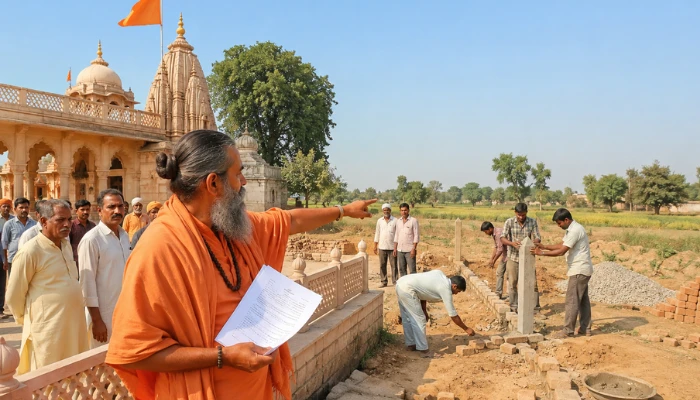
Case Summary
An ancient Hindu temple in Rajasthan's Patan tehsil was illegally encroached upon by miscreants. The Mahant (priest) of the temple was abused and threatened with dire consequences for opposing the encroachment. The incident came to light when the head priest, Mahant Balbir Das of the Shri Thakur Ji Sitaram Ji Mandir, filed a formal police complaint against the encroachment. The complaint stated that unidentified individuals entered 9.76 hectares of temple land on 10 June 2026 with tractors and agricultural equipment, attempting to begin farming on the disputed property. When the mahant stepped forward to object, the accused responded with aggression, verbally abusing him and issuing threats of serious consequences. He further stated that he feared for his life. The complaint did not stop at physical intimidation. Mahant Balbir Das further stated that certain individuals attempted to execute illegal transactions over temple land through forged documents, a calculated effort to strip the ancient institution of its property through paperwork rather than presence. The mahant asserted that this was not an isolated incident. He stated that attempts to interfere with the temple's religious traditions and property had occurred before, pointing to a pattern rather than a one-off transgression. The incident stirred resentment among the village community and the temple's devotees, for whom the temple was not merely real estate but a living centre of faith. In his complaint, Mahant Balbir Das made four specific demands of the police administration: immediate stoppage of the encroachment and farming activity on temple land, eviction of the accused and restoration of the property, criminal action against those responsible, and personal police protection for himself and the temple.
Why it is Hate Crime ?
The primary category selected in this case is "Attack on Hindu religious representations." The selected subcategory is: Encroachment or illicit takeover of temple land/land near the temple. In Hinduism, a temple is the abode of the Deity. The Deity in the Temple is consecrated, thereby making it a real, breathing entity. Hindus believe that not just the Deity but the temple premises itself are sacred to Hindus since Hindus hold the faith that the entire Temple space is an amalgamation of the divine energy of the deity. Not only the Temple but the Temple premises in its entirety are considered sacred by Hindus. In several cases, the premises of the Temple and/or religious centre are illicitly taken over by institutions belonging to other faiths, like the Waqf board or the Church. Other times, the temple property, land or the property of religious centres are illicitly encroached upon by non-Hindu groups. Any illicit takeover or encroachment is a crime an initio; however, when non-Hindu groups illicitly take over or encroach on the sacred land of Hindus, it is an affront to the Hindu community and is therefore classified as a religiously motivated hate crime under this category. The case was included in the Hinduphobia Tracker because it involved the targeting of a Hindu religious institution and its sacred property. The actions were not directed at an ordinary piece of land but at land belonging to a sacred temple. The religious trigger in this case was the targeting of land belonging to a Hindu temple. For Hindus, temple land is not regarded as ordinary real estate but as part of a sacred religious institution dedicated to the deity. Once a deity is consecrated, the entire temple complex, including the surrounding land dedicated to its upkeep and religious functions, is regarded as sacred. Temple land serves religious, cultural, charitable, and community purposes and is considered part of the deity’s domain. Consequently, any attempt to seize, occupy, or unlawfully exercise authority over such land amounts to an intrusion into a space revered by devotees. By attempting to take control of property associated with a Hindu place of worship, the perpetrators targeted an asset carrying deep religious significance for devotees. This transformed the incident from a simple land dispute into an act affecting a sacred Hindu space, thereby giving it a clear anti-Hindu and religious character. The nature of the actions demonstrated an intention to undermine the temple’s ability to exercise control over its own religious property and resources. Such conduct carried consequences beyond the loss of land. It threatened the continuity of religious practices, the authority of the temple administration, and the preservation of a sacred institution that held significance for the local Hindu community. Moreover, by seeking to establish control over property attached to the temple and by executing illegal transactions through forged documents, the perpetrators sought to weaken the temple’s autonomy and diminish its ability to function as an independent religious institution. This transformed the incident from a simple encroachment matter into an act that directly targeted a Hindu religious establishment and the devotees connected to it. The threats issued against the Mahant were significant because they were directed at an individual in his capacity as the guardian of a Hindu religious site. The hostility was not expressed in an unrelated personal context; rather, it arose when opposition was raised to actions affecting temple land. Furthermore, the use of threats was intended to create fear and discourage resistance to the encroachment. Such intimidation served a broader purpose than merely silencing one individual. It sent a message that those responsible for safeguarding Hindu religious property could face personal harm if they attempted to defend it. The objective was to compel compliance through fear, thereby making it easier to interfere with or gain control over property associated with the temple. When threats are used to deter the protection of a Hindu religious institution, they acquire a religious dimension because they target an individual specifically for carrying out responsibilities connected to the preservation of a sacred Hindu space. The incident also reflected hostility towards the religious significance attached to the temple and its assets by devotees. Hindu temples are not simply places where rituals occur; they are regarded as living centres of faith, and those entrusted with their care perform a religious duty on behalf of the community. Therefore, threatening a temple custodian while interfering with temple property constituted an attack not only on an individual but also on the institution he represented and the faith community connected to it. Taken together, these actions demonstrated a deliberate attempt to undermine the sanctity, security, and independence of a Hindu temple and to intimidate those defending it. The intention was to facilitate control over property dedicated to a Hindu place of worship by creating fear and weakening resistance, thereby giving the incident a clear anti-Hindu and religiously motivated character. For these reasons, the incident met the criteria for inclusion in the Hinduphobia Tracker.
Victim Details
Total Victim
1
Deceased
0
Gender
- Male 1
- Female 0
- Third Gender 0
- Unknown 0
Caste
- SC/ST 0
- OBC 0
- General 0
- Unknown 1
Age Group
- Minor 0
- Adult 1
- Senior Citizen 0
- Unknown 0


Case Status
Complaint filed


Perpetrators Details
Perpetrators
Unknown
Perpetrators Range
Unknown
Perpetrators Gender
unknown
 Sources




