Hindu temple in Muzaffarnagar desecrated as miscreants drink alcohol inside its premises, temple priest killed for objecting
 Muzaffarnagar, Uttar Pradesh, India
  10 June, 2026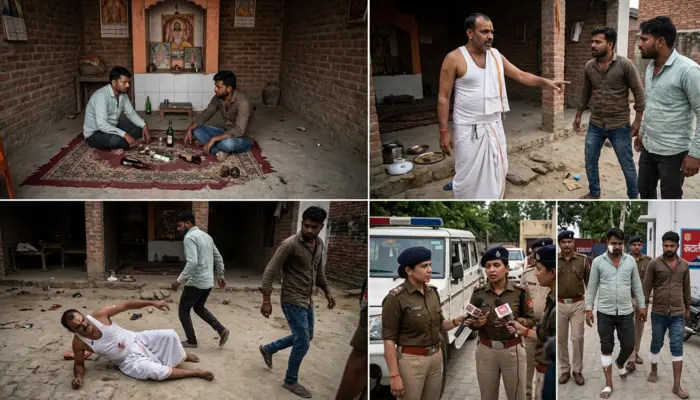
Case Summary
In Begrajpur village of Muzaffarnagar district, Uttar Pradesh, the sanctity of a Hindu Ravidas temple was desecrated when two miscreant men consumed alcohol inside its premises. When the temple priest, 45-year-old Natthan Singh, objected to their actions, he was brutally assaulted. He later succumbed to his injuries during treatment on 11 June 2026. Following a complaint lodged by Natthan's nephew, Sagar Singh, the police arrested the two accused, Aniket and Arun, on the night of 12 June 2026 after an encounter in which both sustained gunshot injuries to their legs. According to Khatauli Circle Officer Rupali Rao, the accused, both in their late twenties, were attempting to flee the area on a motorcycle when a police team, acting on a tip-off, set up a checking operation near the Begrajpur underpass. The suspects tried to evade arrest and opened fire when signalled to stop. The police retaliated, injuring both men before taking them into custody. During interrogation, the accused confessed to the crime. The officer stated that the murder case was solved within 24 hours of its registration and that further legal action was being taken based on the evidence collected during the investigation.
Why it is Hate Crime ?
The first primary category selected in this case is: Attack on Hindu religious representations. The subcategory selected is: Breaking rules of worship. Sanatan Dharma is not a religion of one book, which is to say that while it has religious scriptures that form the central tenets of the faith, there are several traditions followed through thousands of years, mostly passed from generation to generation orally. One of these oral traditions or written traditions is the rules of specific temples. Certain temples have rules which are traditional rules, dependent on the worship of the presiding deities. These rules and traditions have been followed for thousands of years whether they find scriptural mention or not. Such traditions are based on the nature and rules of worship of the presiding deity of that temple. Any non-compliance of these traditions owing to animosity towards the faith or for the sake of activism stems not only from the lack of faith in the presiding deity but also disregard for the faith of the devotees of that deity/temple and implicit bias against the faith, the tradition and the deity itself. Since these specific traditions are central to the faith of the devotees of that specific temple and presiding deity, any non-compliance with these traditional rules would be considered a religiously motivated hate crime. The other subcategory selected is: Defiling religious customs. Sanatan Dharma is not a religion of one book, which is to say that while it has religious scriptures that form the central tenets of the faith, there are several traditions followed through thousands of years, mostly passed from generation to generation orally. There are several such customs and traditions that are followed by various Hindus and Hindu sects. Defiling of these traditions and customs is a breach of an individual or group’s religious practices. Such practices can range from dietary restrictions like not eating non-vegetarian food for a certain period of the year, not eating non-vegetarian food at all, not eating beef since the cow is considered holy in Hinduism, the sanctity of religious customs followed in the house (like many ISCKON devotees), etc. Any malicious action leading to the breach of such traditions or defilement of these traditions owing to animosity towards the faith or for the sake of activism stems not only from the lack of faith in the religion itself but also from disregard for the faith of the devotees who follow the customs/traditions and implicit bias against the faith, the tradition itself. Since these specific traditions are central to the faith of the devotees of that specific sect of Hindus, any non-compliance with these traditional rules would be considered a religiously motivated hate crime. The second primary category selected is: Attack resulting in death. The subcategory selected is: Attacked for opposing radicals or trying to save victim. In several cases, Hindus are attacked for opposing religiously motivated crimes being committed against a fellow Hindu or simply for voicing an opinion opposing radical elements, who either have in the past or continue to persecute Hindus. In such cases, the initial attack against the victim, against which the Hindu was trying to defend the victim, would also need to be classified as a religiously motivated hate crime. Since the initial crime itself was religiously motivated and the subsequent crime of attempting to save the victim or speaking against the radical elements ends up inviting a violent attack, it would also be classified as a religiously motivated hate crime. Under this category, cases where the attack led to the death of the Hindu victim/s would be documented. This incident meets the parameters of a religiously motivated hate crime because it involved the desecration of a Hindu temple through the consumption of alcohol inside its premises, followed by the killing of the temple priest who opposed the act. The combination of an attack on a sacred religious space and the lethal violence inflicted on its custodian makes it a clear case of hostility directed towards a Hindu place of worship and its adherents. Hindu temples occupy a central place in the religious and cultural life of the Hindu community. They are regarded as sacred spaces where the divine is believed to reside following rituals of consecration, and devotees enter them with the expectation of maintaining physical and spiritual purity. The customs governing temple conduct are rooted in the Agamas, a body of Hindu scriptures that prescribe the rituals, practices, and standards required to preserve the sanctity of temples. In accordance with these traditions, intoxicants such as alcohol, along with other substances considered impure, are prohibited within temple premises because they are viewed as incompatible with the sacred nature of the space. The deliberate consumption of alcohol inside the temple therefore amounted to a direct violation of established religious rules and defiled a space that Hindus hold in the highest reverence. By disregarding these sacred rules and undermining the purity of the temple environment, the perpetrators desecrated the sanctity of the temple and violated principles enshrined in Hindu religious tradition. This deliberate act of defilement transformed the incident into an attack on a revered Hindu religious institution, making it a clear case of hostility directed towards a Hindu place of worship. Within Hindu tradition, alcohol is regarded as an impure substance that has no place within the consecrated environment of a temple. Temples therefore prohibit the entry and consumption of alcohol, meat, cigarettes, and other items that are considered capable of polluting the sacred atmosphere and disrupting the spiritual purity maintained through prescribed rituals. The fact that the perpetrators consumed alcohol inside the temple premises did not merely amount to inappropriate behaviour but constituted the defilement of an entire sacred ecosystem that Hindus regard with deep reverence. The act directly violated temple rules and demonstrated disregard for the religious values and practices that govern Hindu worship. The deliberate nature of this conduct reinforces the conclusion that the desecration targeted the sanctity of the temple itself, making it a clear case of a religiously motivated hate crime rooted in hostility towards a Hindu sacred space. When the temple priest opposed the consumption of alcohol inside the temple premises and sought to protect the sanctity of the shrine, he was subjected to such severe violence that he ultimately lost his life. The gravity of the assault, coupled with the prior desecration of the temple, indicates that the attack was not merely a spontaneous disagreement but followed the priest's attempt to uphold the sacred rules governing the temple. The severity of the violence inflicted upon him demonstrates hostility not only towards the individual but also towards the temple and the religious values he represented. By killing the priest for objecting to the defilement of a Hindu temple, the perpetrators conveyed that anyone who sought to protect the sanctity of the sacred space could face violent consequences. Such an act creates fear within the local Hindu community and undermines the ability of temple custodians and devotees to safeguard their places of worship, further reinforcing the communal impact of the incident and its classification as a religiously motivated hate crime. Given that this case involved the desecration of a Hindu temple through the consumption of alcohol in violation of established religious norms, followed by the killing of the temple priest who opposed the act, it satisfies the parameters of a religiously driven hate crime. The incident targeted both a sacred Hindu place of worship and its religious custodian, demonstrating hostility towards the institution and its adherents. Accordingly, this case is being added to the hate crime database of the Hinduphobia Tracker. Disclaimer: The Hinduphobia Tracker records incident dates based on when the crime occurs rather than when it is reported in the media. However, in the present case, media reports did not specify the exact date on which the incident took place and only mentioned that the temple priest succumbed to his injuries on 11 June 2026. Therefore, an indicative incident date of 11 June 2026 has been selected solely for documentation purposes and should not be construed as the confirmed date of the offence.
Victim Details
Total Victim
1
Deceased
1
Gender
- Male 1
- Female 0
- Third Gender 0
- Unknown 0
Caste
- SC/ST 0
- OBC 0
- General 0
- Unknown 1
Age Group
- Minor 0
- Adult 1
- Senior Citizen 0
- Unknown 0


Case Status
Arrested


Perpetrators Details
Perpetrators
Others
Perpetrators Range
From 2 To 5
Perpetrators Gender
male
 Sources




