Hindu woman deceived into relationship and taken from Assam by Muslim man pretending to be Hindu
 Tinsukia, Assam, India
  12 June, 2026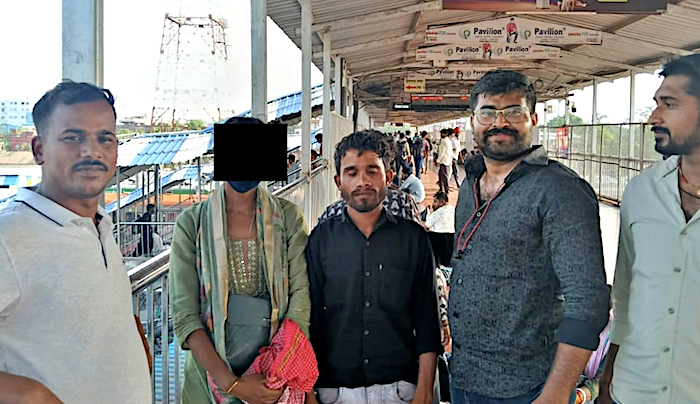
Case Summary
A Hindu young woman from Philobari in Tinsukia district, Assam, was taken away from her home after developing contact with a Muslim man who had concealed his religious identity. Her disappearance triggered concern among her family and local residents, who began searching for her after learning that she had travelled with him out of the state. The incident soon drew attention across the area after details emerged regarding the man's true identity and the circumstances under which he had established the relationship. The Hindu victim came into contact with a Muslim man identified as Sheikh Shakil Siddiqui, a resident of Kakjan village in Tinsukia district. He introduced himself as "Sameer" and presented himself as a Hindu. Through regular communication, he developed familiarity with the Hindu young woman and maintained frequent contact with her over the telephone. During this period, he concealed his Muslim identity while building trust with the victim. The victim's father stated that Sheikh Shakil Siddiqui's father had previously worked at their residence. Following that connection, Sheikh Shakil Siddiqui became acquainted with the Hindu young woman and gradually increased communication with her. The victim's family later stated that the relationship developed after this initial contact and that the Muslim man continued interacting with her while presenting himself under a Hindu identity. Within a relatively short period, the Hindu victim was persuaded to leave with Sheikh Shakil Siddiqui. The Muslim man took her away from Philobari and travelled with her towards Bihar. Family members stated that the Hindu young woman had been enticed and taken away under false pretences after the perpetrator had concealed both his religious identity and his real name. The disappearance of the Hindu victim caused immediate alarm within her family. After discovering that she had left with Sheikh Shakil Siddiqui, her family approached Philobari Police Station and lodged a complaint. They informed authorities that a Muslim man using the Hindu name "Sameer" had taken their daughter away from Assam. As news of the incident spread, local residents gathered and sought information regarding the whereabouts of the Hindu young woman. Community members assembled near the residence associated with Sheikh Shakil Siddiqui and demanded action. Concerns intensified after it became known that the Muslim perpetrator had concealed his identity while developing the relationship with the Hindu victim. The victim's family maintained that their daughter had been taken away through deception and repeatedly appealed for her safe recovery. They stated that she had been transported out of Assam and expressed concern about her welfare while she remained away from home. Local residents also urged authorities to locate the Hindu young woman as quickly as possible. Following the complaint, police initiated efforts to trace the victim and the perpetrator. Investigators tracked their movements beyond Assam and coordinated with authorities in Bihar. The search eventually led officers to Muzaffarnagar railway station in Bihar, where the Hindu victim was located and recovered. After the recovery of the Hindu young woman, Sheikh Shakil Siddiqui was taken into police custody. The victim was rescued safely and returned from Bihar. Authorities subsequently continued their investigation into the circumstances surrounding the concealment of identity, the development of the relationship, and the removal of the Hindu victim from Assam. The case remained under investigation following the rescue and arrest, with police examining all aspects of the incident and the events that led to the Hindu young woman's departure from her home.
Why it is Hate Crime ?
This case has been added to the tracker under the primary category - Crimes against women in relationships and other sexual crimes. Within this, the subcategory selected is - Man pretends to be Hindu. Under this, the tertiary category selected is - Name changed. When a non-Hindu man pretends to be a Hindu to deceive a Hindu woman into a relationship, the act is seen as triggered by malafide intentions. In some cases, the woman eventually accepts the man’s original religious identity and converts after the man’s identity is revealed. These cases could be argued as cases of religious brainwashing and a result of the pressure a woman feels after getting into a relationship with a man. The woman, it can be argued, also changed her religious identity because of the stigma she believes she might face if she chooses to walk out of a deceptive relationship. However, for the purpose of documenting hate crimes, the cases in this subcategory are limited to those where there is explicit violence aimed at religious conversion against the wishes of the victim (force-feeding beef, blackmailing with intimate videos, rape on refusal to convert, etc), or if the woman herself complains of the man’s religious deception. In such cases, it is established that the deception of the non-Hindu man had a specific aim of religious conversion or targeting of the victim due to her Hindu religious identity, therefore, making it a religiously motivated hate crime. This case exhibits clear religiously motivated targeting because the Muslim perpetrator deliberately concealed his identity and adopted the Hindu name “Sameer” in order to build trust with a Hindu young woman. The deception was not incidental to the offence but was the very mechanism through which access to the victim was obtained. If religion had been irrelevant, there would have been no need to abandon his real identity and assume a Hindu one. The success of the deception depended entirely upon the trust, familiarity, and sense of safety associated with a perceived shared Hindu identity. By presenting himself as a Hindu, the perpetrator created a false sense of religious compatibility that made it easier to gain the confidence of the victim and establish influence over her before ultimately taking her away from her family and community. The religious significance of this conduct extends far beyond the use of a false name. The perpetrator did not merely misrepresent a personal detail; he appropriated a Hindu identity in order to access a Hindu victim. This demonstrates a conscious understanding that the victim's faith and religious background were important factors in determining whom she would trust and associate with. Rather than respecting her right to make informed decisions based upon accurate knowledge of another person's identity, he circumvented that choice through religious deception. The victim's Hindu identity therefore became central to the offence because it was specifically exploited as a vulnerability that could be manipulated through the adoption of a fabricated Hindu persona. The deliberate change of name to “Sameer” further reinforces the religiously motivated nature of the conduct. Names are often among the most immediate indicators of religious and cultural identity. By replacing his Muslim identity with a Hindu name, the perpetrator removed a significant barrier that may have influenced the victim's decisions and those of her family. This was religiously significant because the deception specifically relied upon creating the impression that he belonged to the same faith community as the victim. The false Hindu identity was not simply a disguise; it functioned as a tool designed to secure acceptance, reduce suspicion, and facilitate long-term access to a Hindu young woman under false pretences. The conduct also demonstrated a disregard for the importance of religious identity in personal relationships. The perpetrator treated Hindu identity as something that could be adopted and discarded whenever it became useful for achieving his objective. In doing so, he exploited not only the victim's trust but also the broader trust that exists within religious communities. Hindu identity was effectively weaponised as a means of gaining influence over a Hindu victim, turning a marker of faith and community belonging into an instrument of deception. Such actions undermine the ability of individuals to make informed choices regarding their relationships and associations based upon their sincerely held religious beliefs. It is also significant that the deception specifically targeted a Hindu victim rather than occurring in a religiously neutral context. The entire scheme depended upon convincing the victim that the perpetrator shared her faith and background. This demonstrates that her Hindu identity was not incidental to the offence but one of the reasons the method succeeded. The perpetrator consciously selected a strategy that exploited religious trust and familiarity, showing that religion was not a peripheral factor but a central component of the targeting process. Taken together, the concealment of a Muslim identity, the adoption of the Hindu name “Sameer”, the exploitation of trust associated with a shared Hindu identity, and the use of religious deception to gain access to and influence over a Hindu young woman establish clear religiously aggravating elements. The victim's Hindu identity was not merely a characteristic she happened to possess; it was specifically exploited through calculated deception. For that reason, the case demonstrates a pattern of religiously motivated targeting in which Hindu identity itself became the means through which the victim was approached, manipulated, and ultimately victimised. Disclaimer: The exact date of when the Hindu woman and the Muslim perpetrator first came into contact was not specified in the available sources. However, the incident became publicly known through reports published on 13th June 2026. Accordingly, the Hinduphobia Tracker has recorded the respective date as the incident date for documentation purposes only.
Victim Details
Total Victim
1
Deceased
0
Gender
- Male 0
- Female 1
- Third Gender 0
- Unknown 0
Caste
- SC/ST 0
- OBC 0
- General 0
- Unknown 1
Age Group
- Minor 0
- Adult 0
- Senior Citizen 0
- Unknown 1


Case Status
Arrested


Perpetrators Details
Perpetrators
Muslim Extremists
Perpetrators Range
One Person
Perpetrators Gender
male
 Sources




