Hindu devotees faced prolonged encroachment on Chamunda Temple land in Moradabad
 Moradabad, Uttar Pradesh, India
  11 June, 2026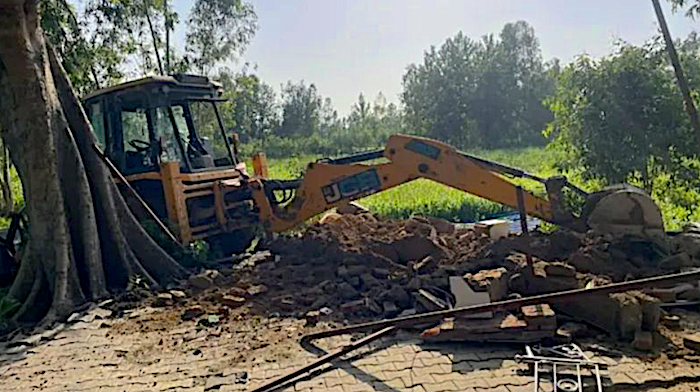
Case Summary
A Hindu place of worship in Moradabad, Uttar Pradesh, became the centre of a prolonged land dispute after a shrine was constructed on land recorded in the name of the Chamunda Temple. The dispute continued for years and created sustained tensions around a site used by Hindu devotees for worship. The matter culminated in administrative action after an official investigation confirmed the land's ownership status. The incident took place in Dharkangla village in Bhojpur, Moradabad district, where a Chamunda Temple stood on land recorded in the official revenue records as temple property. Hindu devotees regularly visited the site to perform religious worship and other devotional activities connected to the temple. Approximately two years before the demolition action, construction of a shrine began on land belonging to the Chamunda Temple. Despite objections from local Hindus, the structure continued to expand over time. Temporary construction gradually developed into a more permanent establishment. Tin sheds were erected around the site, and an inverter system was installed. As the structure expanded, Hindu devotees faced increasing difficulty accessing and using their own religious site. The continued occupation of temple land generated persistent disputes within the village. The issue became a source of recurring tension between the groups involved. The situation escalated to the point that police personnel were deployed in the area on multiple occasions to maintain order and prevent disturbances arising from the dispute. The conflict surrounding the land had already been the subject of legal and administrative proceedings for several years. Proceedings concerning potential breaches of peace involving members of both sides were initiated before the Sub Divisional Magistrate court. When tensions escalated again in February 2026, police action was taken against individuals from both groups under preventive provisions relating to the maintenance of public order. As concerns regarding the occupation of temple land intensified, villagers submitted complaints to the District Magistrate. The complaints stated that a shrine had been constructed on land belonging to the Chamunda Temple and that the occupation had continued despite objections from Hindu residents and temple supporters. The matter was subsequently referred for official examination. Following these complaints, the administration ordered an investigation. A revenue team conducted an inquiry into the ownership status of the disputed land. The investigation examined official land records and revenue documentation relating to the site. The inquiry determined that the land was registered in the name of the Chamunda Temple and that the shrine erected on the property had no legal status. The structure was consequently classified as an illegal encroachment upon temple land. After the investigation was completed, the administrative authorities directed the removal of the structure. On 12th June 2026, a joint operation involving revenue officials and police personnel was carried out at the site. A large police presence was deployed due to the sensitivity of the dispute and the risk of unrest. The structure constructed on the temple land was demolished using heavy machinery, and the occupied area was cleared. The operation was conducted under the supervision of local administrative officials and revenue authorities. Officials involved in the action included members of the revenue department and police force assigned to implement the demolition order. Following the removal of the structure, authorities warned that future encroachments on government land or religious property would not be tolerated and would result in legal action. The demolition ended the specific encroachment on the Chamunda Temple land. Administrative records continued to recognise the land as belonging to the temple, and the action was taken following the completion of official investigations and verification of ownership documents. No protests were recorded during the demolition operation, and the site remained under administrative oversight following the operation.
Why it is Hate Crime ?
This case has been added to the tracker under the primary category - Attack on Hindu religious representations. Within this, the subcategory selected is - Encroachment or illicit takeover of temple land/land near temple. In Hinduism, a temple is the abode of the Deity. The Deity in the Temple is consecrated, thereby, making it a real, breathing entity. Hindus believe that not just the Deity but the temple premises itself are sacred to Hindus since Hindus hold the faith that the entire Temple space is an amalgamation of the divine energy of the deity. Not only the Temple but the Temple premises in its entirety are considered sacred by Hindus. In several cases, the premises of the Temple and/or religious centre are illicitly taken over by institutions belonging to other faiths – like the Waqf board or the Church. Other times, the temple property, land or the property of religious centres are illicitly encroached by non-Hindu groups. Any illicit take over or encroachment is a crime an initio, however, when non-Hindu groups illicitly take over or encroach the sacred land of Hindus, it is an affront to the Hindu community and is therefore classified as a religiously motivated hate crime under this category. This case qualified as a religiously motivated hate crime because the encroachment occurred on land officially recorded as belonging to the Chamunda Temple, a Hindu place of worship. The significance of the incident extended far beyond a dispute over property ownership. Temple land serves a religious function and exists to facilitate worship, religious observances, gatherings of devotees, and the continued functioning of a sacred Hindu institution. The occupation and use of such land for an unrelated structure directly interfered with a space dedicated to Hindu religious life and therefore carried a clear religious dimension. The encroachment demonstrated a disregard for the sanctity of a Hindu religious site and the rights of Hindu devotees who relied upon the temple for worship. Religious freedom is not limited to the existence of a temple building alone; it also includes the ability of devotees to access, use, preserve, and maintain the surrounding land that supports the religious activities of the institution. Temple land often accommodates the movement of worshippers, religious gatherings, festivals, devotional practices, and the broader functioning of the religious site. When land belonging to a Hindu temple is occupied and repurposed, the impact is felt not only on the institution itself but also on the Hindu community that depends upon it for the exercise of its faith. The prolonged nature of the occupation further strengthened the religious significance of the incident. The structure did not remain a temporary presence but expanded over time and became increasingly established on land recognised as belonging to the temple. The continuation of the encroachment despite objections from Hindu devotees demonstrated a sustained interference with a religious space that was known to hold importance for the local Hindu community. Such conduct altered the character and use of land intended for Hindu religious purposes and reduced devotees' ability to enjoy and utilise the property in the manner in which it existed. The religious impact of encroaching upon temple land differs fundamentally from an ordinary property dispute because the affected resource is inseparable from the practice of faith. Hindu temples are not merely physical structures; they are centres of worship, devotion, community life, and religious identity. The land attached to them forms part of the broader sacred environment through which religious activities are carried out. Occupying such land compromises a religious institution's ability to function freely and undermines devotees' rights to use religious property dedicated to their faith. The harm, therefore, extends beyond ownership and enters the realm of religious freedom and religious expression. The official determination that the land belonged to the Chamunda Temple is also significant because it confirmed that the occupied area was recognised as a Hindu religious resource. The subsequent administrative action restored the land to its recorded purpose, but the encroachment had already persisted for an extended period and had affected a space connected to Hindu worship and religious activity. The fact that Hindu devotees repeatedly objected to the occupation further demonstrated that the issue concerned the protection of a religious site rather than a purely civil disagreement over land. Taken together, the occupation of land belonging to a Hindu temple, the prolonged interference with a space used for Hindu religious purposes, and the resulting impact on devotees' ability to freely access and utilise a religious resource demonstrate why this incident had a clear religious dimension. The encroachment compromised the sanctity, functioning, and intended use of a Hindu place of worship and affected the religious rights of the Hindu community associated with it. For these reasons, the case met the threshold of a religiously motivated hate crime and was added to the hate crime database of the tracker.


Case Status
Complaint filed


Perpetrators Details
Perpetrators
Others
Perpetrators Range
Unknown
Perpetrators Gender
unknown
 Sources




