Hindu family brutally attacked and threatened by Muslim mob, victim says Muslims want the Hindus to 'run away' so they can take over the locality
 Kheda, Gujarat, India
  6 June, 2026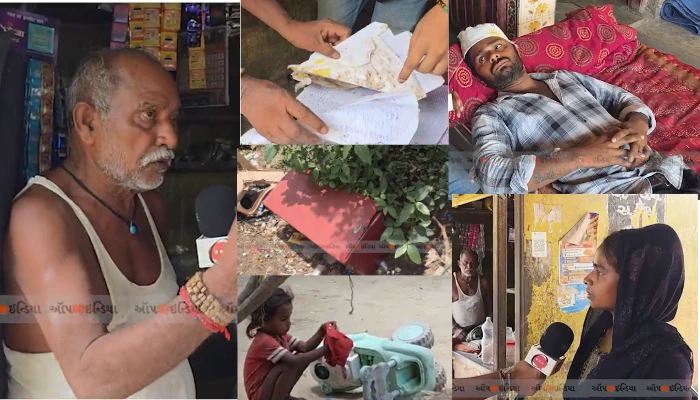
Case Summary
In Garmala village of Matar taluka, Kheda district, the family of Hindu shopkeeper Popatbhai Takhabhai Parmar, who ran a tea and water cabin, was violently attacked by Muslim on 7 June 2026. The Hindu shopkeeper and his wife sustained critical injuries, their son-in-law was beaten with iron rods, the infant granddaughter was thrown from a motorcycle and suffered a head injury, and the daughter was also beaten. The assault was carried out by a group of 10 to 15 Muslim men who routinely gathered near the shop to drink alcohol. Five of them, Reshma Banu Firozsha Diwan, Rajaksha Firozsha Diwan, Arif Ali Sabir Ali Syed, Mustaqsha Firozsha Diwan and Nasirsha Zakirsha Diwan, were later named in the FIR filed at Matar police station. The confrontation began when one of the men gathered near Popatbhai's shop asked for sugar. The family gave it to him. To wrap the sugar packet, the man tore pages out of the shop's account books. When the shopkeeper objected, the group turned upon the family, and the altercation escalated rapidly into a physical assault. Arjunbhai Solanki, Popatbhai's son-in-law, was returning from work when the attackers intercepted and dragged him away. He was beaten with iron rods and thrown into a roadside drain. While he was down, some of the attackers pressed their feet on his neck, attempting to suffocate him. The assault extended to the women of the household. Popatbhai's wife was kicked with such force that she sustained serious injuries to her face. Women were present among the attackers as well. She pleaded with the group not to beat her, but the assault continued until she lost consciousness. During the attack, the family was warned: “If you appear here again, we will not leave you alive.” Popatbhai's daughter, who tried to intervene to protect her family, was also attacked. During the assault, the family's infant granddaughter was thrown off a moving motorcycle by the attackers. She landed on a mattress lying on the ground below and survived, but suffered a serious head injury. In the aftermath, the children were so frightened that their mother took them to hide in a nearby farmhouse. Based on the complaint filed by Arjunbhai Solanki, Matar police registered an FIR against the five named accused under sections 189(2), 191, 190, 109(1), 115(2), 352 and 351(3) of the Bharatiya Nyaya Sanhita. Four of the five accused were arrested, and the search for the fifth was ongoing at the time of reporting. Following the incident, Ronak Singh Parmar, co-convenor of the Bajrang Dal in Nadiad district, described the attack as pre-planned and said the organisation would continue to stand by the family. The victims' families demanded the strictest possible police action. Villagers additionally called for the accused to be publicly paraded through the village and for their houses to be demolished, saying that without firm action, Hindu families might be forced to permanently leave the village. A separate incident from January, recounted by Garmala resident Bhargava Kumar Dabhi, was also raised in this context. Dabhi stated that during Uttarayan, Muslim neighbours flying kites on a nearby rooftop used abusive language toward the women of his family. When he asked them to stop, he was beaten and had to be hospitalised at the Civil Hospital, Nadiad.
Why it is Hate Crime ?
The primary category for this case is "Attack not resulting in death". The sub-category selected for this case is "Attacked to induce migration from non- Hindu dominated area". There have been cases where the Hindus living in an area, often with a majority dwelling belonging to non-Hindus or those harbouring animosity towards the Hindu faith, the Hindu residents experience threats and violence. The violence is employed to make the Hindus leave the area and relocate, so the area could be turned into an exclusive ghetto for adherents of the non-Hindu faith or those who harbour animosity towards the Hindu faith. In several cases, the aim of the exodus is explicit. However, in several cases, the demand for the exodus of Hindu residents is not explicit; however, violence by non-Hindu residents leaves the Hindu residents no option but to leave the area, thereby turning the area into an exclusive ghetto of non-Hindu residents. In such cases, there are instances of violence against the Hindu residents explicitly. For example, in the Hauz Qazi case of 2019, the Muslim residents claimed that mob violence against the Hindu residents had been triggered by a parking dispute. However, the violence did turn religious, with a temple being desecrated and directed specifically against the Hindu residents. The Hindu residents of the area were clear that the violence was religiously motivated, and one of the motives was to affect an exodus of the Hindu residents. In such cases, even though the perpetrators have not explicitly expressed the aim of affecting exodus, the given circumstances and violence and precedent point to the intention of exodus and therefore would be categorised under this sub-category. Such crimes are religiously motivated and therefore are hate crimes. The other sub-category selected is "Attacked for opposing radicals or trying to save a victim" In several cases, Hindus are attacked for opposing religiously motivated crimes being committed against a fellow Hindu or simply for voicing an opinion opposing radical elements, who either have in the past or continue to persecute Hindus. In such cases, the initial attack against the victim, against which the Hindu was trying to defend the victim, would also need to be classified as a religiously motivated hate crime. Since the initial crime itself was religiously motivated and the subsequent crime of attempting to save the victim or speaking against the radical elements ends up inviting a violent attack, it would also be classified as a religiously motivated hate crime under this category. The other sub-category selected is "Attacked for Hindu identity". In several cases, Hindus are attacked merely for their Hindu identity without any perceived provocation. A classic example of this category of religiously motivated hate crime is a murder in 2016. 7 ISIS terrorists were convicted for shooting a school principal in Kanpur because they got ‘triggered’ seeing the Kalava on his wrist and the tilak that he had put. In this, the Hindu victim had offered no provocation except for his Hindu religious identity. The motivation for the murder was purely religious, driven by religious supremacy. Such cases where Hindus are targeted merely for their religious identity would be documented as a hate crime under this category. This case qualifies as a religiously motivated hate crime because the available facts suggest that the violence was directed not merely at an individual victim but at creating fear and insecurity within a Hindu family and, by extension, the wider Hindu community living in the area. In this incident, a Hindu businessman and his family, including women, an elderly family member, and small children, were brutally attacked by a group of Muslim men over a trivial issue. The sheer scale of the violence inflicted over such a minor disagreement points to something far more serious than an ordinary personal dispute. What could have remained a minor altercation escalated into a coordinated assault targeting multiple members of an entire Hindu family. This disproportionate response is itself one of the most telling aspects of the incident. The aspect that gives the incident its clearest communal dimension is the victim family's assertion that the attack was premeditated and that the attackers wanted Hindu families to leave the area so that they could establish control over it. According to the family, the objective was not merely to assault them but to create such fear and insecurity that Hindus would eventually be forced to abandon their homes, businesses, and livelihoods. When violence, threats, and intimidation are used to make the continued presence of a particular religious community difficult, the incident can no longer be viewed as an ordinary personal conflict. The victim family's account also points towards a mindset of dominance and supremacy. The violence appears to have been intended not merely to punish the immediate victims but to send a broader message to other Hindus in the locality. By responding to a minor objection with overwhelming force, the attackers sought to demonstrate that resistance would not be tolerated and that those who challenged them could face severe consequences. Such conduct reflects an attempt to establish control through fear, where members of a minority community are expected to remain silent, accept intimidation, and refrain from asserting their rights. The nature of the attack further strengthens this conclusion. The violence was not confined to the person involved in the initial disagreement. Multiple members of the family were allegedly targeted, including women, an elderly woman, and even a small child. The attackers are also said to have dragged the victim away, assaulted him with iron rods, attempted to suffocate him, and issued death threats. Such indiscriminate violence directed at an entire family suggests an intention to terrorise rather than merely retaliate. The objective appears to have been to break the family's sense of security and make them fearful of continuing to live and work in the area. The threats issued during and after the attack are equally significant. The family stated that they were warned of further consequences if they continued to remain in the locality. Such threats serve a purpose beyond the immediate incident. They create an atmosphere of fear not only for the direct victims but also for other Hindu families, signalling that continued residence, economic activity, or resistance could invite violence. In effect, the assault functioned as a warning to the wider Hindu community about the consequences of standing up for themselves or challenging those responsible. The attack is also notable because it allegedly arose from something as trivial as objecting to the tearing of pages from a shop's record book. The fact that such a minor issue resulted in a coordinated and brutal assault lends weight to the victims' belief that the violence was motivated by factors far deeper than the immediate dispute. The incident appears less like a spontaneous altercation and more like an opportunity to intimidate a Hindu family and reinforce a climate of fear. Viewed in its entirety, the coordinated nature of the attack, the disproportionate violence, the targeting of multiple members of a Hindu family, the threats issued afterwards, and the victim family's assertion that the objective was to force Hindus to leave the area collectively point towards a pattern of communal intimidation. The attack therefore bears the hallmarks of religiously motivated targeting and has been included in the hate crime database of the tracker.
Victim Details
Total Victim
5
Deceased
0
Gender
- Male 2
- Female 3
- Third Gender 0
- Unknown 0
Caste
- SC/ST 0
- OBC 0
- General 0
- Unknown 5
Age Group
- Minor 1
- Adult 4
- Senior Citizen 0
- Unknown 0


Case Status
Case sub-judice


Perpetrators Details
Perpetrators
Muslim Extremists
Perpetrators Range
From 10 to 100
Perpetrators Gender
male
 Sources




