Hindu businessman targeted in violent roadside attack, injured after ambush amidst ongoing persecution of Hindu minorities in Bangladesh
 Chittagong District, Bangladesh
  7 June, 2026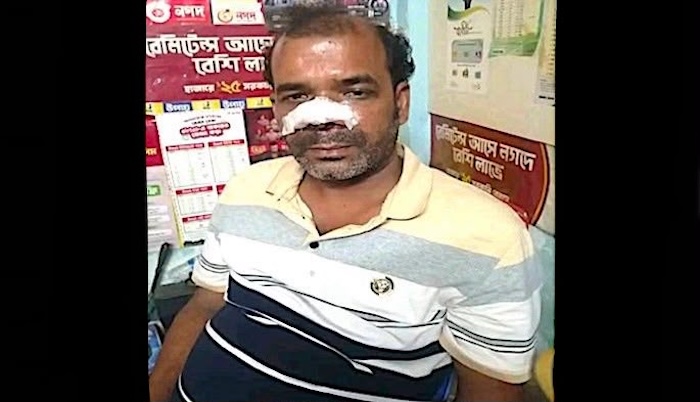
Case Summary
In Chattogram district's Boalkhali upazila of Bangladesh, Hindu businessman Goutam Choudhury was targeted in a violent attack while returning home late at night from his business. The incident involved assailants obstructing his path, attacking him with chilli powder and a heavy object, and forcibly taking cash and mobile phones from his possession. The attack left the Hindu victim injured and generated concern within the local area. According to information provided by the victim, Goutam Choudhury (46) operated a clothing business named Loknath Cloth Store at Shakpura Chowmuhani Bazar in Boalkhali upazila. In addition to his clothing business, he also worked as a mobile banking agent and regularly carried cash and mobile devices in connection with his business activities. The attack took place during the night of 8th June 2026. After closing his shop, Goutam Choudhury travelled towards his residence in the Durgabari area of Ward No. 4 under Saroatali Union. At approximately 12:30 a.m., after getting down from his vehicle and proceeding along the familiar route towards his home, he was confronted by two young men. As he approached the area, the assailants suddenly obstructed his movement by shining a bright torchlight directly into his eyes. The sudden obstruction prevented him from seeing clearly and left him vulnerable to attack. Immediately afterwards, the attackers threw chilli powder into his face and began assaulting him with a heavy object. During the attack, the perpetrators forcibly took cash and valuables belonging to the Hindu businessman. They seized approximately 30,000 Bangladeshi Taka in cash and three mobile phones valued at around 18,000 Bangladeshi Taka before fleeing the scene. The assault was carried out on a route that the victim had used regularly for a long period of time. Following the incident, Goutam Choudhury informed authorities and submitted a written complaint to Boalkhali Police Station on 9th June 2026. He stated that the route he had travelled safely for many years had suddenly become a place of fear following the attack. The victim further indicated that the attackers appeared to be between 28 and 30 years of age. It was believed that they had been waiting in concealment beside the road before launching the assault. The manner in which the attackers obstructed the victim's movement and immediately carried out the attack suggested prior preparation before targeting him on his route home. After receiving the complaint, law enforcement authorities initiated an investigation into the incident. Boalkhali Police Station Officer-in-Charge Mahfuzur Rahman stated that the matter was being examined seriously and that efforts were underway to identify those involved in the attack. The incident occurred amid an increasingly hostile environment faced by Hindus in Bangladesh, where members of the Hindu minority have repeatedly been subjected to attacks, intimidation, assaults, looting, and other forms of targeted violence. As a Hindu businessman, Goutam Choudhury belonged to a community that has experienced heightened vulnerability during a period marked by repeated incidents directed against Hindu individuals, families, religious institutions, and businesses across the country. This escalation of violence against Hindus in Bangladesh has unfolded in three distinct phases: first, following the ouster of Sheikh Hasina's government in August 2024; second, after the death of Sharif Osman Bin Hadi in December 2025; and third, in the immediate aftermath of the 13th National Parliamentary Election 2026. Following the ouster of Sheikh Hasina, multiple reports documented attacks on Hindu homes, temples, and religious institutions, alongside intimidation campaigns, arson, and mob assaults targeting minority neighbourhoods. The Hinduphobia Tracker recorded 336 such incidents against the Hindu minority, underscoring the scale and persistence of anti-Hindu violence during this period. A further escalation occurred following the death of Sharif Osman Bin Hadi, a Muslim political activist and student leader known for his anti-Hindu and anti-India rhetoric. Hadi had been involved in political unrest after the fall of the Hasina government and was killed in Dhaka on 18th December 2025 during clashes. In the aftermath of his death, Hindu communities were blamed and subsequently targeted in retaliatory violence. Hindu homes were selectively set ablaze in multiple localities, forcing families to flee and leaving many displaced. The attacks appeared patterned rather than sporadic, with Muslim mobs focusing on Hindu neighbourhoods, properties, and religious symbols. Among the victims was Dipu Chandra Das, who was lynched to death and his body was set ablaze by a Muslim mob over false blasphemy allegations. The Hinduphobia Tracker documented 51 incidents of anti-Hindu violence in the period following Hadi's death alone. Reports further indicated that posters and written materials calling for the extermination of Hindus were displayed in public spaces, signalling an alarming normalisation of genocidal rhetoric. When combined with acts of arson, vandalism, assault, and targeted intimidation, these developments contributed to an environment of hostility and insecurity for the Hindu minority. The third phase of violence emerged after the 13th National Parliamentary Election 2026. Within days of the announcement of results, Hindu families in districts including Noakhali, Rangpur, Nilphamari, Sylhet, Thakurgaon, and Dinajpur reported attacks involving arson, looting, assault, and vandalism of temples and homes. In several instances, Hindu homes were selectively targeted, looted, and families were threatened with displacement.
Why it is Hate Crime ?
This case was added to the tracker under the primary category, Attack not resulting in death. The subcategory selected was, Attacked for Hindu identity. In several cases, Hindus are attacked merely for their Hindu identity without any perceived provocation. A classic example of this category of religiously motivated hate crime is a murder in 2016. 7 ISIS terrorists were convicted for shooting a school principal in Kanpur because they got ‘triggered’ seeing the Kalava on his wrist and tilak that he had put. In this, the Hindu victim had offered no provocation except for his Hindu religious identity. The motivation for the murder was purely religious, driven by religious supremacy. Such cases where Hindus are targeted merely for their religious identity would be documented as a hate crime under this category. In this case, Hindu businessman Goutam Chowdhury was subjected to a targeted assault in which he was intercepted, physically attacked, and robbed while returning home at night. While the available details do not explicitly indicate a religious motive, the broader context cannot be ignored. When there is an ongoing ethnic cleansing based on religious identity, every crime in and of itself is assumed to be motivated by the same religious animosity, even if there is a lack of a specific religious marker in the immediate crime. During an ongoing ethnic cleansing, the dehumanisation of people based on their religious identity and the normalisation of religious hostility drive the crimes committed against them, even when there is a lack of stated religious motive. For the purpose of documenting the 2024 ethnic cleansing of Hindus in Bangladesh, the Hinduphobia Tracker is assuming religious motivation ab initio. If a case is proven beyond a reasonable doubt to be driven by motivations other than religious hostility, it will be removed from the hate crime database post facto.
Victim Details
Total Victim
1
Deceased
0
Gender
- Male 1
- Female 0
- Third Gender 0
- Unknown 0
Caste
- SC/ST 0
- OBC 0
- General 0
- Unknown 1
Age Group
- Minor 0
- Adult 1
- Senior Citizen 0
- Unknown 0


Case Status
Complaint filed


Perpetrators Details
Perpetrators
Unknown
Perpetrators Range
From 2 To 5
Perpetrators Gender
male
 Sources




