Hindu religious beliefs denigrated through objectionable comments about Lord Shiva on social media by Muslim man
 Saharanpur, Uttar Pradesh, India
  2 June, 2026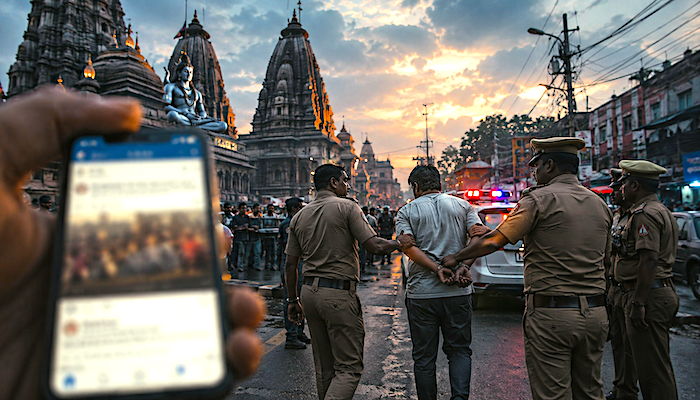
Case Summary
Lord Shiva, one of the most revered deities in Hinduism, was targeted with derogatory comments on social media by a Muslim man in Saharanpur, Uttar Pradesh. The offensive remarks were posted publicly on Instagram and drew strong objections from local Hindu residents, who expressed strong displeasure over the insult of the sacred Hindu deity. On Wednesday, 3rd June 2026, local authorities received information that a young Muslim man was posting objectionable comments on a picture of Lord Shiva through his Instagram account. The content was shared from near the TVS showroom on Link Road in Saharanpur. Upon receiving this information, the police initiated an inquiry into the social media activity. Investigators examined the Instagram account and verified the presence of objectionable content directed at Lord Shiva. The inquiry established that the remarks had been publicly posted and that the account was being operated by Ajmat Abad, son of Mohammad Ali, a resident of the Kotwali Nagar area of Saharanpur. The derogatory remarks remained accessible on a public social media platform, enabling their dissemination beyond a private audience. After confirming the objectionable activity, the police registered a criminal case against Ajmat Abad. A police team subsequently located him within the jurisdiction of Janakpuri Police Station and took him into custody late in the evening. He was arrested under Section 299 of the Indian Penal Code and Section 67 of the Information Technology Act for posting objectionable content on social media. Police stated that posting offensive material against any religion, deity, or community on social media constituted a punishable offence under the law. Authorities further stated that such online activity was being monitored and that action would be taken against individuals found sharing content that could disturb public order or hurt religious sentiments. Following the arrest, Ajmat Abad was produced before the court. Police also appealed to the public to use social media responsibly and refrain from circulating inflammatory or controversial content. The matter remained under legal process at the time of reporting.
Why it is Hate Crime ?
This case has been added to the tracker under the primary category - Hate Speech against Hindus. Within this, the subcategory selected is - Anti-Hindu slurs, mocking faith. Anti-Hindu slurs and the deliberate mocking of the Hindu faith owing to religious animosity involve the usage of derogatory terms, stereotypes, or offensive references to religious practices, symbols, or figures. One of the common anti-Hindu slurs used against Hindus is “cow-worshipper” and “cow piss drinker”. The intention of using this term is to demean and mock Hindus as a group and their religious beliefs since Hindus consider the cow holy. Additionally, some symbols and the slurs attached to them have a historical context that exacerbates the insult, hate, stereotyping, dehumanisation and oppression against Hindus. Cow worship has been used for centuries to denigrate Hindus, insult their faith and oppress Hindus specifically as a religious group. There has been overwhelming documentation about how cow slaughter has been used to persecute Hindus with cow meat being thrown in temples and places of worship. There has also been overwhelming documentation where cow meat (beef) has been force-fed to Hindus to either forcefully convert them to Islam or denigrate their faith. Apart from cow worship, the Swastika – which holds deep religious significance for the Hindus – has also been misinterpreted and distorted to use as a slur against Hindus. Similarly, the worship of the Shivling has been used by supremacist ideologies and religions to denigrate Hindus owing to religious animosity. Such slurs and denigration stem out of inherent animosity and hate towards Hindus and their faith, therefore, it is categorised as hate speech targeted at Hindus specifically owing to their religious identity. This case has been added to the hate crime database because the perpetrator deliberately used social media to post derogatory remarks about Lord Shiva, a deity who occupies one of the most sacred and revered positions within Hinduism. The conduct was not directed at a private individual or a secular institution. Instead, it targeted a central figure of Hindu worship and devotion. By choosing a revered Hindu deity as the subject of ridicule and offensive commentary, the perpetrator directed hostility towards a core symbol of the Hindu faith, making the religious nature of the act unmistakable. The use of derogatory remarks directed at Hindu beliefs demonstrated clear contempt towards the religious convictions of Hindus. Religious faith is deeply intertwined with the identity, values, traditions, and cultural life of Hindu devotees. Insulting or ridiculing those beliefs is not merely an expression of disagreement with a religion. It is an attack on the dignity of the individuals who adhere to that faith. Such conduct seeks to belittle, humiliate, and degrade members of a religious community because of what they believe. The perpetrator's decision to publicly post such content on a social media platform further amplified its impact, ensuring that the ridicule was visible to a wider audience and exposing Hindu devotees to hostility directed at their faith. This transformed the act from a private expression into a public display of contempt towards Hinduism and those who follow it. The targeting of Lord Shiva carried even greater religious significance. Lord Shiva is one of the principal deities of Hinduism and is worshipped by millions of Hindus across India and the world. He is not merely a historical figure, public personality, or ideological symbol open to ordinary criticism. He is a divine figure, extremely sacred and central to the spiritual lives of Hindus. For practising Hindus, insults directed towards Lord Shiva are not perceived as attacks on an abstract concept but as attacks on a deeply held object of worship. The deliberate choice to target such a revered deity demonstrated a conscious decision to attack something that holds immense religious importance for Hindus. This is what distinguishes the act from random offensive speech. The perpetrator did not select a neutral topic or make a general provocative statement. He specifically chose a deity whose sacred status is universally recognised within Hinduism. It was a deliberate choice to offend Hindus because the religious significance of Lord Shiva is widely known and understood. By directing derogatory remarks towards a deity who commands immense devotion, the perpetrator exploited that religious significance as a means of insulting and provoking Hindu devotees. The offence arose precisely because the target was sacred to Hindus. This demonstrated that the harm inflicted was inseparable from the religious identity of the community being targeted. The fact that the remarks were published on social media is also significant. Online platforms enable offensive content to be disseminated rapidly, viewed by large numbers of people, and repeatedly shared. When derogatory content is directed at a revered Hindu deity, it contributes to an atmosphere in which disrespect and contempt towards Hindu beliefs become normalised. Such actions encourage hostility towards the faith by presenting sacred religious figures as legitimate objects of ridicule and abuse. The public nature of the posts, therefore, magnified both the reach and the impact of the anti-Hindu content. The deliberate denigration of a central Hindu deity reflected hostility not merely towards a single religious figure but towards the broader Hindu faith itself. Hindu deities are inseparable from Hindu religious identity, worship, and tradition. Consequently, attacking those deities is effectively an attack on the faith and on the community that venerates them. The perpetrator's actions demonstrated an intention to mock and demean beliefs that are fundamental to Hindu religious life, thereby targeting Hindus on the basis of their faith. Given that this case involved anti-Hindu slurs, public ridicule of Hindu beliefs, and the deliberate denigration of one of Hinduism's most revered deities, it met the parameters of a religiously motivated hate speech incident. Therefore, it was added to the tracker's hate crime database.


Case Status
Arrested


Perpetrators Details
Perpetrators
Muslim Extremists
Perpetrators Range
One Person
Perpetrators Gender
male
 Sources




