Hindu religious sentiments outraged, pregnant cow brutally beaten to death by unknown assailants in Firozabad
 Firozabad, Uttar Pradesh, India
  1 May, 2026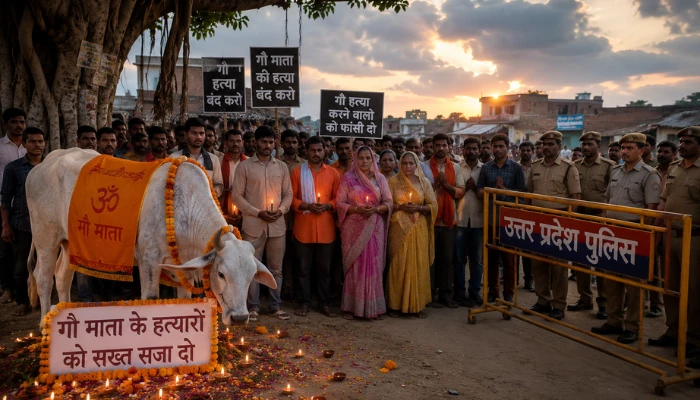
Case Summary
In Dabarai village, under the jurisdiction of the Matsena Police Station in Firozabad district, a pregnant cow was beaten to death by unidentified assailants. The incident triggered widespread anger among Hindu villagers, and a large number of residents gathered at the scene. Villagers stated that the cow had been brutally assaulted, resulting in its death on the spot. When police arrived after being informed and began making arrangements to remove the cow’s body for last rites, local residents objected to the process. Villagers demanded the immediate registration of a case against the perpetrators and their arrest. They informed police that the cow’s body would not be allowed to be cremated without a post-mortem examination, arguing that the post-mortem report would establish the exact cause of death and help identify those responsible. A brief and heated exchange took place between police and villagers over this issue. Upon learning of the incident, members of the Bajrang Dal also reached the site. They condemned the incident, described it as a serious case of cow slaughter, and demanded strict legal action against those involved. They warned that if firm action was not taken against the guilty parties, they would launch an agitation. Police assured the villagers that a post-mortem examination of the cow’s body would be conducted and that appropriate legal provisions would be applied based on the investigation. The situation eased after these assurances. Station House Officer Vimlesh Tripathi stated that action was being taken on the basis of the written complaint.
Why it is Hate Crime ?
The primary category selected in this case is: Attack on Hindu religious representations. The subcategory selected is: Desecration of Hindu symbol. Icons and symbols or a religious representation of a spiritual ideal are widely revered in Hinduism. Iconography is of vital significance in the Hindu milieu. It helps connect people’s spiritual beliefs with the real world. Iconography within the Hindu faith takes several shapes and forms. Murtis are of most significance to Hindus, to which daily rituals, prayers and offerings are done. Besides the murtis, there are several other symbols which have deep significance in the Hindu faith – the Om and Swastika for example. Since these Hindu religious symbols hold paramount importance in Hinduism, any desecration of symbols, icons, murtis, religious representations and manifestations, is driven by animosity towards the faith itself which manifests itself through these murtis, icons and symbols. Therefore, any desecration of these Hindu religious symbols and representations is considered religiously motivated hate crimes under this category. This case was a clear example of a crime rooted in hostility towards Hindu religious sentiment, as unidentified assailants desecrated a sacred Hindu symbol, a cow referred to as Gau Mata in Hinduism. To understand why cow slaughter evokes such profound anguish within Hindu society, one must first understand what the cow represents within Hindu civilisation. The cow is not merely an animal. It is revered as a sacred religious symbol of motherhood, nurturing, sacrifice, compassion, and life-giving abundance. Hindu civilisation has for millennia accorded a uniquely elevated position to the feminine through the worship of goddesses such as Durga, Lakshmi, Saraswati, Kali, and countless local manifestations of the Divine Mother. The cow occupies a sacred place within this civilisational framework because it is seen as an embodiment of maternal care and feminine divinity. The sacred status of the cow is rooted in centuries of Hindu belief and practice. Vedic literature refers to the cow as “Aghanya”, meaning one that should not be harmed or killed. Cow-derived products play an important role in Hindu rituals, ceremonies, and religious observances. For Hindus, therefore, the cow is not simply livestock. It is a sacred symbol intimately connected to religion, culture, and civilisational identity. This sacred status is precisely why acts of cow slaughter or killing repeatedly evoke strong reactions within Hindu society. In such cases, the focus on the cow becomes significant because it carries a religious meaning that other animals do not. The act of killing cows acquires its impact from the fact that it affects something regarded as sacred within Hindu consciousness. The logic behind such killing is often interpreted within a broader pattern of symbolic targeting. If the objective were merely to kill an animal, countless other animals could serve the same purpose. If the objective were merely to consume meat, alternative sources would be available. The repeated focus on cows becomes significant because the cow carries a religious meaning that is uniquely rooted in Hindu belief. The act acquires its significance because it hurts religious sentiments associated with a sacred Hindu symbol. At the heart of such incidents lies hostility towards a faith and its deeply held beliefs, as the cow is not targeted as an ordinary animal but as a symbol of religious importance. In this particular case, the cow was not killed for any discernible material purpose such as smuggling, trade, or consumption. Instead, a pregnant cow was brutally beaten to death by unidentified assailants in a manner that appeared entirely purposeless from an economic or practical standpoint. This complete absence of any utilitarian motive indicates that the act cannot be understood as ordinary livestock-related violence, but as a deliberate act of cruelty directed at a sacred being revered within Hindu tradition. Acts of violence against cows are thus not viewed in isolation as harm inflicted upon an animal, but as a violation of a deeply revered religious symbol. When such an act takes place without any apparent material motive, it reflects disregard for that sacred status and, by extension, for the beliefs and sentiments of those who revere it. In this context, the incident is understood as a desecration of a symbol central to Hindu religious identity, and therefore becomes a matter of profound communal sensitivity. It is on this basis that such acts are characterised as a hate crime rooted in hostility towards Hindu religious sentiment and the sacred symbols associated with it. Historically, cow slaughter has been used as a tool to humiliate Hindu society and challenge or reshape its moral and religious sensibilities. When hostility is directed towards Hindus as a collective by anti-Hindu elements, the targeting does not always manifest against Hindu individuals alone but is expressed through attacks on sacred symbols that carry deep religious significance. Within this framework, sacred symbols become vulnerable points of cultural and religious identity, and the cow, being one of the most widely revered and visible symbols in Hindu tradition, is placed at the centre of such symbolic targeting. When this symbolism is violated in a manner that disregards its sacred status, it is understood as an act directed not merely at an animal but at the religious identity of the community itself, and on this basis it is characterised as a hate crime rooted in underlying hostility towards Hindu religious sentiment and its sacred symbol Given that this case meets the parameters of a religiously driven hate crime, it is being added to the hate crime database of the Hinduphobia Tracker. Disclaimer: The Hinduphobia Tracker records incident dates based on when the crime occurs rather than when it is reported by the media. However, in this case, media reports have not specified the exact date on which the incident took place. Therefore, the date on which the media first reported this incident, 2 May 2026, has been selected as the indicative incident date. This is recorded for documentation purposes only.


Case Status
Complaint filed


Perpetrators Details
Perpetrators
Unknown
Perpetrators Range
Unknown
Perpetrators Gender
unknown
 Sources




