Tribal Hindu woman dies after converting and marrying Muslim man in Bangladesh; victim's family says she was subjected to severe torture
 Mymensingh, Mymensingh District, Bangladesh
  9 June, 2026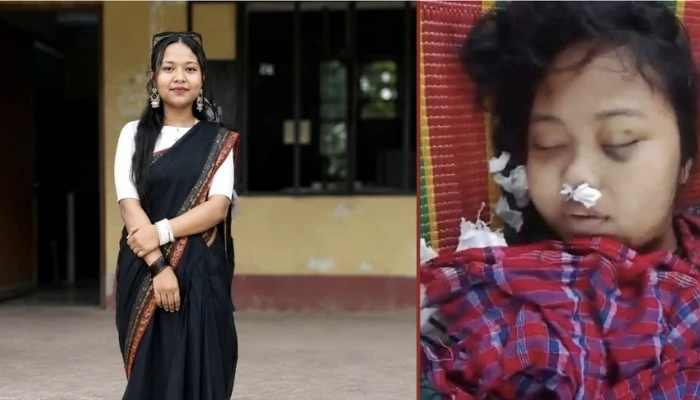
Case Summary
In Mymensingh, Bangladesh, a young Hindu woman from the Garo indigenous community, Bani Darou, died after eloping, converting to Islam, and marrying a Muslim man. According to the victim's family, she had eloped against her family's wishes around six months earlier (December 2025) and married a Muslim man. She converted to Islam for the marriage and had been living at her husband's residence since then. Six months later, her body was returned to her family. The family stated that she had been subjected to physical and mental torture at her husband's home throughout the marriage. News of her death spread on social media and triggered widespread discussion in the area. According to available information, young women from various Hindu indigenous communities had converted to Islam to enter relationships with Bengali Muslim men. These relationships were often formed against the wishes of their families and communities. It was found that, in many such cases, these marriages resulted in separation from family and the loss of contact with relatives. Some women had faced physical violence, mental abuse, family conflict, separation or divorce, and social insecurity after such marriages. Following separation, many were unable to return to their families and were left in conditions of uncertainty and hardship. The murder of Bani Darou occurred in Bangladesh during a period marked by a sustained wave of anti-Hindu hostility. The escalation of violence unfolded in three distinct phases: first, following the ouster of Sheikh Hasina’s government in August 2024; second, after the death of Sharif Osman Bin Hadi in December 2025; and third, in the immediate aftermath of the 13th National Parliamentary Election in 2026. Following the ouster of Sheikh Hasina, multiple reports documented attacks on Hindu homes, temples, and religious institutions, alongside intimidation campaigns, arson, and mob assaults targeting minority neighbourhoods. The Hinduphobia Tracker recorded 336 such incidents against the Hindu minority during this period. A further escalation occurred after the death of Sharif Osman Bin Hadi, a Muslim political activist and student leader known for anti-Hindu and anti-India rhetoric. Hindu communities were blamed and targeted in retaliatory violence. Hindu homes were selectively set ablaze in multiple localities, forcing families to flee and leaving many displaced. Among the victims was Dipu Chandra Das, who was lynched and his body set ablaze by a Muslim mob over false blasphemy allegations. The Tracker documented 51 incidents of anti-Hindu violence in the period following Hadi’s death alone. Reports indicated that posters and written materials calling for the extermination of Hindus were displayed in public spaces, signalling an alarming normalisation of genocidal rhetoric. The third phase of violence was unleashed after the 13th National Parliamentary Election in 2026. Within days of the announcement of results, Hindu families in districts such as Noakhali, Rangpur, Nilphamari, Sylhet, Thakurgaon, and Dinajpur reported coordinated attacks involving arson, looting, assault, and vandalism of temples and homes. Hindu homes were selectively targeted, looted, and families were threatened with displacement. A social media campaign calling for the desecration of the idol of Lord Ram at the Sanatan Complex in Rangpur emerged within this broader environment of hostility, where Hindu religious symbols, places of worship, and the Hindu community increasingly became targets of intimidation, hatred, and religiously motivated aggression.
Why it is Hate Crime ?
This case is being added to the Undecided database of the Hinduphobia Tracker due to the absence of any immediate or clearly established religious motive behind the crime. In this instance, a young Hindu woman from the Garo indigenous community voluntarily eloped with a Muslim man, converted to Islam, and married him against the wishes of her family. Six months later, her body was returned to her family, who stated that she had been subjected to physical and mental torture at her husband's home throughout the marriage. While the religious identities of the victim and her husband, together with the broader context of anti-Hindu persecution in Bangladesh in which the incident occurred, naturally raise questions about the possibility of a religiously motivated crime, the presently available information does not establish such a motive. The suspicion arises because there have been several documented instances in which Hindu women have been lured into relationships by Muslim men, where they are forcibly converted to Islam, and subsequently face violence, coercion, or even death under circumstances that have given rise to concerns about hostility towards their original Hindu identity. Consequently, the fact that the victim in this case was a Hindu woman who converted to Islam after marrying a Muslim man inevitably invites similar scrutiny. These concerns are further heightened by the fact that the incident occurred in Bangladesh, where the Hindu minority has faced sustained persecution, targeted violence, attacks on temples, destruction of property, sexual violence against women, forced displacement, and intimidation, particularly following the political upheaval and the departure of former Prime Minister Sheikh Hasina. Numerous incidents documented by the Hinduphobia Tracker have demonstrated that Hindus in Bangladesh continue to face discrimination and violence because of their religious identity, making any crime involving a Hindu victim deserving of careful examination for a possible hate motive. However, the presently available facts do not establish that this incident was driven by religious hostility. There is no indication that the victim was killed because she was Hindu or that her conversion or marriage was the product of coercion. Importantly, there is no statement from the victim's family asserting that she was murdered for her faith. Their account states that she was subjected to physical and mental torture during her marriage, but such abuse, while serious and condemnable, may also fall within the scope of domestic violence and does not by itself demonstrate a religious motive. At this stage, there is no evidence connecting the victim's death to animosity towards her Hindu faith or establishing that the immediate crime was committed because of her religious identity. For these reasons, the case is being placed in the Undecided database of the Hinduphobia Tracker rather than the hate crime database. The surrounding circumstances warrant continued attention and scrutiny, particularly given the victim's identity and the broader environment of persecution faced by Hindus in Bangladesh. However, in the absence of evidence demonstrating a definite religious motive behind the immediate crime, it would be premature to classify the incident as a religiously motivated hate crime. Should further information emerge establishing that the victim was targeted because of her Hindu identity or that religious hostility played a role in her death or the abuse she suffered, the classification of this case will be reviewed and updated accordingly. Disclaimer: At Hinduphobia Tracker, we document incidents involving crimes against Hindus and cases where the victim's Hindu identity is explicitly stated or can be reasonably established from the available facts. In this case, the victim was identified as belonging to the Garo indigenous community. While the report did not expressly mention her religion, a significant section of the Garo population in Bangladesh continues to practise either Hinduism or the indigenous Songsarek faith, which shares close philosophical and cultural affinities with the broader Dharmic tradition of India. In the absence of any information indicating otherwise, and considering these cultural and religious syncretic continuities, the victim has been classified as Hindu for documentation purposes. Hinduism has historically not been defined by a single prophet, book, or institutional authority. Rather, it encompasses a broad family of traditions rooted in Sanatana Dharma. Accordingly, individuals and communities who follow Dharmic principles and indigenous traditions aligned with Sanatana Dharma may be regarded as part of the wider Sanatani or Hindu civilisational fold. This classification is therefore based on the information currently available and may be revised should additional facts regarding the victim's religious identity emerge. The Hinduphobia Tracker records incident dates based on when the crime occurs rather than when it is reported by the media. However, in the present case, media reports did not specify the exact date of the victim's death. Therefore, the date on which the incident was first reported by the media, 10 June 2026, has been selected as the indicative incident date. This has been recorded for documentation purposes only.
Victim Details
Total Victim
1
Deceased
1
Gender
- Male 0
- Female 1
- Third Gender 0
- Unknown 0
Caste
- SC/ST 1
- OBC 0
- General 0
- Unknown 0
Age Group
- Minor 0
- Adult 1
- Senior Citizen 0
- Unknown 0


Case Status
Unknown


Perpetrators Details
Perpetrators
Muslim Extremists
Perpetrators Range
Unknown
Perpetrators Gender
unknown
 Sources




